An asylum (lunatic asylum, insane asylum, mental asylum) was a place where people with all manner of mental illness were confined and, in some cases, treated. Asylums were eventually replaced by mental hospitals and psychiatric hospitals, and later supplemented by the advent of Community Care in the 1980s.
The treatment of inmates in early lunatic asylums was often brutal, and focused on containment and restraint. Despite the fact that psychiatric hospitals, which emphasised treatment rather than just containment, were a vast improvement on the old asylums, there were several exposures of abuse and poor quality care of patients with severe learning difficulties and mental illnesses at NHS psychiatric hospitals in the 1960s & 1970s, and cases of abuse are still being reported to this day.
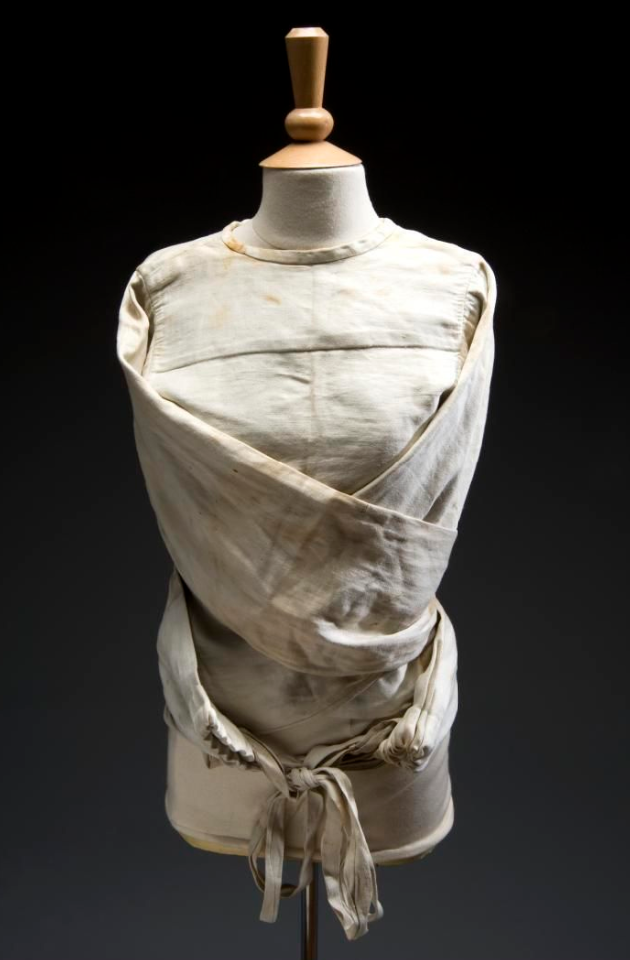
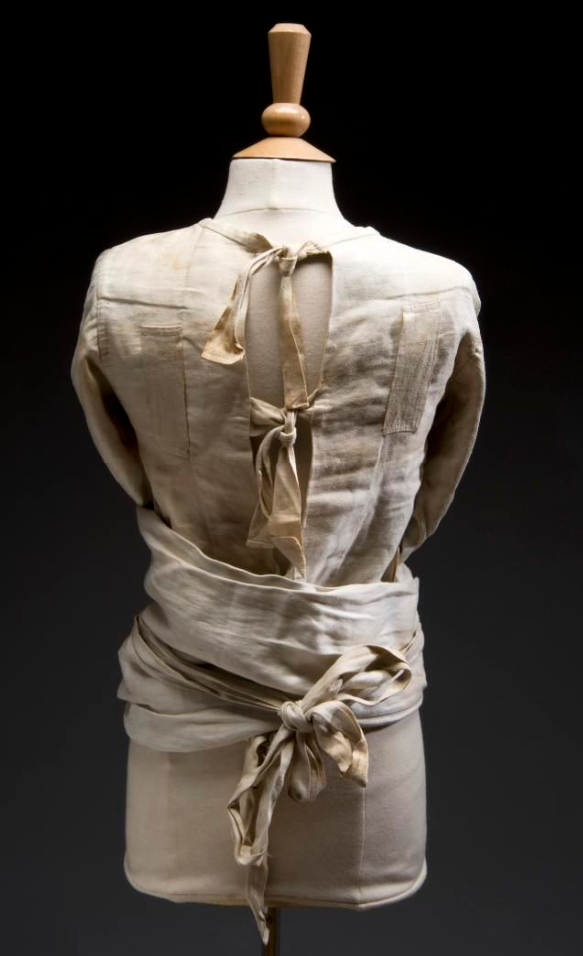
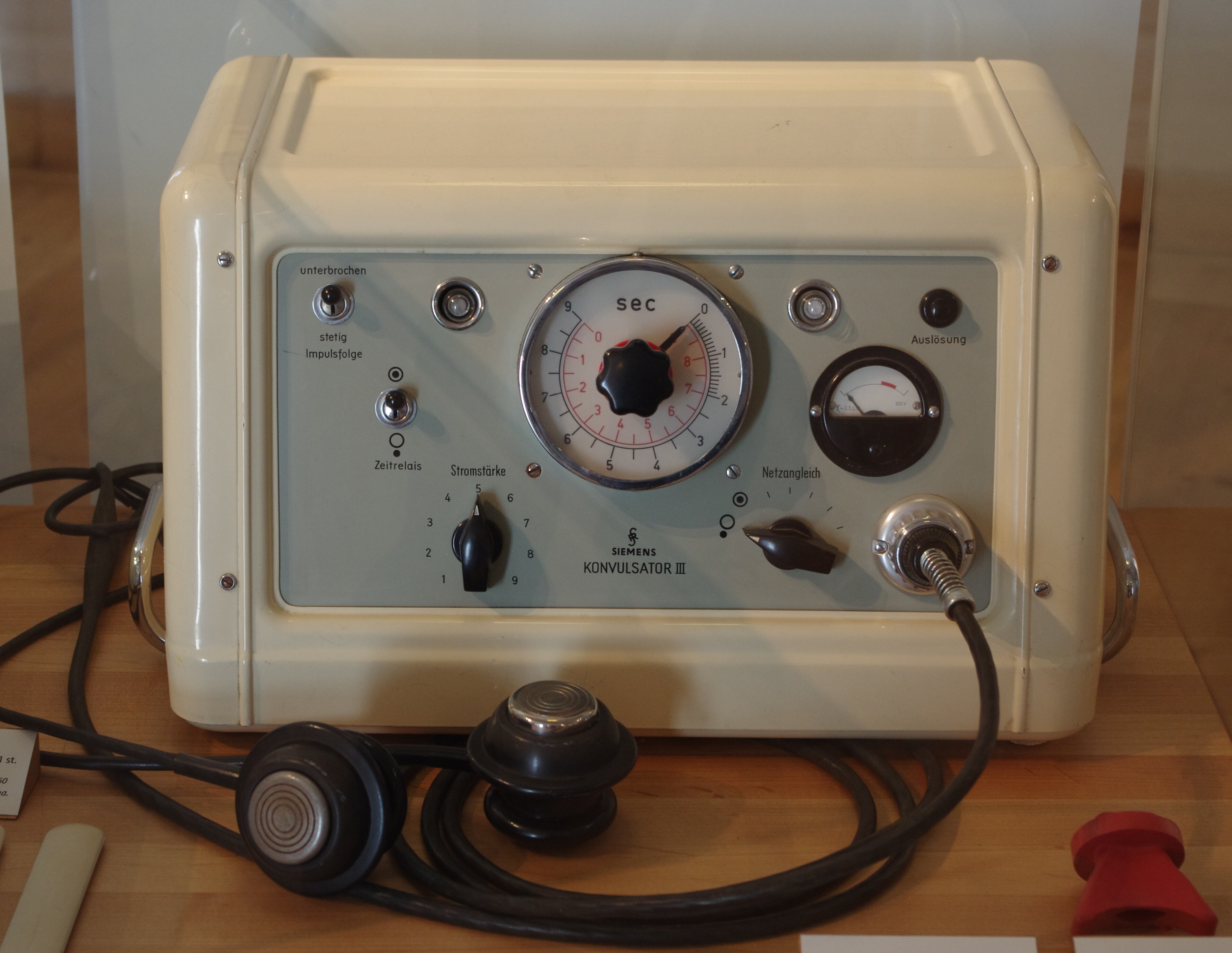
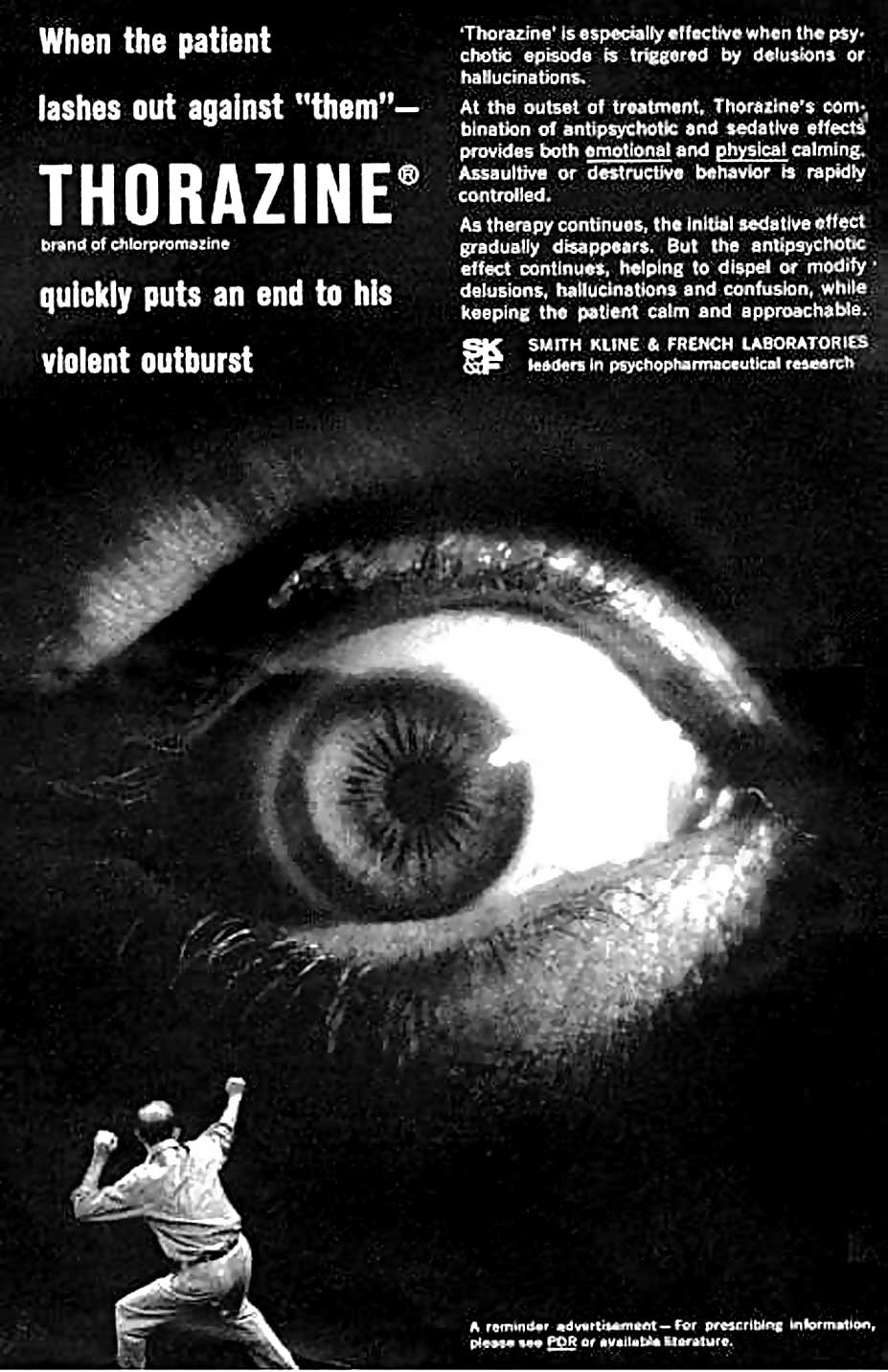
Canvas straitjacket 1930-1960 (Science Museum Collection): Siemens Konvulsator ECT machine c1960: Thorazine advert 1962.
‘There is in every madman a misunderstood genius whose idea, shining in his head, frightened people,
and for whom delirium was the only solution to the strangulation that life had prepared for him’.
‘There is nothing like an insane asylum for gently incubating death’.
Antonin Artaud (1896-1948). Artaud spent the last nine years of his life in various psychiatric hospitals in France.
* * *
Some of the earliest hospitals treating both physical and mental illnesses, were the Bimaristans of the medieval Islamic world, found in Baghdad, Damascus, Cairo and other parts of the Middle East and later in Morocco and Al-Andalus (Spain). Bimaristans were secular: they served all people regardless of their race, religion, citizenship, or gender. In theory nobody was to be turned away, including those with mental illnesses or disorders, and there was no time limit a patient could spend as an inpatient. They were funded by charitable endowments (waqf), and were not just a place to treat patients but also served as medical schools. European travellers were particularly impressed at the care and kindness shown to lunatics.
One of the most important medieval Bimaristans dedicated to those with mental illness was Bimaristan al-Arghuni in Aleppo, Syria, where care for the patients was humane and in stark contrast to the situation in Europe: treatments at Arghun al-Kamili were said to include abundant light, fresh air, the sound of running water, medication, diet, conversation, prayer and music.
Built in 1354 by Arghun al-Kamili, it was still in use in the early 20th century, and is now a museum.
Photo by Bernard Gagnon
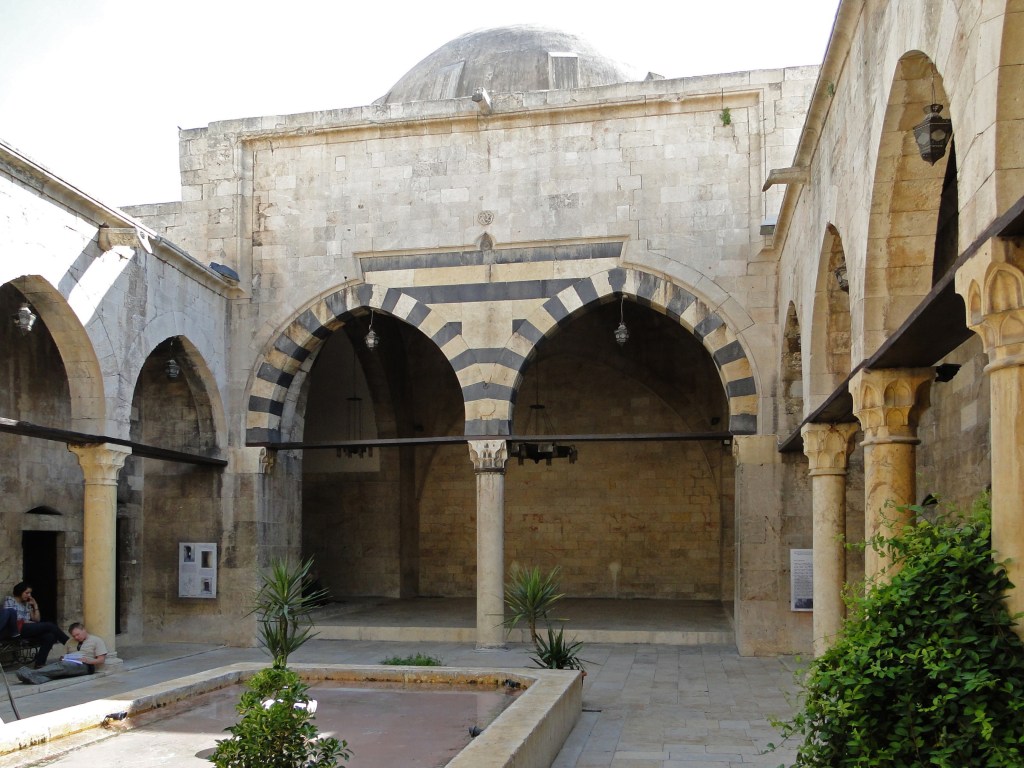
The Battle of Aleppo between 2012 and 2016 was one of the most destructive conflicts in the Syrian Civil War: it left over 31,000 people dead and resulted in the almost complete destruction of the Old City of Aleppo, a UNESCO World Heritage Site. An estimated 33,500 buildings were either damaged or destroyed, but somehow Bimaristan al-Arghuni survived with comparatively minor damage.
* * *
To find out more about people from Wainsgate who lived (and died) in asylums or psychiatric hospitals, and to learn more about these institutions:
Click on the LINKS…..
Ellis GREENWOOD
Mally KENYON
Elizabeth PICKLES (c1850-1903)
Ernest Thomas PRIESTLEY
Died at Parkside Asylum, Macclesfield, in 1907, aged 37. Buried with his family at Wainsgate.
Samuel Chadwick OLDHAM
Died at Storthes Hall Asylum in 1909, aged 50. Buried with his parents at Wainsgate.
Richard GREENWOOD
Orphaned as a child, he died in Storthes Hall Asylum in 1909, aged 57. Buried at Wainsgate with his wife Susannah and members of her family.
Elizabeth PICKLES (1849-1911)
Fred WADSWORTH
Died at Storthes Hall Asylum in 1915, aged 46. Buried at Wainsgate with his wife Mary Jane and mother-in-law Jane Wadsworth (Fred and his wife were first cousins).
Sam Shaw WILCOCK
Ada Victoria DILLON
George REDMAN
Herbert SUTCLIFFE
Died at The Retreat, York, where he was being treated for depression, in 1940, aged 54. Buried at Wainsgate with his wife Beatrice.
Emily JACKSON
Dan Thomas WILCOCK
Ellen Gwendoline THORNTON
Maud May BROWN
Vera SALTONSTALL
WAKEFIELD ASYLUM
Opened in 1818 as the West Riding Pauper Lunatic Asylum, familiarly known as Wakefield Asylum. Renamed as Stanley Royd Hospital in 1948, closed in 1995.
STORTHES HALL
The fourth West Riding Pauper Lunatic Asylum opened in 1904 at Kirkburton near Huddersfield. Known as Storthes Hall Asylum until 1928, renamed as Storthes Hall Mental Hospital in 1929, West Riding Mental Hospital in 1939 and Storthes Hall Hospital from 1949 until its closure in 1991. Also known as ‘North Spring House’.
SCALEBOR PARK
Scalebor Park Asylum, also known as the West Riding Private Asylum, opened in Burley in Wharfedale in 1902. In the 1920s it became Scalebor Park Mental Hospital, joined the National Health Service as Scalebor Park Hospital in 1948, and closed in 1995.
The RETREAT
The Retreat, York, commonly known as the York Retreat, was founded in 1796, and was originally only open to Quakers. The Retreat only stopped providing inpatient services in 2018, but continues to provide outpatient services to NHS and private patients.
The CENSUS ‘INFIRMITY’ QUESTION
Every England & Wales census from 1871 to 1911 had a question which asked whether a person was a ‘lunatic’, ‘imbecile’, idiot’ or’ feeble-minded’.
* * *
Ellis GREENWOOD (c1831-1877)
Died in the West Yorkshire Asylum, Wakefield in 1877, aged 46. Buried at Wainsgate in plot B6a.
Mally KENYON (c1824-1880)
Died in Wakefield Asylum in 1880, aged 56. Buried at Wainsgate in plot B5a.
Elizabeth PICKLES (c1850-1903)
Almost certainly died at Whittingham Hospital, Preston in 1903, aged 53. Buried at Wainsgate in plot B318a.
Ernest Thomas PRIESTLEY (1869-1907)
Ernest Thomas Priestley was born in Halifax in 1869, the son of James Priestley a machine maker and sewing machine dealer, and his wife Sarah. James was born in Bradford and Sarah was born in Wadsworth, which probably explains why members of the family are buried at Wainsgate. Her maiden name was almost certainly Bancroft, Armitage or Parker, and the couple married in 1867.
Eleven year old Ernest was living in Halifax with his parents and siblings in 1881, but in 1891 he was lodging with the Ackerley family in Altrincham and working as a machine tool fitter (the other lodger was Uriah Hitchen, a metal planer also originally from Halifax). In 1901 he was living in Harlesden North London, unmarried, lodging in Nightingale Road and working as a tool fitter. Nightingale Road is very close to Willesden Junction, and Ernest’s landlord and many of his neighbours worked on the railway: it seems likely that Ernest had moved to this rapidly expanding industrial area on the edge of London because of the opportunities for skilled employment that it offered.

We don’t know what happened in the next few years, but on 2nd April 1907 Ernest was admitted to Parkside Asylum in Macclesfield (the register records his status as ‘pauper’, and he died there on 7th May 1907, aged 37. He had presumably moved back to Cheshire, where he had previously lived, but why was he admitted to Parkside? One possibility is that he suffered from epilepsy, and at that time epileptics were often accommodated and ‘treated’ in what were then still known as lunatic asylums.
Parkside opened as the Second Cheshire County Asylum in May 1871. Originally designed to hold 700 patients, but following various extensions and new buildings, accommodation had increased to over 1,500 by 1940. A female epileptic block was completed in 1891 and a male epileptic block was completed in 1903. It became Cheshire County Mental Hospital in 1920 and joined the National Health Service as Parkside Hospital in 1948. After the introduction of Care in the Community in the early 1980s, the hospital went into a period of decline and closed in January 1997. The main administration block was subsequently converted into apartments.
Ernest Thomas Priestley was buried at Wainsgate on 13th May 1907 in plot B19a with his father and a brother, Frank James, who had predeceased him and his mother and two sisters, Ruth and Emma Jane, who died later.
Samuel Chadwick OLDHAM (1858-1909)
Samuel Chadwick Oldham was born in Wadsworth on 11th December 1858. His father, Samuel Oldham was born in Rochdale and his mother Esther (born Kershaw) was from Littleborough. He worked as a cotton weaver and lived with his parents and sister Melinda at Boston Hill and Chiserley Terrace, and after their deaths in 1892 and 1893 he was recorded living on his own in Old Town in 1901. There is no record of him ever marrying.
Samuel is listed three times in the Lunacy Patients Admission Register: on the first occasion he was admitted on 19th April 1904 to what is assumed to be Wakefield Asylum (or to give it its full name, The West Riding Pauper Lunatic Asylum). He was discharged on the 3rd August, and his condition is recorded as ‘Recovered’.
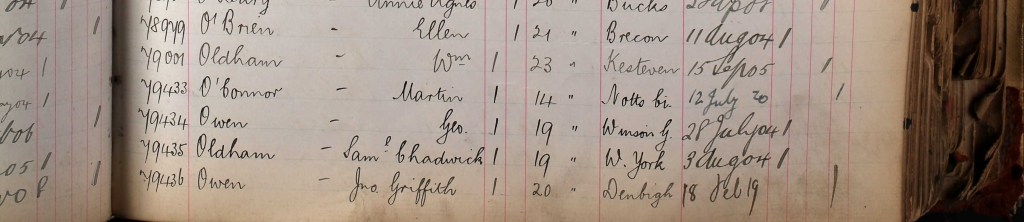
He was re-admitted (presumably to the same institution) on 1st November 1904. He was discharged four years later on 30th October 1908, but this time his condition was recorded as ‘Not Improved’, and rather than being discharged to return home, he was transferred to Storthes Hall, which had opened in June 1904 as the Fourth West Riding Pauper Lunatic Asylum. He died at Storthes Hall on 27th November 1909, aged 50.
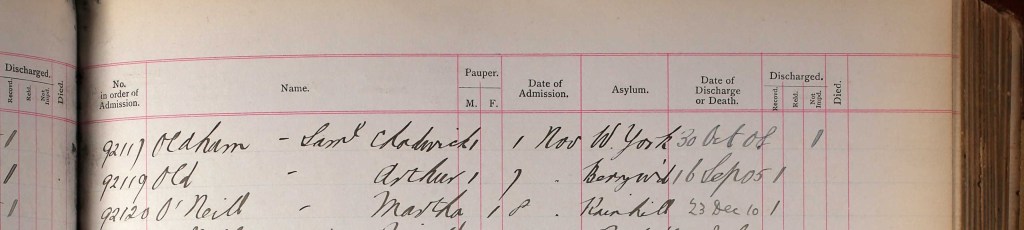
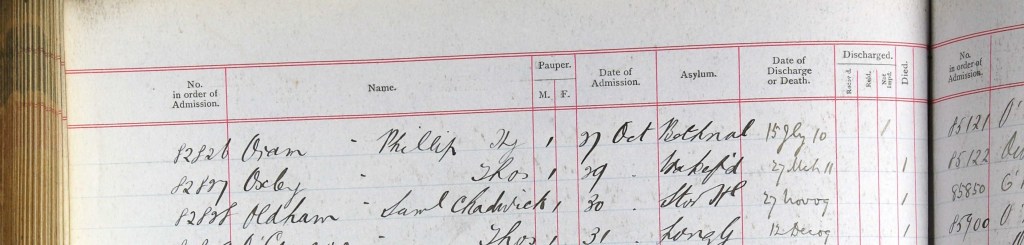
Samuel was buried with his parents on the 1st December in plot B134a, which is marked only by a marker stone with the initials S.O. The burial register records that he died at ‘Storthes Hall Asylum’, and give his age (incorrectly) as 52.
Richard GREENWOOD (1852-1909)
Richard Greenwood was born in Wadsworth in 1852, the son of Cornelius Greenwood, a handloom weaver and farmer. Richard’s mother Mary (born Crossley) seems to have died when he was a child, and he lived with his father, siblings and grandmother at Owlers, near Shackleton. Cornelius Greenwood died in1867, aged 48, and Richard continued living at Owlers with his aunt, Mary Greenwood, and his siblings, working for his aunt as a farm labourer.
In 1890 Richard married Susannah Redman, nine years his junior, and the daughter of George and Grace Redman. The couple had two children, Amos (1894-1954) and Ada, later Ada Carter (1891-1970): in 1891 they were living in Hebden Bridge, and Richard was a self-employed Milk Dealer, and in 1901 the family were living at Hill Head Farm (close to Owlers) and Richard was employed as an ‘ordinary agricultural labourer’. Susannah died in 1906, aged 45.

We don’t know what happened to Richard after Susannah’s death, but he was admitted to Storthes Hall Asylum on 24th November 1908 and died there on 19th December 1909. His age was registered as being 54, but was correctly recorded in the burial register and on his headstone as being 57. He was buried in plot B171a with Susannah and her parents and sister. His son Amos may also have been later interred in this plot, although it is possible that he was interred with his sister Ada and her family.
Elizabeth PICKLES (1849-1911)
Died at Storthes Hall Asylum in 1911, aged 62. Buried at Wainsgate in plot B59a.
Fred WADSWORTH (1868-1915)
Fred Wadsworth was born in Birkenshaw, near Bradford, the son of William and Ann Wadsworth. His father was born in Wadsworth, the son of John Wadsworth, and Ann was born in Thornton, near Bradford. William’s sister was Jane Wadsworth, whose daughter Mary Jane Wadsworth later married Fred, her first cousin.
Fred worked as an engineer, machine tool maker, mechanic and fitter, and until his marriage lived with his widowed mother in Halifax. In 1910 he married Mary Jane Wadsworth, who lived with her single mother Jane at Little Nook: the marriage certificate does not record a name for her father, and neither does her birth certificate, but her father is believed to be James Redman, a local farmer (he is named as her father on her second marriage certificate). After their marriage Fred and Mary Jane lived at Norland View, Delph Hill, Halifax. There is no record of them having any children.
No record has been found of Fred’s admision to Storthes Hall Asylum, but the Wainsgate burial register states that he died there, aged 46, and was buried on 26th March 1915. The headstone on his grave gives the date of his death as 22nd March and his address (or his wife’s address) as Norland View, Halifax. His death was registered in Huddersfield registration district. Fred is buried in plot B319a with his mother-in-law Jane Wadsworth, who died in 1901 and his wife Mary Jane (‘beloved wife of J.T. Gregory, Sheffield’).
Four years after Fred’s death, Mary Jane had married John Thomas Gregory, a widower, in 1919 and died in Sheffield in 1937, aged 65. She was buried at Wainsgate with her mother and first husband, and her second husband was buried in Sheffield with his first wife and their son.
Sam Shaw WILCOCK (1855-1932)
Died at Scalebor Park, Burley in Wharfedale in 1932, aged 77. Buried at Wainsgate in plot B70a-113a.
Ada Victoria DILLON (1890-1939)
Died in Storthes Hall Mental Hospital, Kirkburton, in 1939, aged 48. Born in Plumstead, she had spent over half of her life at Storthes Hall, having been admitted in December 1911. Buried at Wainsgate in plot C604.
George REDMAN (1862-1939)
Died at Scalebor Park, Burley in Wharfedale in 1939, aged 77. Buried at Wainsgate in plot F767.
Herbert SUTCLIFFE (1885-1940)
Herbert Sutcliffe was born in Hebden Bridge, the son of Lister Sutcliffe, a fustian cutter & tailor, and his wife Emily Rushton Sutcliffe (born Hoyle in Manchester). The family lived at Wood Top, Hebden Bridge, and after starting his working life as a warehouseman in a cotton mill (and also keeping chickens and selling ‘eggs for sitting’ and broody hens), Herbert married Beatrice Greenwood in 1910: Beatrice lived at Wood Top Farm, and was the daughter of Charles andLucy Greenwood. The marriage certificate describes Herbert as a ‘Poultry Dealer’ and Beatrice as a ‘Fustian Tailoress’. In 1911 Herbert and Beatrice were living at 2, Guildford Street, Hebden Bridge, and Herbert was now a ‘Poultry Farmer’, employing at least one person.
The 1921 census (taken in June 1921) found Herbert and Beatrice on holiday in Blackpool, staying in a boarding house with their five year old son, Harold Kenelm Sutcliffe. Herbert was now a ‘Manufacturer of Poultry Appliances’ – the company, F. & H. Sutcliffe was formed with his brother Fred Arthur Sutcliffe, and had been making timber hen houses, runs and coops at Wood Top since at least 1915.

In 1939 the family were living at Beech House, Fairfield, and Herbert is described as ‘Manager & Director, making Government Huts for Army & RAF’. The firm of F. & H. Sutcliffe had branched out from hen houses and was now making all manner of timber buildings: obviously manufacturing temporary buildings for the Army and RAF was a useful sideline during the war.
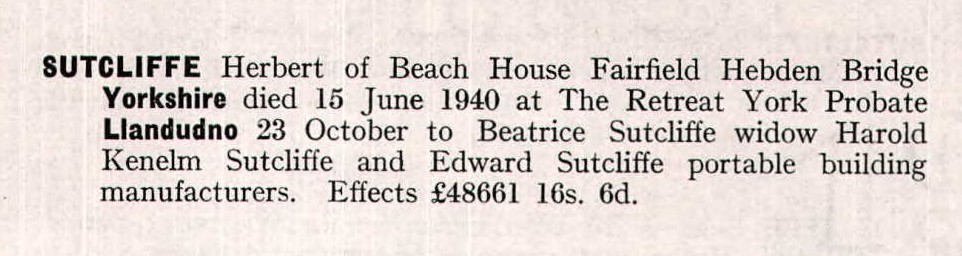
Herbert died on 15th June 1940, aged 54. Probate records show that he died at The Retreat, York, a pioneering establishment founded by Quakers in 1796 to provide ‘moral treatment’ for people with mental health issues, where he was being treated for depression.
Herbert was buried at Wainsgate in plot J746, which he had bought on 21st April 1939. Beatrice died in 1975, aged 89, and her ashes are assumed to be interred with her husband.
Other members of Herbert’s family are buried in adjacent plots: his brother Fred is buried in plot J747 with his wife Annie, and their parents Lister and Emily, younger brother Edward Sutcliffe and his wife Lucy are buried in plot F745. Herbert and Beatrice’s only child, Harold Kenelm Sutcliffe died in Spain in 1998, as did his wife Jessie in 2011.
Emily JACKSON (1902-1941)
Died in 1941, aged 38. The burial register records her living at 22, Nutclough, Hebden Bridge, but the only recorded matching death was registered in Upper Agbrigg registration district, which includes Kirkburton, suggesting that she may have been a patient at Storthes Hall. Buried at Wainsgate in plot F762.
Dan Thomas WILCOCK (1878-1954)
Died at ‘North Spring House, Kirkburton’ (aka Storthes Hall) in 1954, aged 75. He had a burial plot (J858) reserved for him at Wainsgate by his uncle, John Thomas, but was buried in an unmarked grave at St. Thomas, Thurstonland.
Ellen Gwendoline THORNTON (1893-1955)
Died at ‘North Spring House, Kirkburton’ (aka Storthes Hall) in 1955, aged 62. Buried at Wainsgate in plot G704.
Maud May BROWN (1889-1964)
Died at Winwick Hospital, near Warrington in 1964, aged 74. Buried at Wainsgate in plot G682/683.
Vera SALTONSTALL (1907-1984)
Died at ‘North Spring House, Kirkburton’ (aka Storthes Hall) in 1984, aged 77. Buried at Wainsgate in plot J837.
* * *
WAKEFIELD ASYLUM
The first West Riding Pauper Lunatic Asylum, familiarly known as Wakefield Asylum, was opened in 1818 with accommodation for 150 patients. The asylum was enlarged over the next two decades, and by the 1860s housed over a thousand patients. The first superintendent was William Charles Ellis, whose ideas on the treatment of mental illness
became influential. A Methodist with strong religious convictions, he employed the principles of humane treatment and ‘moral therapy’ that he had previously practised at Sculcoates Refuge in Hull.
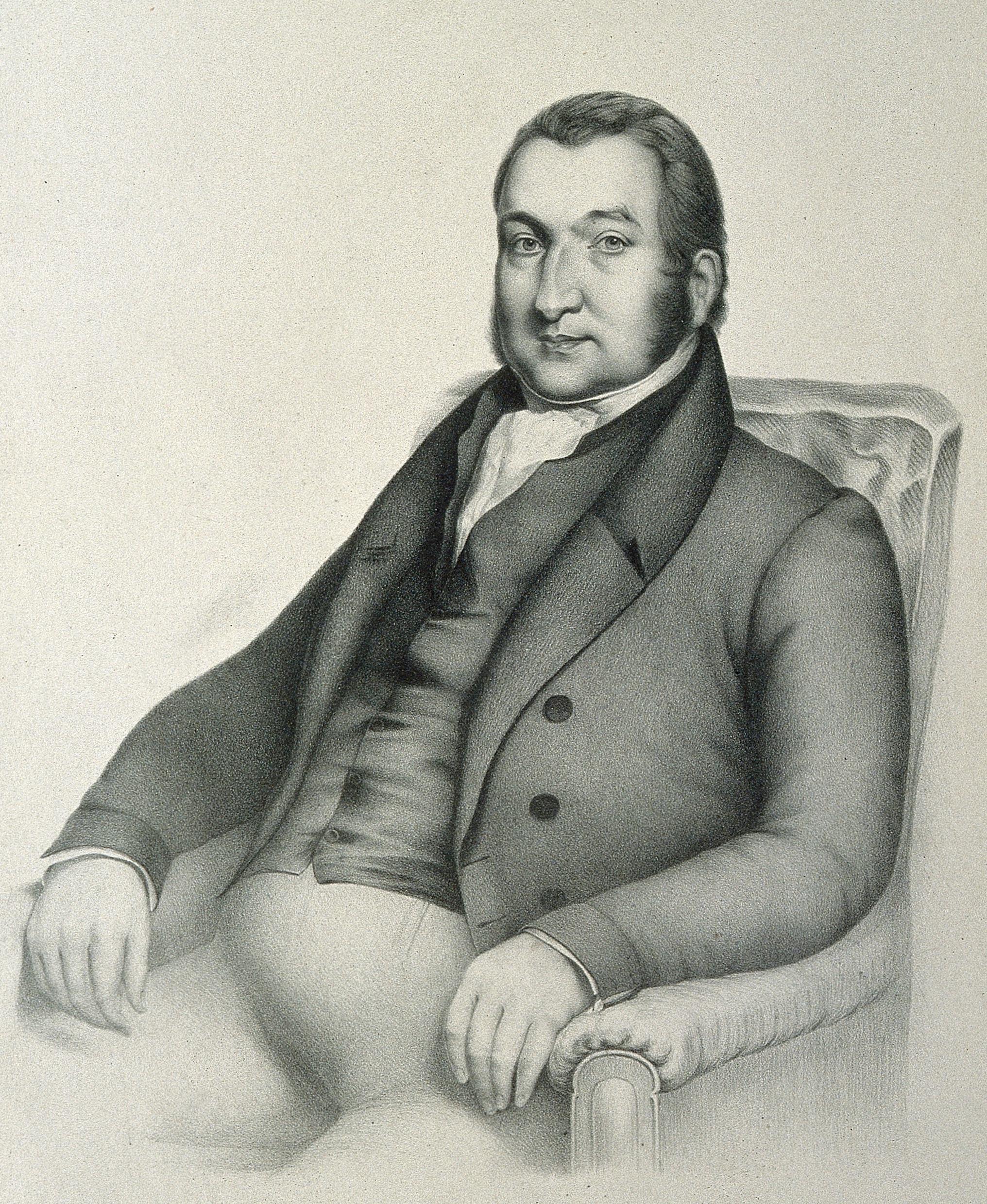
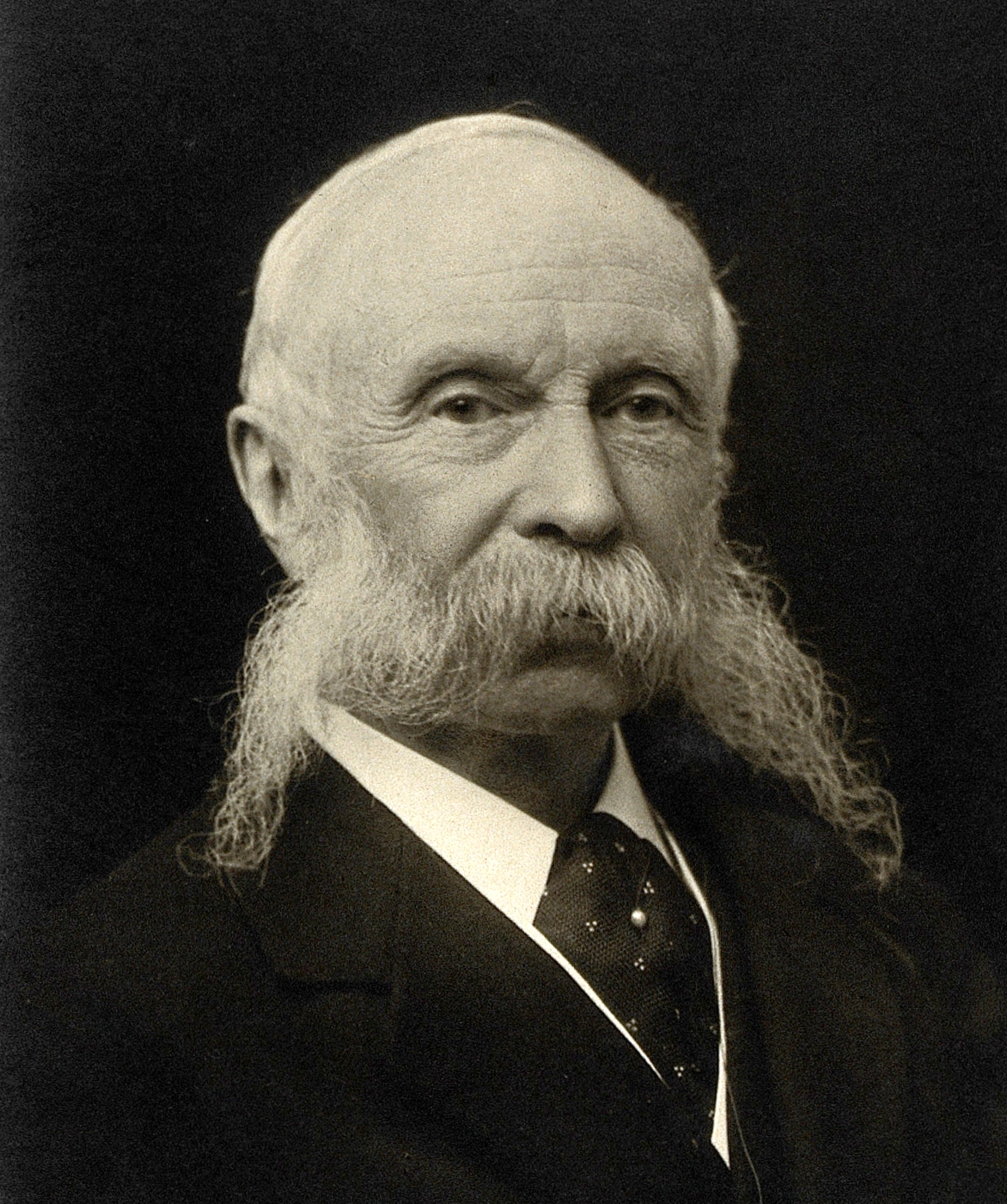
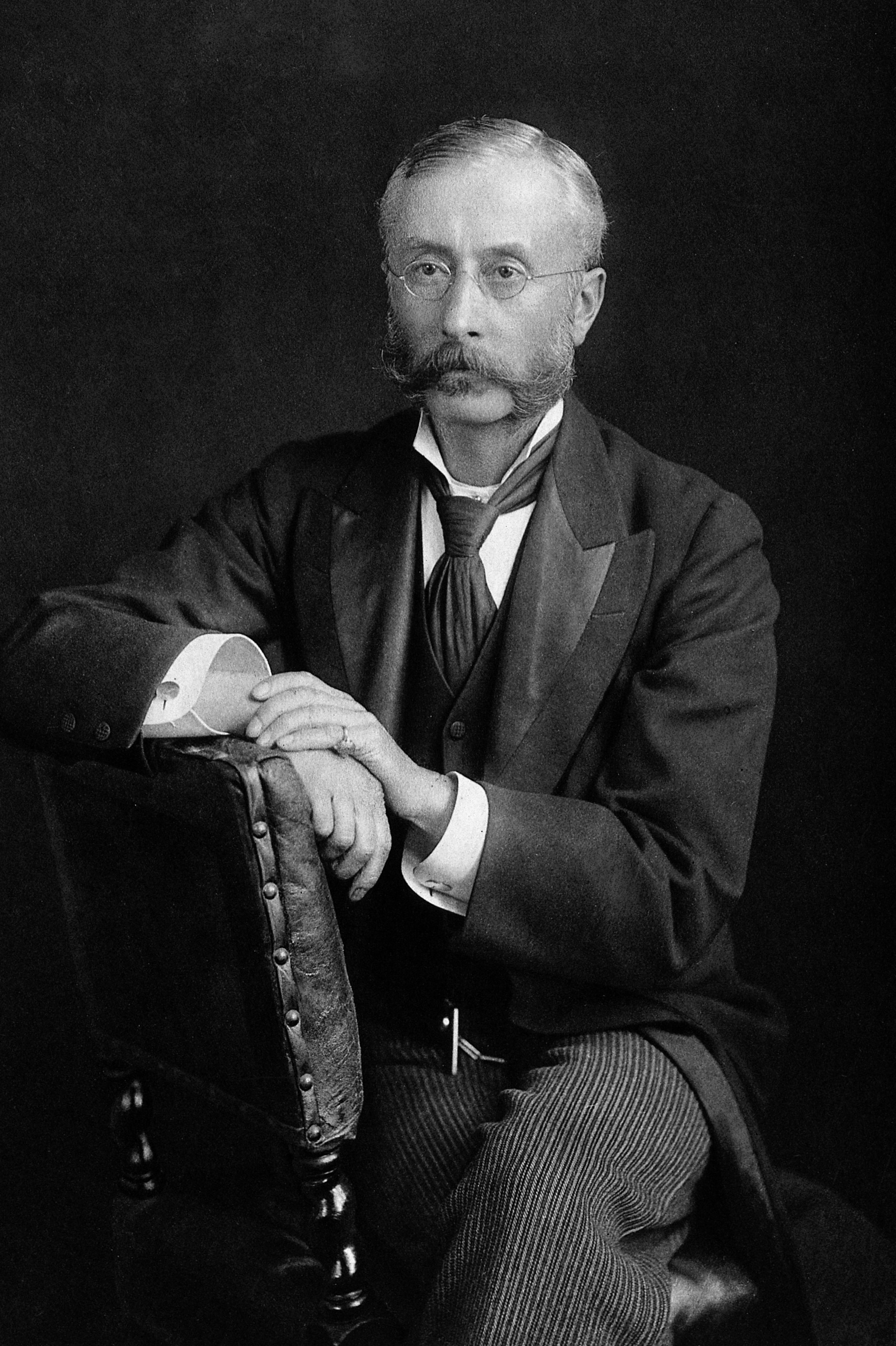
L to R: William Charles Ellis (1780-1839), James Crichton-Browne (1840-1938), David Ferrier (1843-1928).
The superintendent from 1866 until 1875 was the eminent Victorian psychiatrist James Crichton-Browne, who went on to carry out pioneering research on the neuropathology of insanity. He believed that the asylum should be an educational as well as a therapeutic institution, and together with the neurologist David Ferrier transformed the asylum into a world renowned centre for neuropsychiatry. Crichton-Browne was also an enthusiastic advocate of eugenics, and in 1908 became the first president of the Eugenics Education Society.
The asylum kept meticulous records, with over 5000 photographs and details of the patients’ diagnosis and treatment. Diagnoses included ‘imbecility’, ‘simple mania’, ‘acute melancholia’, ‘constructive dementia’, ‘general paralysis of the insane’, ‘mania of suspicion’ and ‘mono mania of pride’. It is also likely that patients included those with more general health problems such as epilepsy and post-natal depression, as well as social problems such as malnutrition and domestic abuse. In 1948 the asylum was renamed Stanley Royd Hospital, and eventually closed in 1995.
More coming soon…..
STORTHES HALL
The fourth, and last, West Riding Pauper Lunatic Asylum was opened in 1904 at Kirkburton near Huddersfield. Known as Storthes Hall Asylum until 1928, it was renamed as Storthes Hall Mental Hospital (1929 – 1938), West Riding Mental Hospital (1939 – 1948) and finally Storthes Hall Hospital from 1949 until its closure in 1991.
Deaths at Storthes Hall were sometimes recorded as having taken place at ‘North Spring House, Kirkburton’ to avoid the supposed stigma of the name appearing on death certificates, obituaries and probate records.
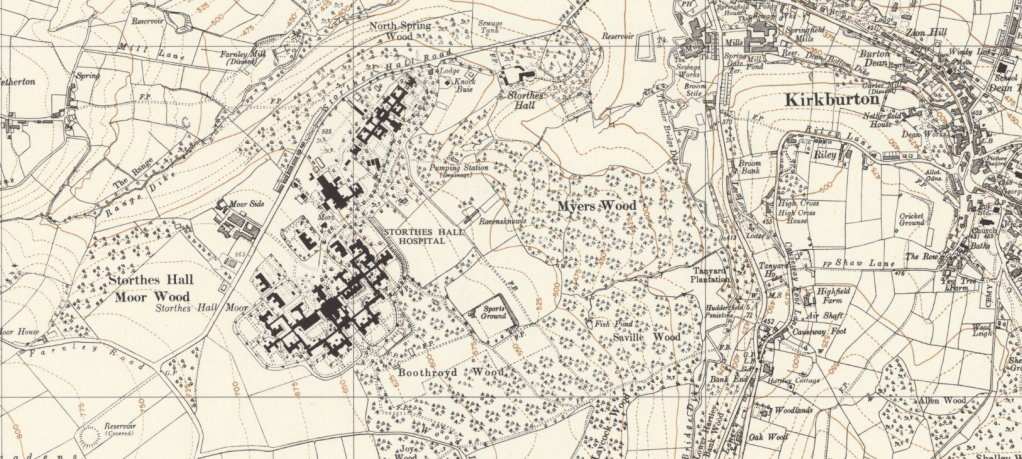
Storthes Hall and Kirkburton (1955 Ordnance Survey map)
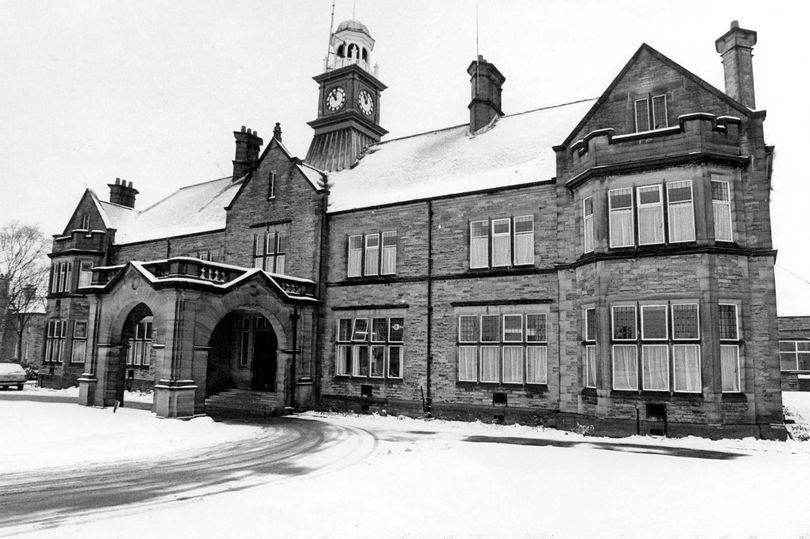
Storthes Hall, Kirkburton
More coming soon…..
SCALEBOR PARK
Scalebor Park Asylum, also known as the West Riding Private Asylum, opened in Burley in Wharfedale in 1902. Although initially established as a private asylum for fee-paying patients, the facility was owned by the West Riding County Council. In the 1920s it became Scalebor Park Mental Hospital, and joined the National Health Service as Scalebor Park Hospital in 1948.
After the introduction of Care in the Community in the early 1980s, the hospital went into a period of decline and closed in 1995. Parts of the hospital site were demolished, and the main administration block was converted into apartments in 2001.
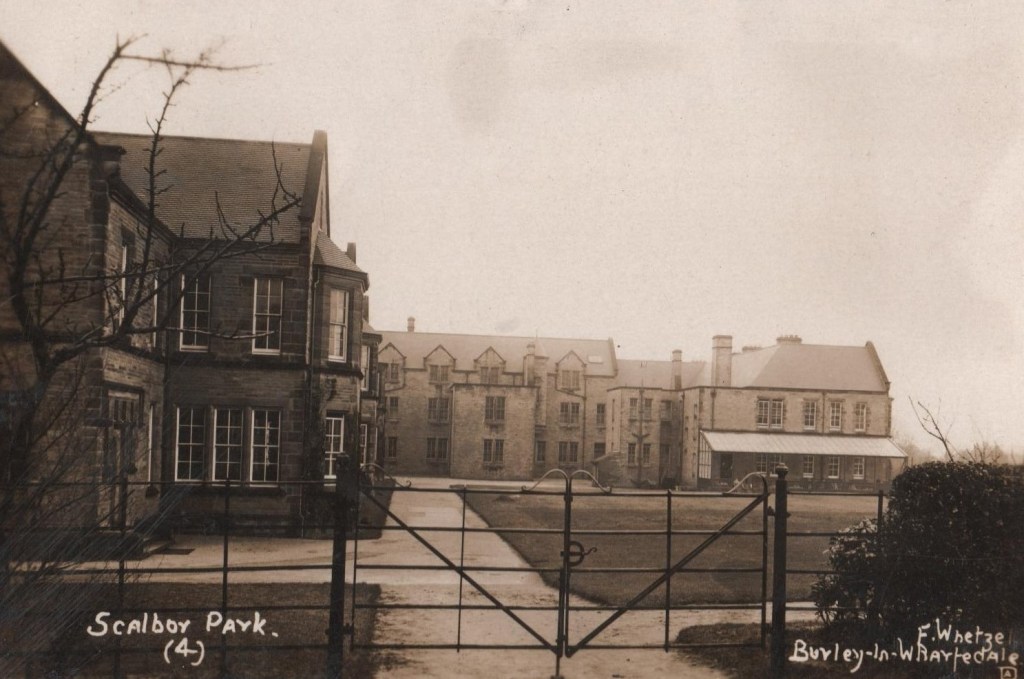
Photo courtesy of County Asylums – countyasylums.co.uk
More coming soon…..
The RETREAT
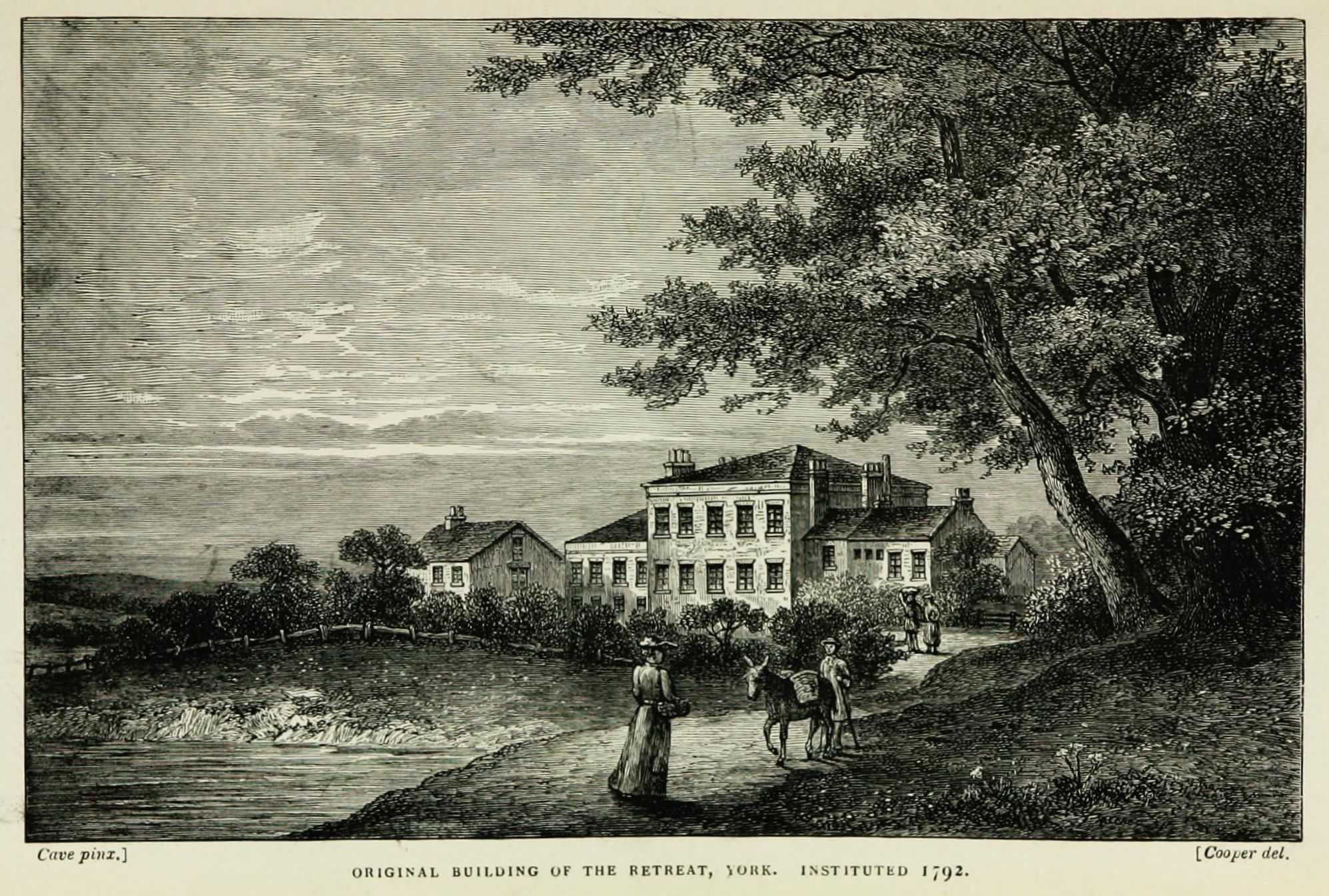
The Retreat, York, commonly known as the York Retreat, was founded in 1796 by William Tuke (1732-1822), a tea merchant, philanthropist and Quaker. The motivation for opening The Retreat was the death of a Quaker woman from Leeds, Hannah Mills, who had been admitted to York Lunatic Asylum suffering from ‘melancholy’, and died there unexpectedly. Although her cause of death was unclear, mistreatment was suspected and the managers had forbidden Mills from having visitors.
The Quakers’ fears about conditions in the asylum were fully justified, and a national investigation in 1813-14 led to questions in Parliament. The asylum became Bootham Park Hospital in 1904 and joined the National Health Service in 1948. In late September 2015 the hospital building was declared unfit by the Care Quality Commission, and ordered to close by the end of the month. Staff were given 5 days’ notice to close the building, and the hospital was closed on 1st October 2015, having been declared unfit for purpose.
The Retreat was initially only open to Quakers, but gradually was opened to everyone. Unlike most asylums of the time, nobody was chained or manacled at The Retreat, and physical punishment was banned. Treatment was based on personalised attention and benevolence, restoring the self-esteem and self-control of residents, and it became a model around the world for more humane and psychologically based approaches.
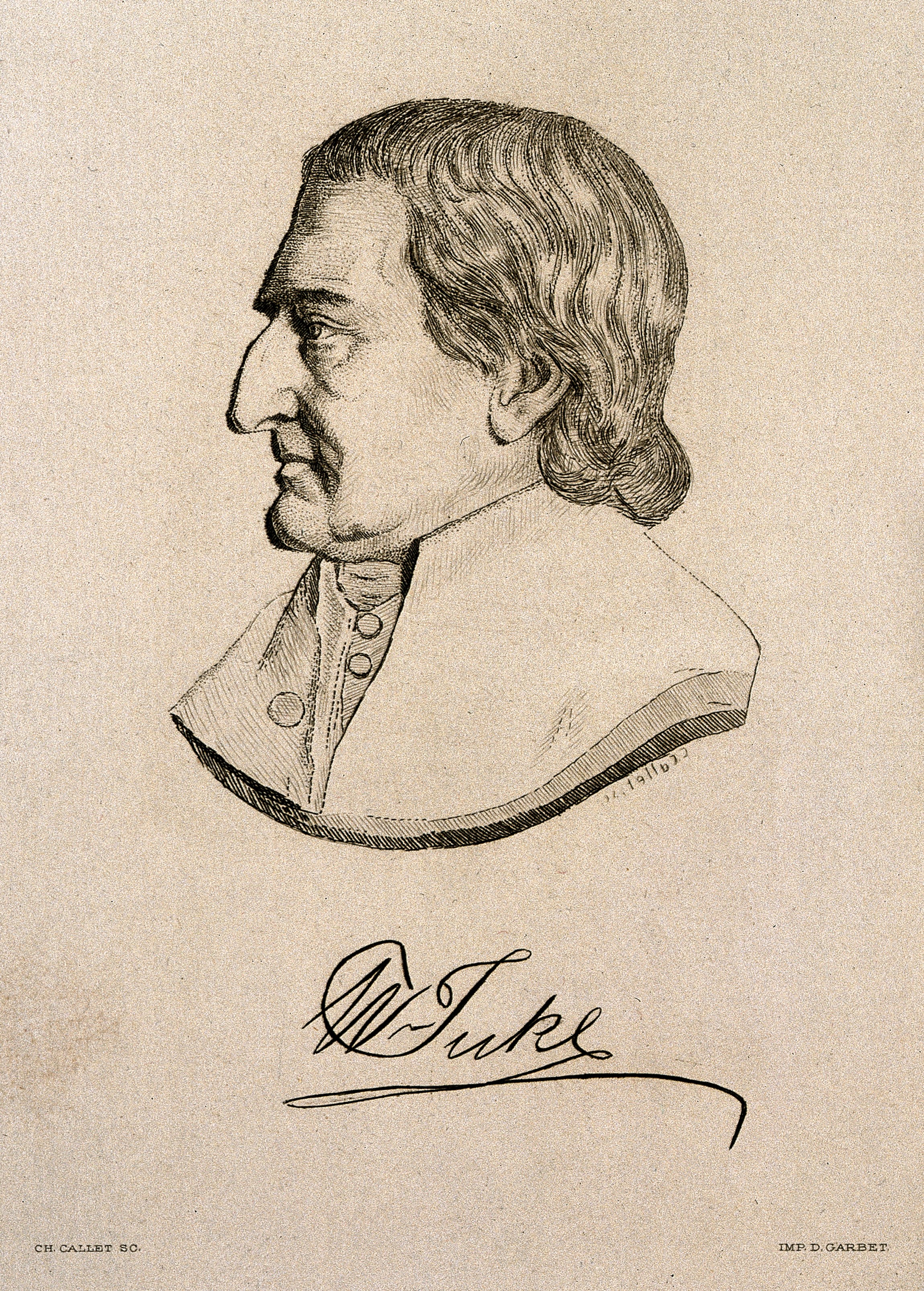
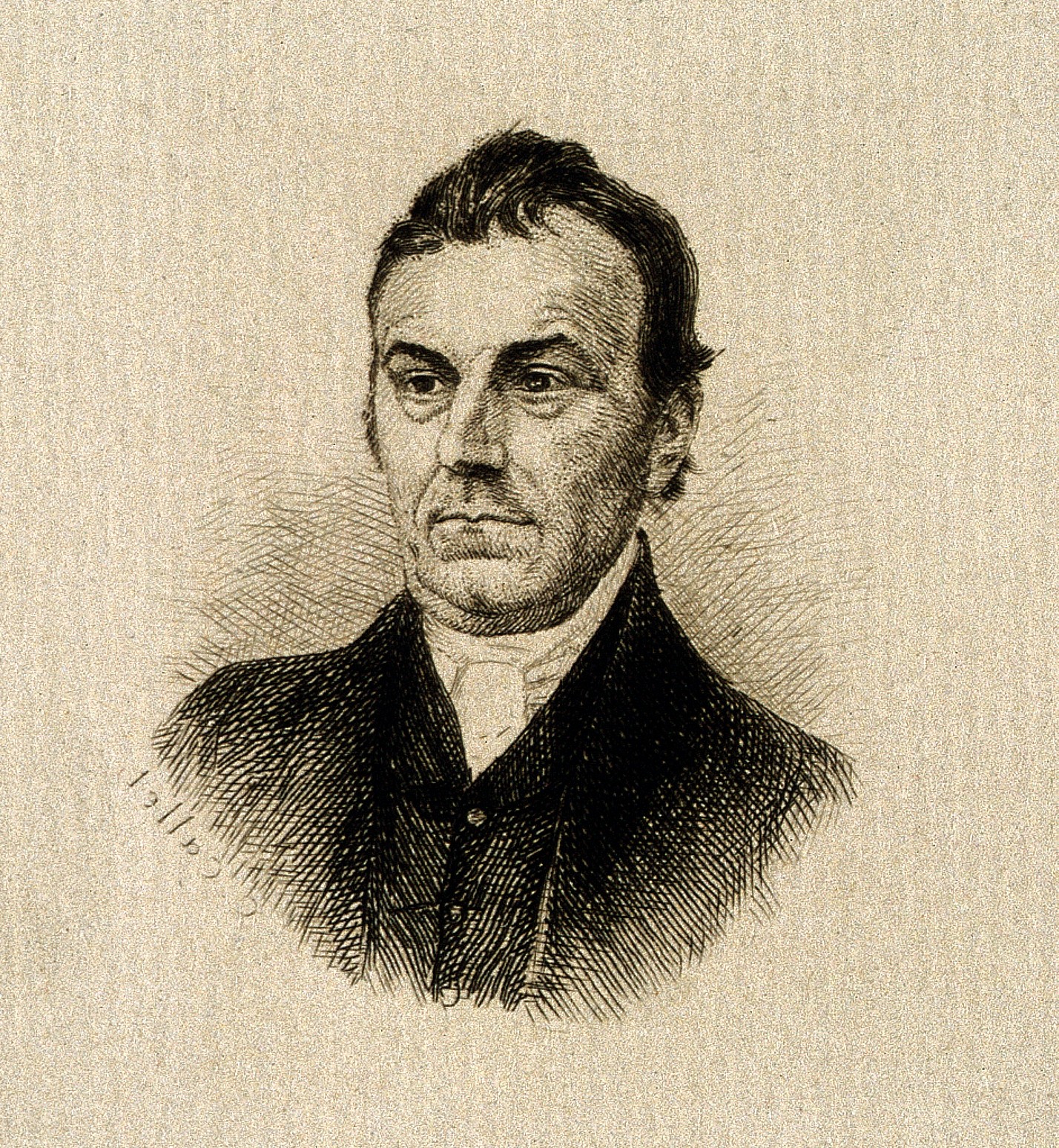
Etchings of William Tuke (l) and Samuel Tuke (r) by C. Callet (Wellcome Collection)
William Tuke’s grandson, Samuel Tuke (1784-1857), also a Quaker philanthropist and reformer, was responsible for popularising the approach used at The Retreat, based on the work of Jean-Baptiste Pussin and Phillipe Pinel in France, which Tuke called ‘moral treatment’. Samuel Tuke was also the author of an influential book published in 1813 called Description of The Retreat, an Institution near York, for Insane Persons of the Society of Friends: ‘containing an account of its origin and progress, the modes of treatment and a statement of cases’.
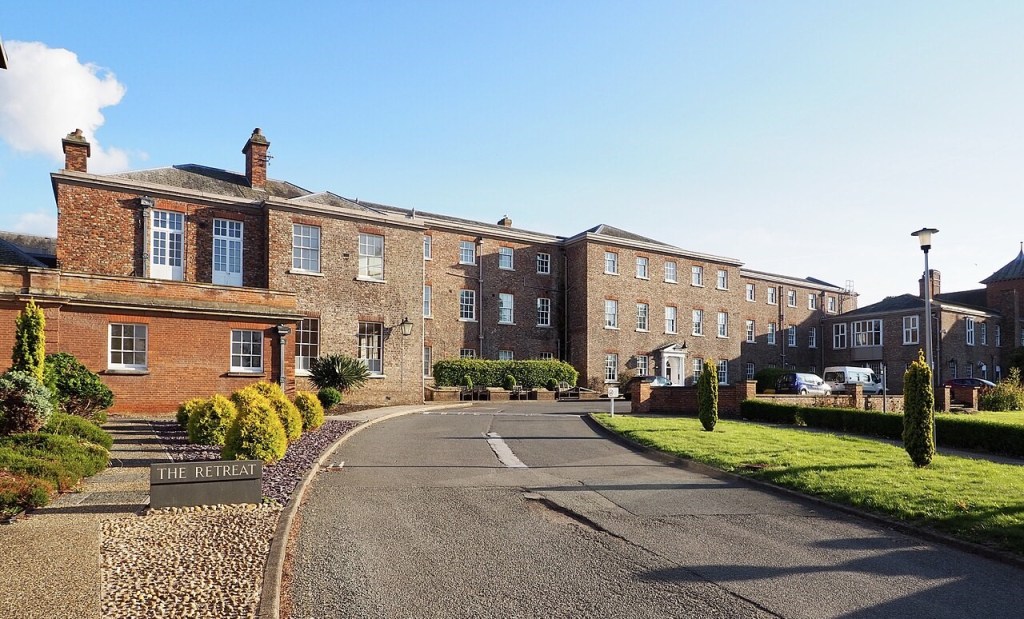
The Retreat, 2023.
The Retreat withdrew from the delivery of inpatient services after 222 years on 31 December 2018. It still operates as an independent clinic, providing outpatient therapies and diagnostic assessment services for children and adults.
* * *
The CENSUS ‘INFIRMITY’ QUESTION
Every England & Wales census from 1851 to 1911 had a column recording information about certain physical and mental ‘infirmities’ that people in the household may have had. The reason for asking these questions was apparently to help assess social welfare requirements, particularly the need for institutions, such as special schools and asylums.
These questions were discontinued after the 1911 census, for various reasons: it was felt that many people disliked giving details of this nature, particularly when it concerned their children, and also the definitions of some of the infirmities were unclear (how do you distiguish ‘lunatic’ from ‘idiot‘, ‘imbecile’ or ‘feeble-minded‘?). Both of these factors meant that the information was unreliable. The advent of National Insurance in 1911 also meant that the government now had far more detailed and reliable information about the health of the population.
The 1851 and 1861 census forms had a column which asked: ‘Whether Blind, or Deaf-and-Dumb’.
The 1871 and 1881 censuses had four categories:
1. Deaf-and-Dumb.
2. Blind.
3. Imbecile or Idiot.
4. Lunatic.
In 1891 there were now only three categories:
1. Deaf-and Dumb.
2. Blind.
3. Lunatic, Imbecile or Idiot.
In 1901 it was back to four categories, and ‘idiot’ was now repaced by ‘feeble-minded’, mainly because statisticians doubted that many people would describe themselves, or another family member, particularly a child, as an idiot:
1. Deaf and Dumb.
2. Blind.
3. Lunatic.
4. Imbecile, feeble-minded.
The 1911 census form (opposite) has four similar categories:
1. Totally Deaf or Deaf and Dumb.
2. Totally Blind.
3. Lunatic.
4. Imbecile or Feeble-minded.
It also asks for the age at which the person in question was ‘afflicted’.
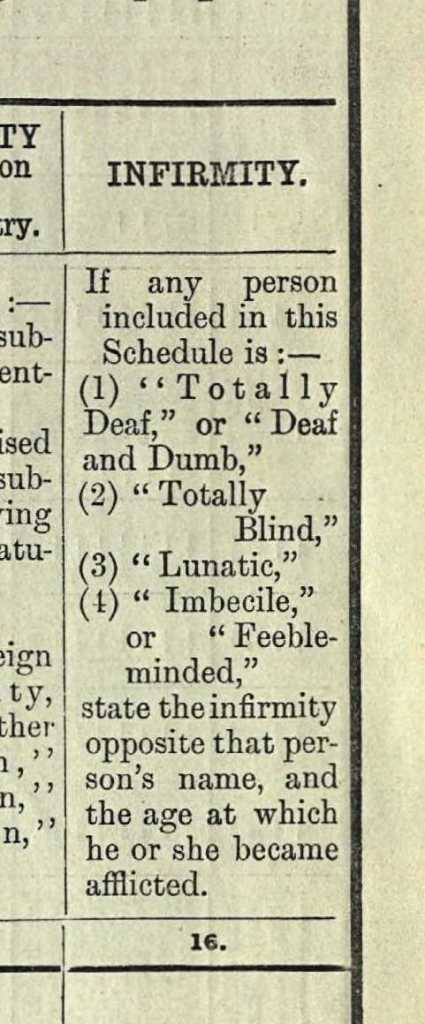
The terms used to describe various states of mental illness or incapacity were never properly defined, and it is highly unlikely that most households or census enumerators would have been capable of entering an appropriate description on the form. In 1881 the Census Commissioners for England and Wales had to point out:
‘how very incomplete are the returns which relate to these afflictions, and more especially those which relate to idiocy and imbecility. We have done the best we could with this unsatisfactory data. We cannot, however, but express our decided opinion that statements made by persons as to the deficiencies, mental or bodily, of their children or other relatives are not worth the cost and labour of collection and tabulation’.
* * *
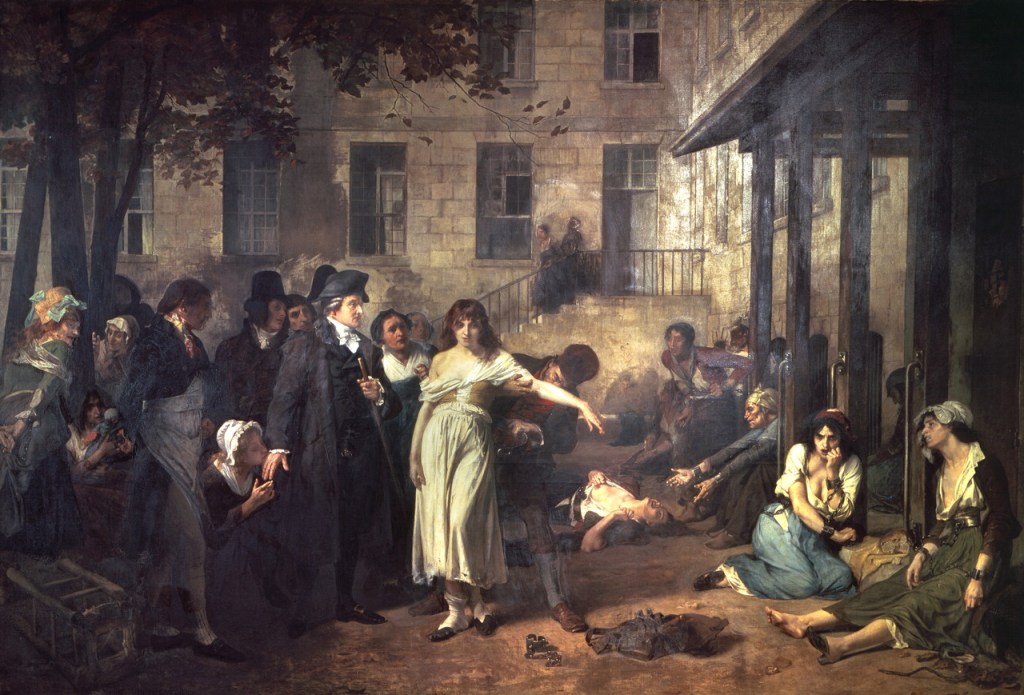
Pinel, médecin en chef de La Salpêtrière, délivrant des aliénés de leurs chaînes by Tony Robert-Fleury (1795)
Dr. Philippe Pinel, chief physician of the Hospice de la Salpêtrière, ordering the removal of chains from patients at the Paris asylum for insane women. Pinel was instrumental in the development of a more humane psychological approach to the custody and care of psychiatric patients, and worked for the abolition of the shackling of mental patients by chains and, more generally, for the humanisation of their treatment. He also made notable contributions to the classification of mental disorders and has been described by some as “the father of modern psychiatry”.
 WAINSGATE GRAVEYARD PROJECT