Some of the people behind Wainsgate’s long tradition of musical excellence – three generations of the Ashworth family, John William Parker, George Hall Greenwood, Hird Thomas and many members of Wainsgate choirs over the years are buried in the graveyard or commemorated at Wainsgate.
John Kitchen (music teacher, musical instrument seller and composer) and three Jenkinson brothers, all musicians, are buried at Wainsgate. The youngest brother, Ezra Jenkinson, was a virtuoso violinist who trained in Leipzig.
There are also people interred at Wainsgate from other musical traditions – Duncan Smethurst, Chris Yates, Charles Francis Henesy, and no doubt others we haven’t discovered yet.
Find out more about Wainsgate’s choirs, its magnificent Wordsworth organ, The Sacred Harp, and how Wainsgate Chapel continues to be the home of music of all kinds.
(Thanks to Kay Deighton for providing many of the photographs and other archive material in this section)
* * *
‘As some to church repair, not for the doctrine, but the music there’.
From Essay on Criticism by Alexander Pope (1688-1744)
Click on the LINKS to find out more…..
Richard ASHWORTH
First secretary of Wainsgate Musical Society, founder of the Ashworth musical dynasty.
Albert Richard ASHWORTH
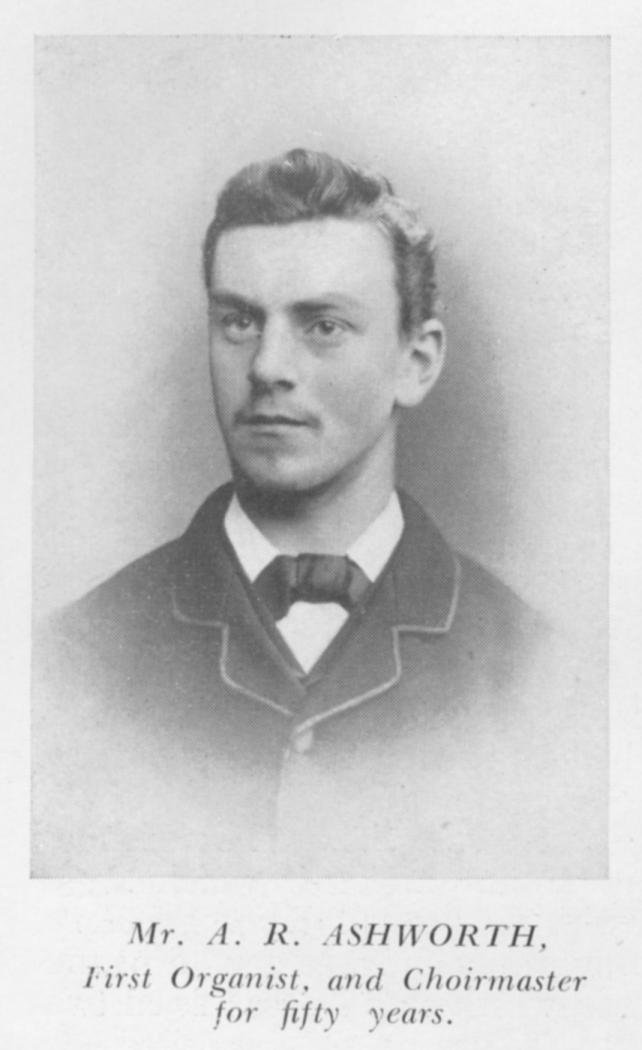
Organist, choirmaster for over 50 years, composer of hymn tunes.
Raymond ASHWORTH
Choirmaster for 40 years (and much more besides). Wainsgate’s very own Renaissance man.
The WAINSGATE CHOIR
Winner of the first prize for ‘choirs of from sixteen to twenty five voices’ at the 20th Nonconformist Choir Union Festival at Crystal Palace in 1908.
The 1951 HMV RECORDING
The choir were recorded at Wainsgate and two 78rpm records released by HMV.
John William PARKER
Organist for over 37 years.
George Hall GREENWOOD
Organist for over 20 years and member of the Wainsgate choir.
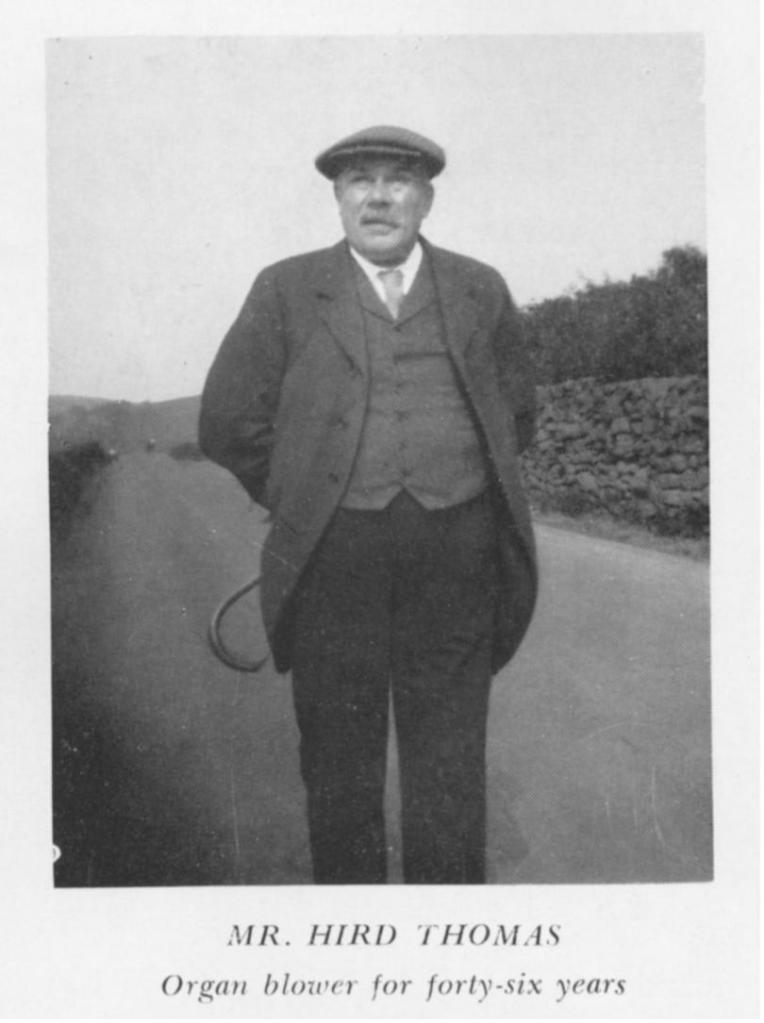
Hird THOMAS
Organ blower for 46 years, from its installation until electrification in 1937.
The WAINSGATE ORGAN
Built and installed in 1891 by Wordsworth & Co. of Leeds.
John KITCHEN
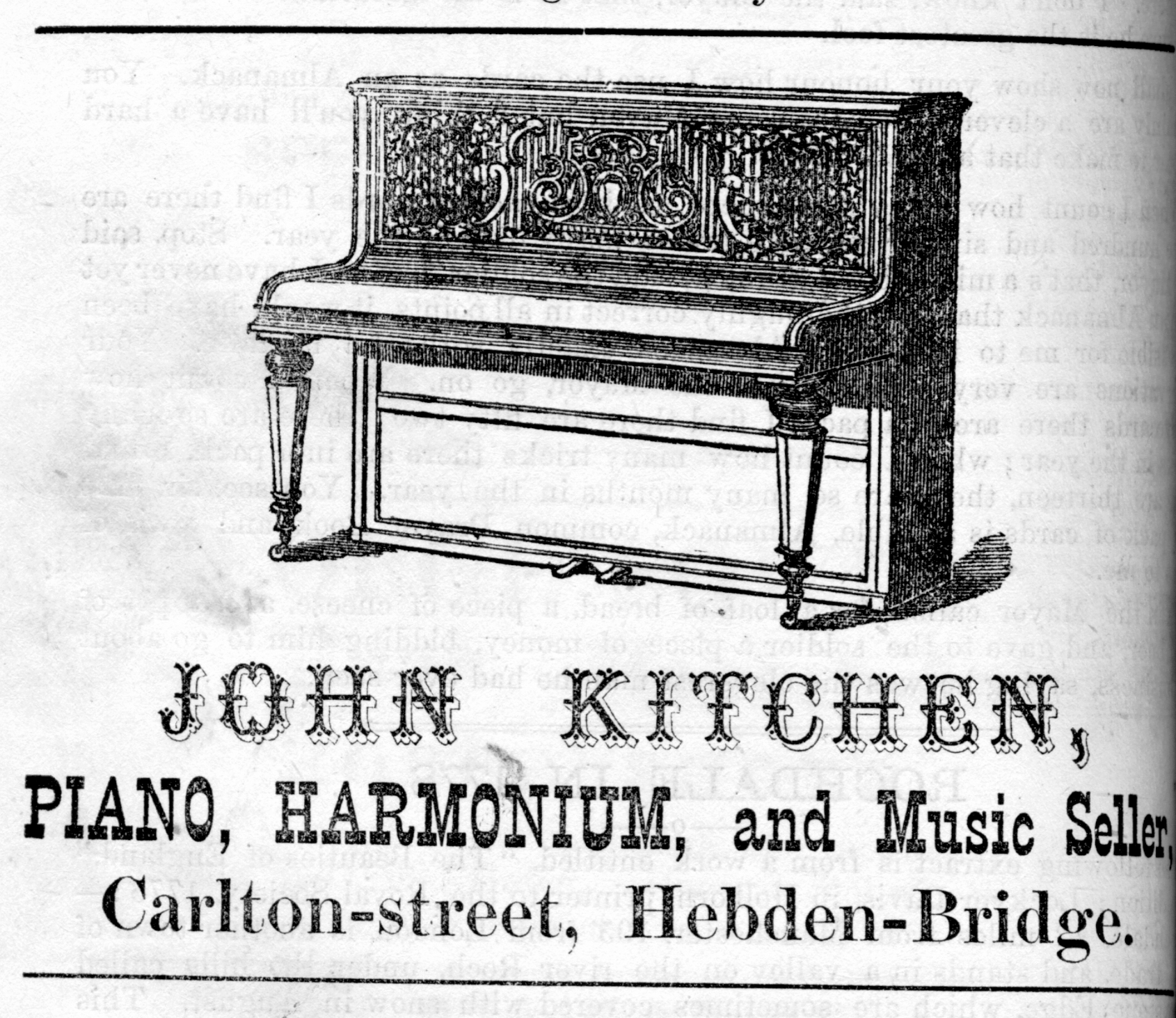
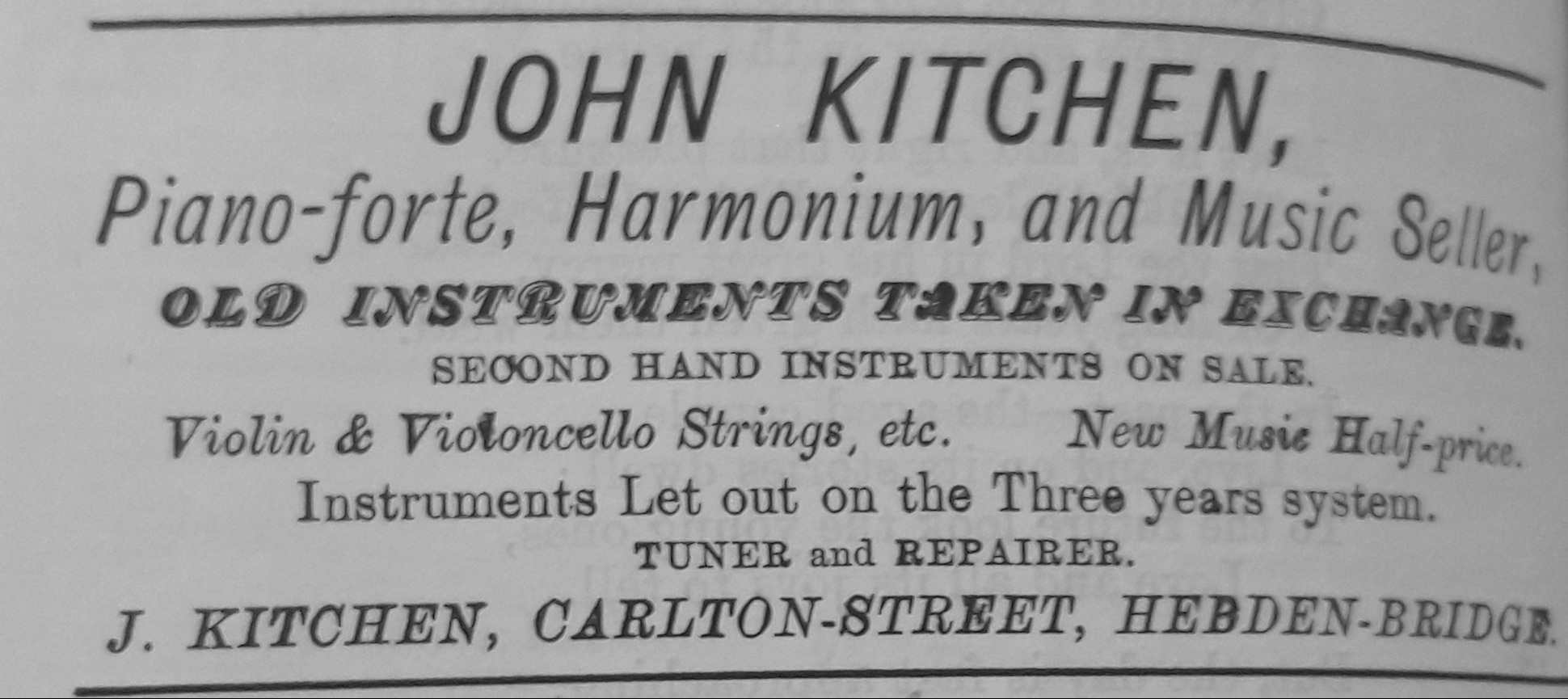
Shoemaker, music teacher, ‘Piano-forte, Harmonium and Music Seller’, composer of hymns, anthems and an oratorio.
The JENKINSONS
Three musical brothers – Henry, Herbert Edward and Ezra, all buried at Wainsgate.
Ezra JENKINSON
Virtuoso violinist and music teacher, trained at the Conservatory of Music in Leipzig. He later became a recluse and died in poverty.
THE SACRED HARP
A tradition of sacred choral music with strong connections to Wainsgate: two of the hymns in the Sacred Harp songbook were written by John Fawcett. ‘
The heavy metal music of the nineteenth century‘…..’The punk rock of choral music’.
OTHER MUSICIANS:
Duncan SMETHURST
Guitarist with legendary Hebden Bridge ska/rock band Owter Zeds and sound engineer at Hebden Bridge Trades Club. Buried at Wainsgate.
Chris YATES
Fiddle player with local band Rakish Paddy, died onstage in 2013 while doing what he loved. His ashes are interred at Wainsgate.
Charles Francis HENESY
Born in Liverpool, a professional musician who played the piano and accordion with the Charles Henesy Sextet. Lived with his wife May at Moorfield: they are both buried at Wainsgate.
THE MUSIC NEVER STOPPED……
Wainsgate’s continuing tradition of musical excellence.
* * *
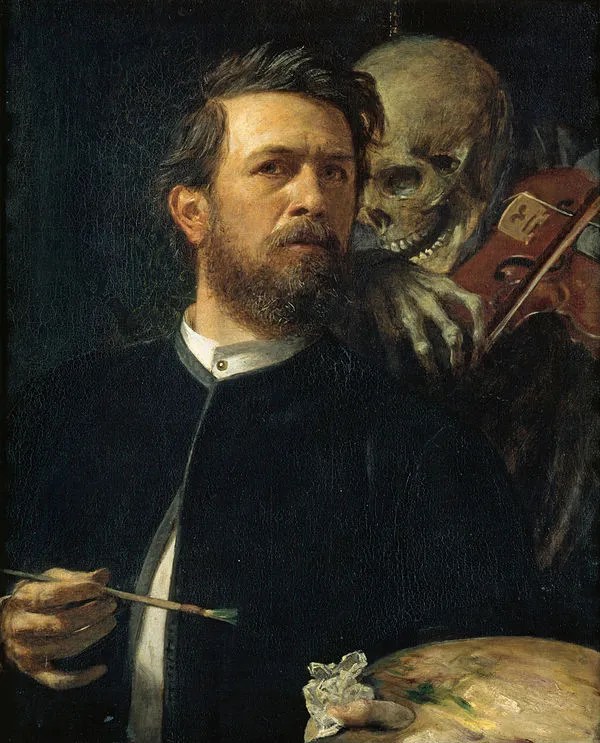
Self-Portrait with Death Playing the Fiddle by Arnold Böcklin (1872)
The image of a skeletal figure playing the violin, or indeed the violin (or fiddle) itself, has often been used as an emblem of death, and the violin itself has long been seen as “the devil’s instrument.”
* * *
The ASHWORTH family
Richard ASHWORTH (1822-1892)
Born in Wadsworth, Richard Ashworth lived in Old Town for most of his life, and was the son of William Ashworth ‘Farmer of 28 acres’ and his wife Sarah (born Thomas). William and Sarah are buried in plot A497, with two of their daughters, Grace Uttley and Betty Ashworth.
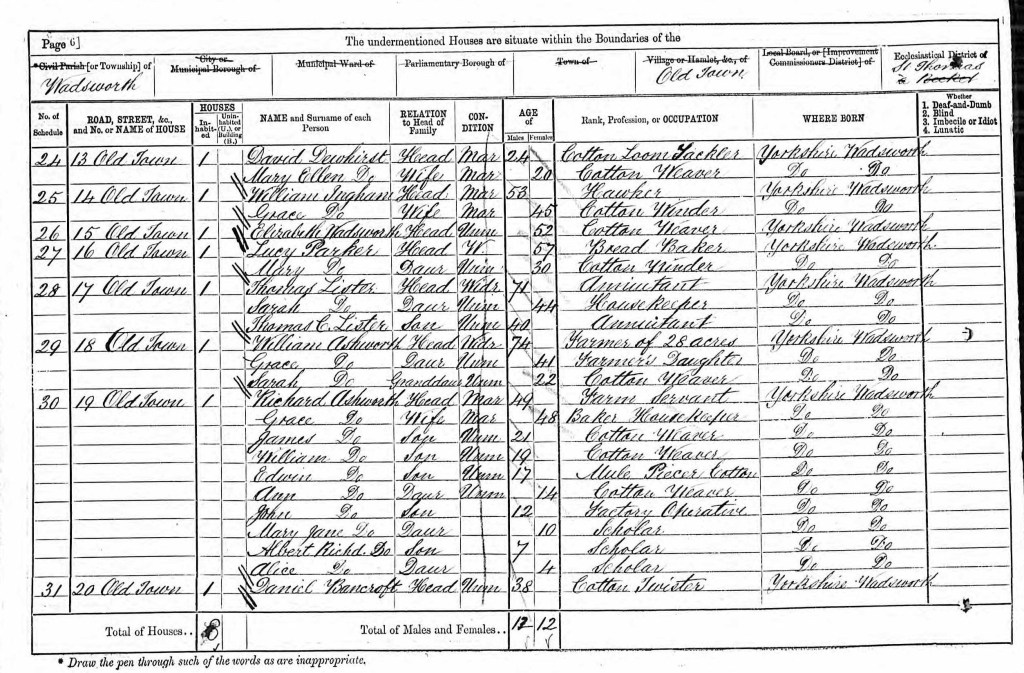
1871 Census: Richard and Grace were living at 19 Old Town with eight of their nine children. Next door to them are Richard’s widowed father William, William’s daughter Grace, and Richard’s eldest daughter Sarah. Richard is described as a ‘Farm Servant’, and was probably working with his father.
Richard was the first secretary of Wainsgate Musical Society, established in 1843, which formed the basis of the chapel choir, of which he was a member. He married Grace Ingham in 1847, and they had nine children (Sarah, James, William, Edwin, Ann, John, Mary Jane, Albert Richard and Alice).
All were members of the choir, and the total length of service in Wainsgate Choir of these nine brothers and sisters totalled 406 years, with their youngest daughter Alice Ashworth, ‘noted for her rich contralto voice’, serving for 63 years from the age of eleven until her death in 1943. James Ashworth played the harmonium, which was installed in 1866, and was Choirmaster prior to his younger brother Albert Richard Ashworth taking over.
Richard was at various times a weaver, carter and farmer. The 1851 census describes both Richard and his wife Grace as ‘Weaver Lasting, Worsted’. ‘Lasting’ or ‘Everlasting’ was one of the many names given to worsted wool textiles known under the general name of ‘stuff’. Lasting was a popular textile for men’s clothing and ladies shoes in the 18th century, and was often dyed black. Plain lasting was woven with a double warp yarn in a 2/1 weave, producing a pronounced twill.
Richard, his wife Grace and daughter Alice (who never married) are buried in plot A495. All of their other children are buried at Wainsgate:
Sarah (1847-1925) married Abraham Haigh in 1873, and is buried in plot B110a.
James (1849-1901) married Elizabeth Robertshaw and is buried in plot B69a.
William (c1851-1933) married Ellen Hammonds from Chesterfield in 1883, and is buried in plot E927.
Edwin (c1854-1928) married Sarah Redman in 1881, and is buried in plot F795. Like his brother Albert, Edwin lost a son in WW1: his only son, Ernest Ashworth was killed in Belgium in 1918, aged 33.
Ann (1856-1942) married Richard Turner Redman and is buried in plot B203a-216a.
John (c1859-1931) married Florence Preston and is buried in plot C665.
Mary Jane (1861-1934) married Edward Sutcliffe in 1887, and is buried in plot C623/624. The couple had no children.
Albert Richard ASHWORTH (1863-1933)

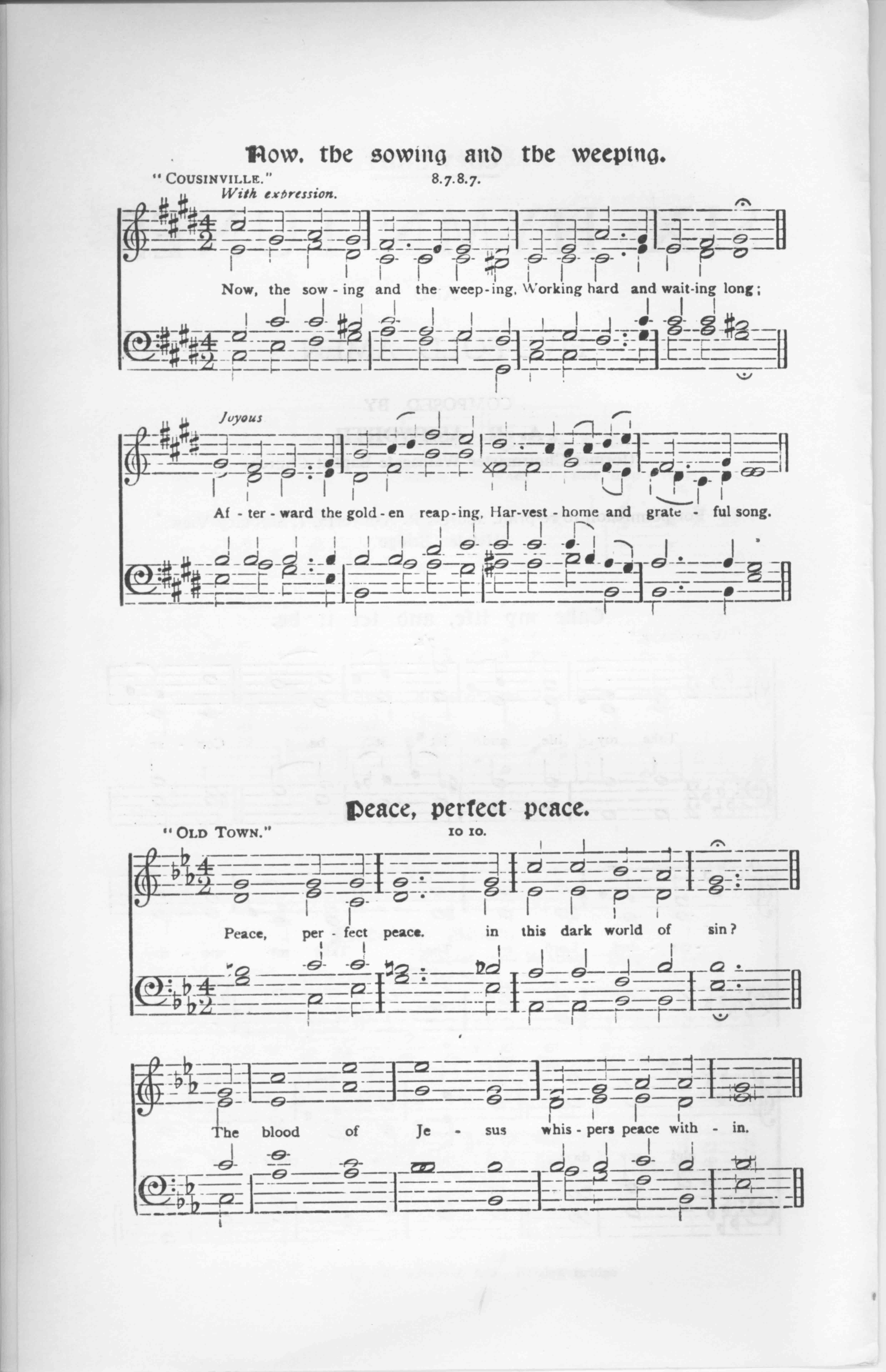
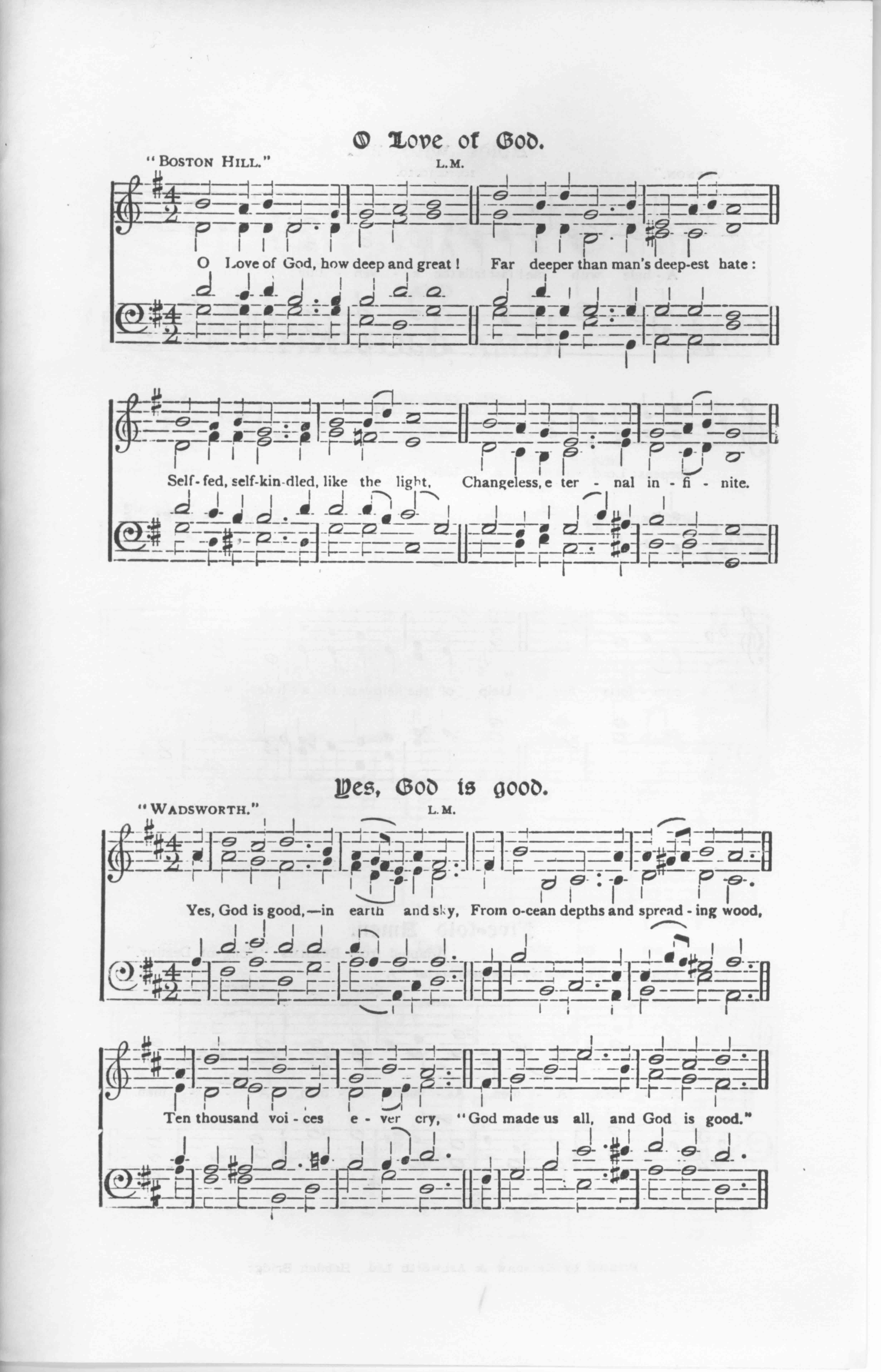
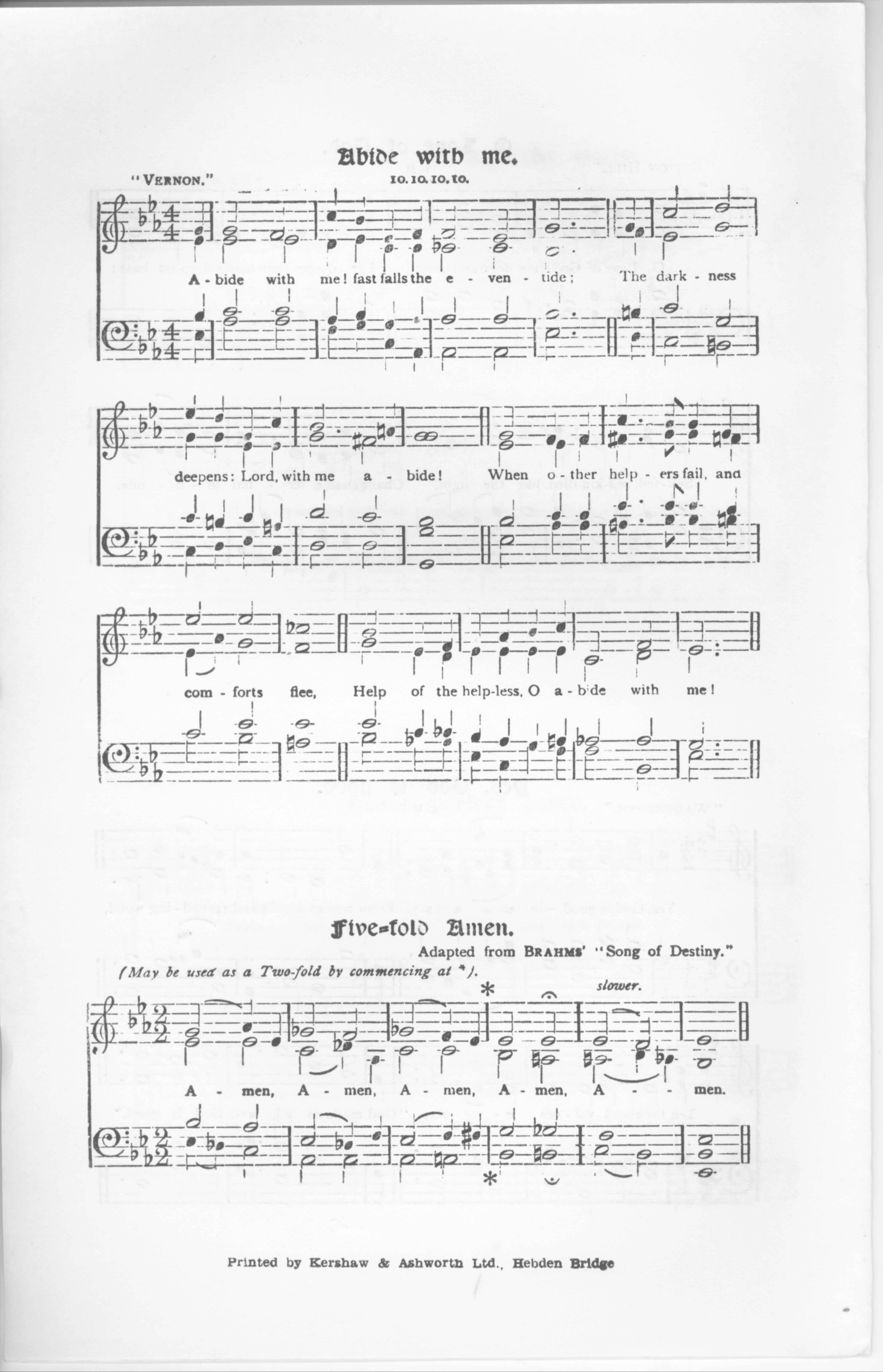
Six hymn tunes and five-fold Amen by A.R. Ashworth: ‘Take my life, and let it be’, ‘Now, the sowing and the weeping’, ‘Peace, perfect peace’, ‘O love of God’, ‘Yes, God is good’ and ‘Abide with me’.
Albert Richard Ashworth, youngest son of Richard and Grace Ashworth, was organist at Wadsworth from 1891, when the organ was installed, until 1894 when he resigned in order to devote more time to his duties as Choirmaster and was replaced by John William Parker. Prior to the installation of the organ he had played the harmonium. He joined the choir aged twelve, and went on to become Choirmaster for over 50 years.
Under his leadership the choir took first prize at the Halifax Musical Festival 1n 1904, and won first prize for ‘choirs of from sixteen to twenty five voices’ at the 20th Nonconformist Choir Union Festival at Crystal Palace on July 4th 1908.
In addition to his duties as Choirmaster, he was musical director of numerous operas performed at Wainsgate. He was a Sunday school teacher, school secretary, treasurer of the Funeral Society, member and librarian of the Hebden Bridge Choral and Harmonic Society, conductor of the Co-operative Choir associated with evening classes at Todmorden, and secretary to the Hebden Bridge Liberal Club. He also composed several hymn tunes, whose titles included ‘Boston Hill’, ‘Wainsgate’ and ‘Vernon’.
In 1897 he married Hannah Vernon, who was born in Brereton, Staffordshire, and they had six children (Vernon, Raymond, Harry Norman, Margaret Grace, Gwendolen Mary and Edward), all of whom were members of the choir. Their eldest son Vernon Ashworth was killed in Flanders in 1917, aged 19.
Albert and Hannah are buried in plot C664, together with their son Raymond, Raymond’s wife Agnes Marie (born Agnes Marie Dillon, and known as Nan), and sons Harry Norman and Edward.
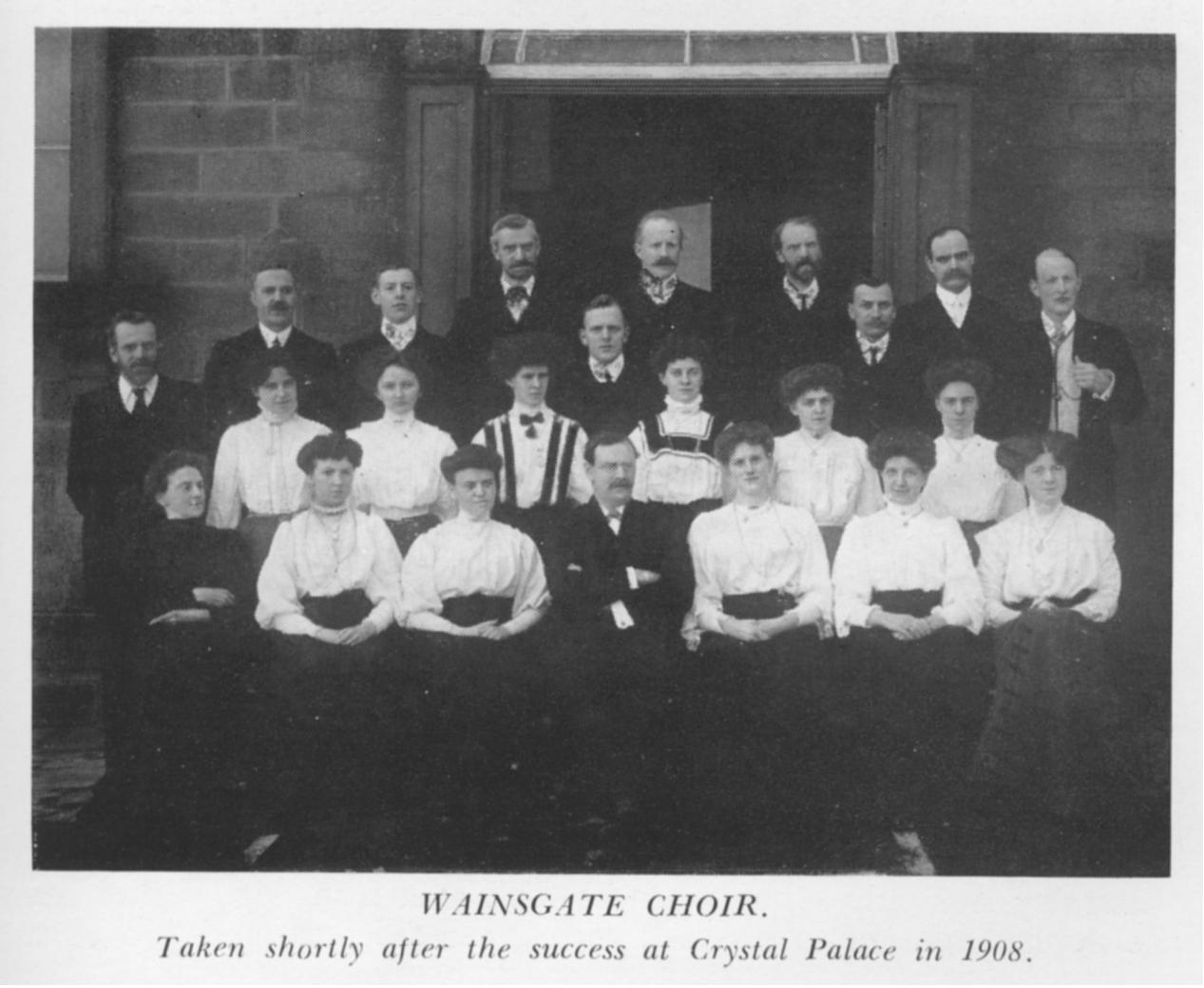
Choirmaster A.R. Ashworth is in the front row of the group photograph. The organist, J.W.Parker, is probably on the far right.
Raymond ASHWORTH (1899-1974)
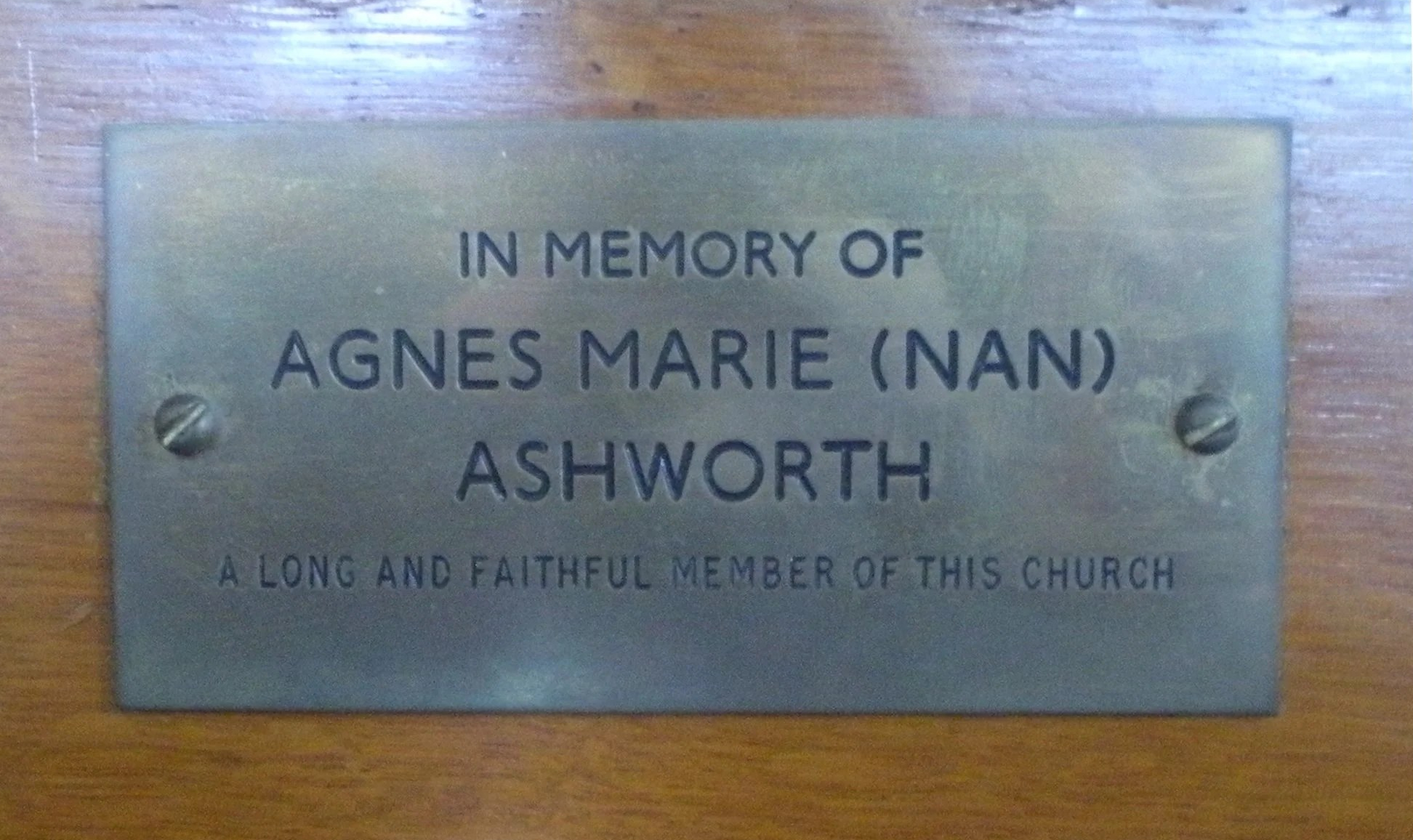
On A.R.Ashworth’s death in 1933, the congregation, unable to contemplate a future for Wainsgate Choir without an Ashworth at the helm, appointed his son Raymond Ashworth as Choirmaster, a position which he held from 1933 to 1974. Raymond and his wife Agnes Marie (Nan) Ashworth (who was born in Newcastle and whose parents were born in Plumstead, south London, and moved to Wadsworth when Agnes was a child) are commemorated with brass plaques on the front of the organ case:
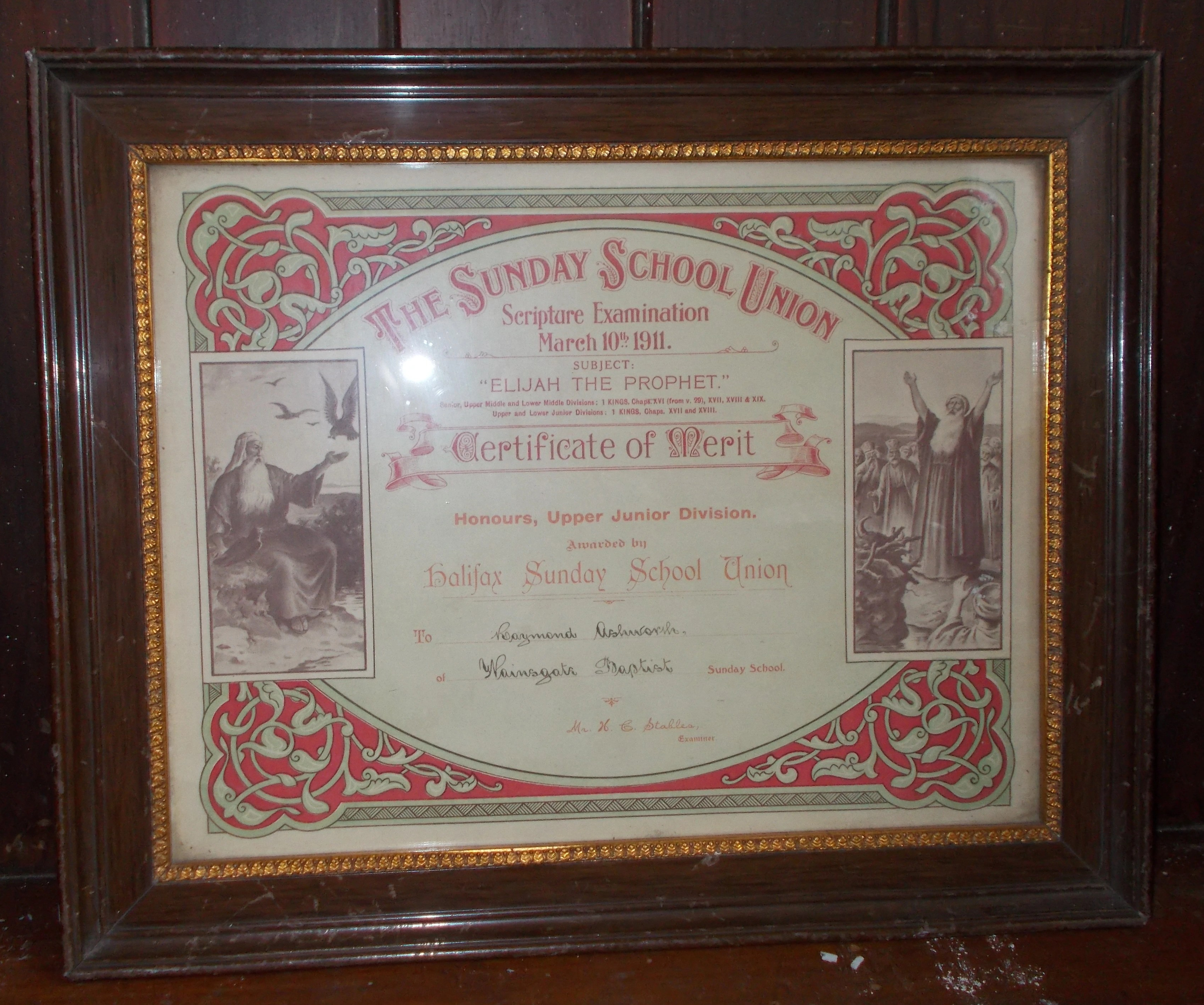

While he was a pupil at Wainsgate Sunday school, Raymond was awarded a Certificate of Merit by The Sunday School Union in 1911, and the framed certificate is displayed at Wainsgate.
Raymond’s day job was as a clerk at Hebden Bridge (later Hebden Royd) Urban District Council. In addition to his leadership of Wainsgate Choir and the Hebden Bridge Over 60s Choir, he was captain of Wadsworth United AFC (undefeated in the 1925/26 season), a stalwart member of Old Town Cricket Club since the end of WW1 (and President of the club from 1950) and the uncredited author of A Short History of the Baptist Church at Wainsgate 1750-1950. Read more about his sporting achievements here:
According to one member of the congregation, Raymond had a habit of nipping out of the back door of the choir stalls just before the minister’s sermon began: he would then call in at Old Town Bowling Club for a quick whisky before returning to Wainsgate, hopefully before the sermon ended, to continue conducting the choir.
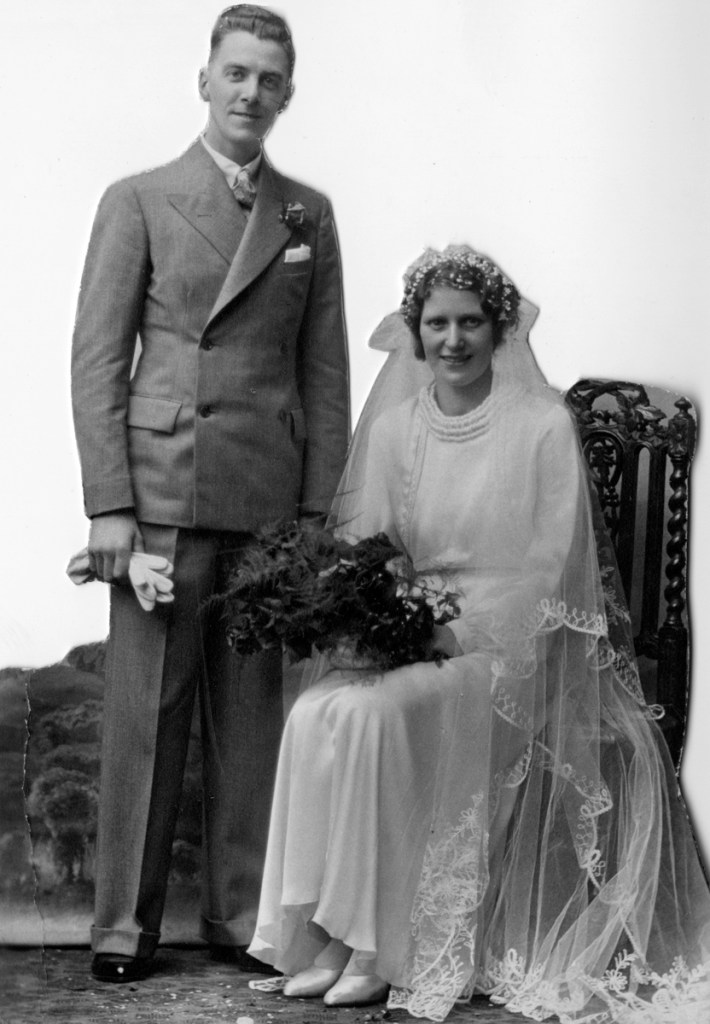
Raymond and his wife lived at 1 Stoodley View, Hurst Road. Nan Ashworth, who died in 1998 aged 93, was committed to keeping Wainsgate going through difficult times, even leading services herself when there was no minister.
Raymond and Nan had no children of their own, but are remembered as being kind and generous to young people in the Sunday school and choir – on at least one occasion they bought dresses and cardigans for children from poor families to wear for special events at Wainsgate, and they entertained some of the children in their home at Christmas.
Raymond Ashworth and Agnes Marie (Nan) Dillon were married in 1927. Photograph from the Alice Longstaff Collection, Pennine Horizons Digital Archive.
On 29th October 1950 Wainsgate hosted a Choir Day under the direction of Raymond Ashworth. Although the war had a considerable impact on the choir and congregation, there were now several new and younger members, and as well as the usual mixed choir there was a Ladies’ Choir and a Male Voice Choir, all connected with the chapel and Sunday school.
* * *
On 28th December 1969 the BBC broadcast Songs of Praise from Calder High School. Hymns were sung by people from the Calder valley, with soloist Vernon Ogden and accompanied by a section of the Hebden Bridge Band, organist Arthur Fielding and pianist James Stansfield, and conducted by Raymond Ashworth. Over 400 local people took part in the recording in the school’s theatre. Arrangements for the programme were made by a committee convened by headmaster John Muschamp and a prayer and blessing were given by Rev. R. Butterworth, Vicar of Mytholmroyd.
Raymond Ashworth was described by the local paper as ‘one of the hardest worked persons in the preparation of the programme’. When asked how he felt the recording had gone, he replied:
‘On the whole I think the singing went very well, and at times there was a lovely volume of happy sound. I was particularly pleased with the way most of the singers were able to watch the beat, which is one of the main essentials of choral singing. It showed that many choristers had gone to the trouble of memorising words and music so that they could concentrate on the conductor’s requirements’.
The programme was produced by Raymond Short of the BBC and presented by Jimmy Savile, described in the local paper as a ‘top disc jockey’, who at the time was an honorary churchwarden of the parish church of St. John the Baptist in the Wilderness, Cragg Vale.
Sir James Wilson Vincent Savile OBE KCSG died on 29th October 2011, aged 84. He was buried in Woodlands Cemetery, Scarborough – his coffin, which was encased in concrete, was buried at an angle of 45 degrees to the horizontal at Savile’s request ‘to enable him to see the sea’.
Shortly after his death, Savile was finally, despite numerous allegations during his lifetime, exposed as a serial rapist and sexual abuser of at least 500 women and vulnerable children, many of them in hospitals, schools and children’s homes where he was a volunteer or visitor. The earliest incident of abuse recorded by the police was in 1955 and his last known offence was in 2009 – the peak period of his abuse is thought to be between 1966 and 1976. The Metropolitan Police said that the scale of sexual abuse allegations reported against Savile was “unprecedented” in Britain.
The headstone on Savile’s grave carried an epitaph that he had chosen himself – ‘It Was Good While It Lasted’. In 2012 the headstone was removed, the inscriptions ground off and the black polished granite broken up and sent to landfill in a skip, leaving his grave unmarked.
* * *
The WAINSGATE CHOIR
‘Sing the Lord, ye voices all,
Magnify His name through all creation,
Celebrate His power and glory,
Let His name resound on high’
From the oratorio ‘The Creation’ by Joseph Haydn (1798)
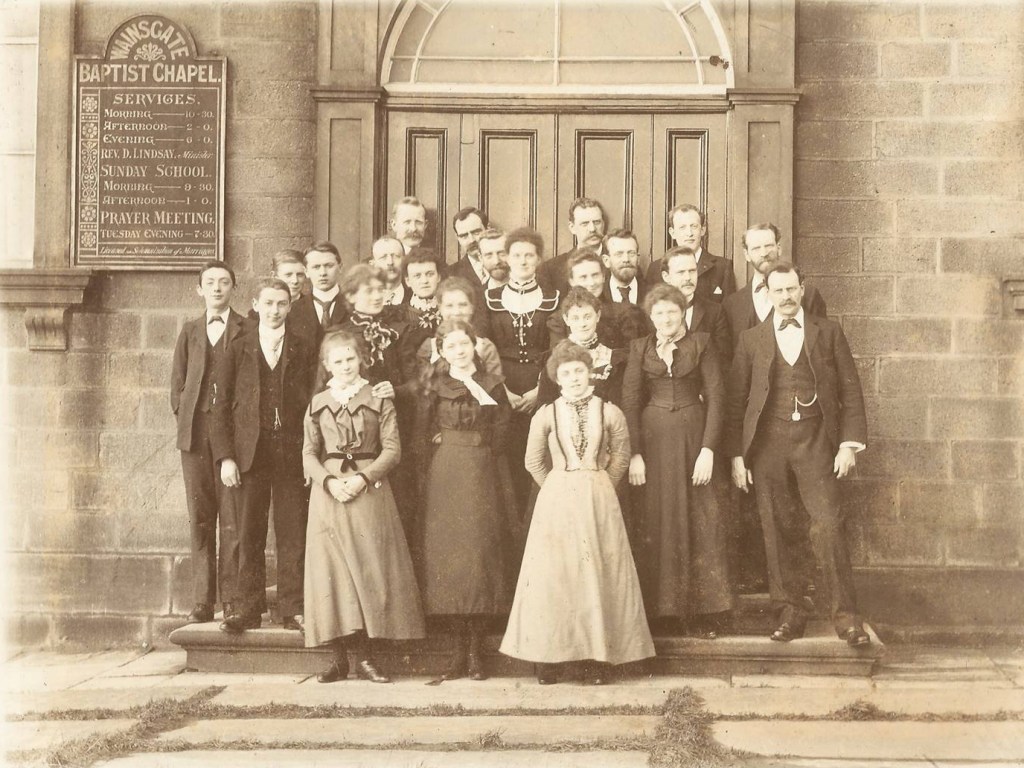
This photograph, the earliest known photograph of the Wainsgate choir, is undated, but the noticeboard says ‘Rev. D. Lindsay, Minister’ – David Lindsay was minister at Wainsgate from 1896 to 1899, although he wasn’t replaced by a permanent minister until the appointment of James Jack in 1901. Choirmaster A.R.Ashworth is on the far right of the photo. The organist at Wainsgate from 1894 was J.W. Parker, who is probably far right on the back row.
The 20th NONCONFORMIST CHOIR UNION FESTIVAL 1908.
The Festival was held at Crystal Palace on 4th July 1908. A total of ten choirs competed in two classes: Class A was for choirs of not less than 26 and not more than 40 voices, and Class B (in which Wainsgate took part) was for choirs of not less than 16 and not more than 25 voices. Each choir had to sing one ‘Test-piece’ and one piece of their own choice. The contest was adjudicated by Arthur Fagge, founder and conductor of the London Choral Society.
The Wainsgate choir were the winners of Class B: the winners of Class A were the only other Yorkshire choir taking part – Ebenezer United Methodist Church Choir from Barnsley.
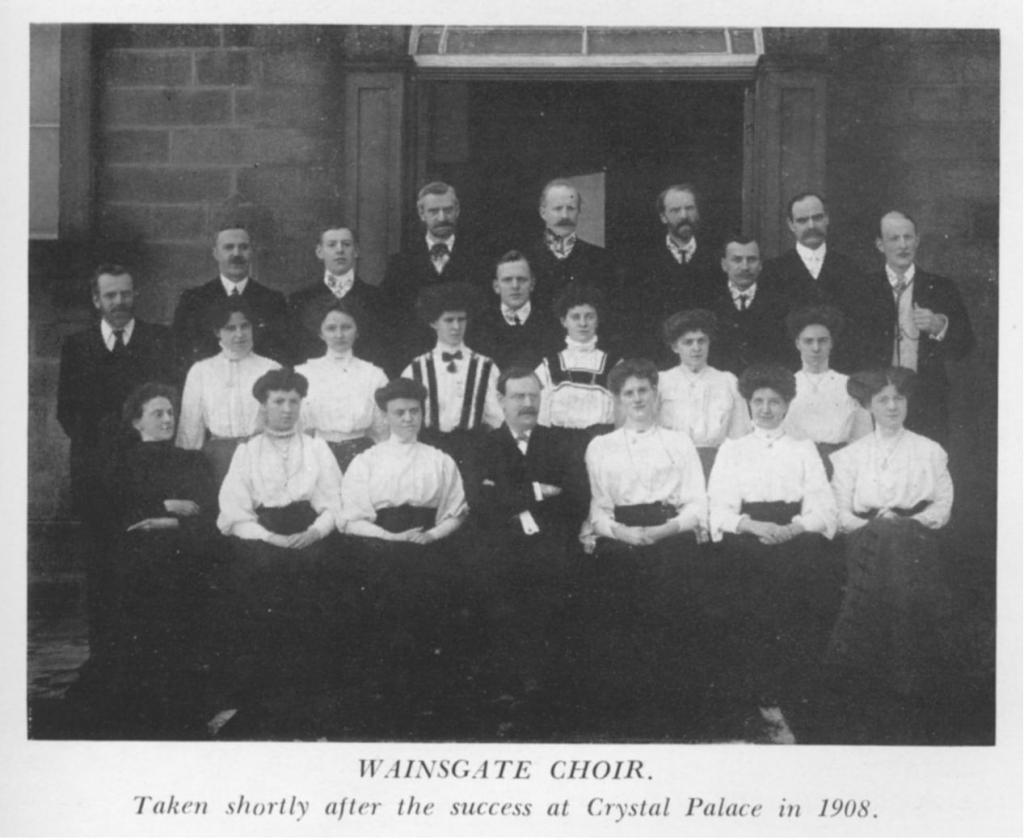
The only two people in this photograph who can be identified (there is no known record of the names of the choir members) are choirmaster A.R.Ashworth (front centre) and organist J.W.Parker (far right).
The choir travelled to London overnight to compete at Crystal Palace, went straight to the venue to sing, and travelled back to Hebden Bridge that night. The following day most of the choir members turned up to sing at the Sunday morning service at Wainsgate.
The ‘Test-piece’ that all of the choirs in Class B had to sing was ‘Unto Thee, O God’ by the Blackburn born composer and organist William Wolstenholme (1865-1931).
The other piece that the choir sang, presumably chosen by A.R.Ashworth, was ‘Three fishers went sailing’, which is credited in the report of the festival in the Musical Times of 1st August 1908 to ‘R. Rogers’ – almost certainly the organist, teacher and composer Roland Rogers (1847-1927). The text which Rogers set to music was written in 1851 by Anglican clergyman, novelist, poet and social reformer Charles Kingsley (1819-1875).
‘Three Fishers’ reflects Kingsley’s social concerns, and was inspired by his memories of living in Clovelly as a child, watching the herring fleet put to sea and knowing that there was a good chance that not all of the boats would return – thirty-one Clovelly fisherman lost their lives in a storm in 1821, and another twenty-one perished in 1838.
The poem was first set to music in 1858 by composer John Pyke Hullah, and was popular during the Victorian era and beyond: it was recorded in 1963 by Joan Baez, and again in 1982 by Canadian singer Stan Rogers, sung to an arrangement by his brother Garnet Rogers.
I have been unable to track down a recording of the Roland Rogers arrangement, but this 1980 recording is of the Hullah arrangement, sung to his own piano accompaniment by Derek B. Scott, Professor of Critical Musicology at Leeds University.
Three fishers went sailing out into the West,
Out into the West as the sun went down;
Each thought on the woman who lov’d him the best;
And the children stood watching them out of the town;
For men must work, and women must weep,
And there’s little to earn, and many to keep,
Though the harbour bar be moaning.
Three wives sat up in the light-house tower,
And they trimm’d the lamps as the sun went down;
They look’d at the squall, and they look’d at the shower,
And the night wrack came rolling up ragged and brown!
But men must work, and women must weep,
Though storms be sudden, and waters deep,
And the harbour bar be moaning.
Three corpses lay out on the shining sands
In the morning gleam as the tide went down,
And the women are weeping and wringing their hands
For those who will never come back to the town;
For men must work, and women must weep,
And the sooner it’s over, the sooner to sleep—
And good-by to the bar and its moaning.

But Men Must Work and Women Must Weep by Walter Langley (1883)
The phrase ‘the harbour bar be moaning’ refers to the belief that it was a bad omen if the tide made a moaning sound as it receded over the sand bar at the harbour entrance.
Charles Kingsley, best known as the author of The Water-Babies, was a founding member of the Christian Socialist movement and a prominent opponent of child labour. He was also a fervent Anglo-Saxonist, and held some profoundly racist views, considering Blacks, Irish, Jews and Catholics to be inferior beings.
* * *
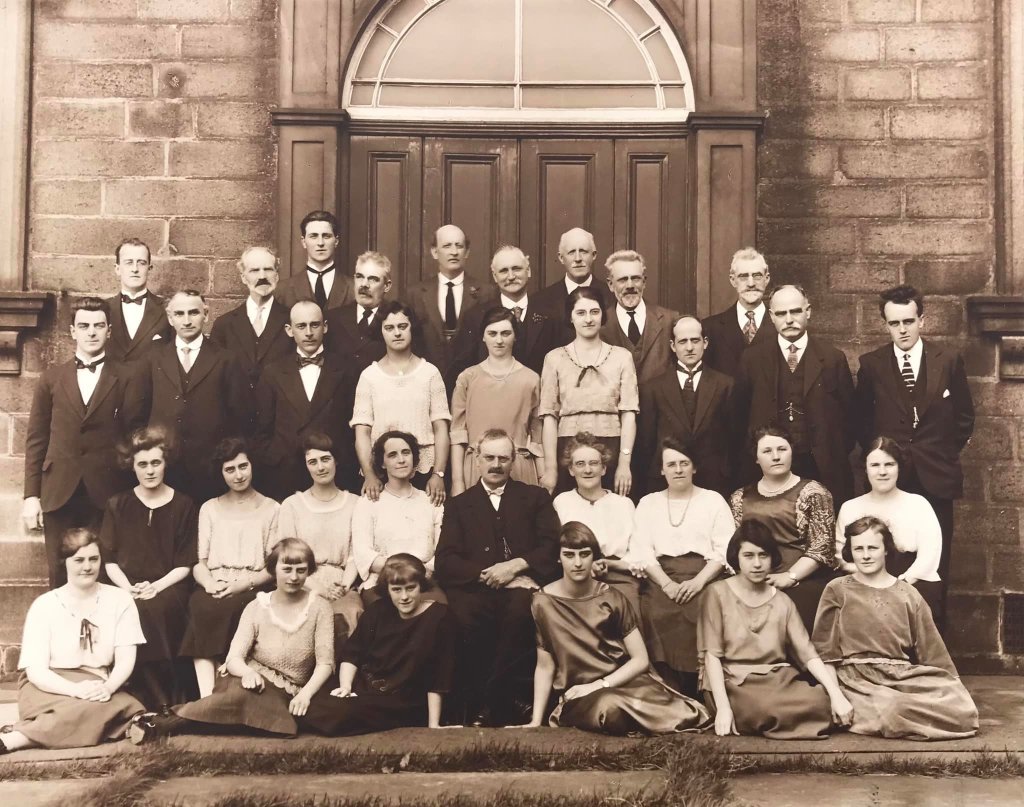
Choirmaster A.R.Ashworth is seated in the centre: his son Raymond Ashworth is far left on the third row, and another son, Harry Norman Ashworth is at the left on the back row: the young woman directly behind him may be his daughter Gracie. Harry Haigh is far right on the third row and his brother Edward Haigh is far left on the fourth row. Eddison Sunderland third from right on the third row. Far left on the second row is Eva Sutcliffe (who married Edward Haigh in 1929), and the young woman next to her could be her friend Phyllis Arundel. The organist, J.W.Parker, is presumably in the photograph, and is probably in the centre of the back row. The man in the fourth row, third from the left, may be Hird Thomas.
(Thanks to Susan Earnshaw for identifying several people in the photograph).
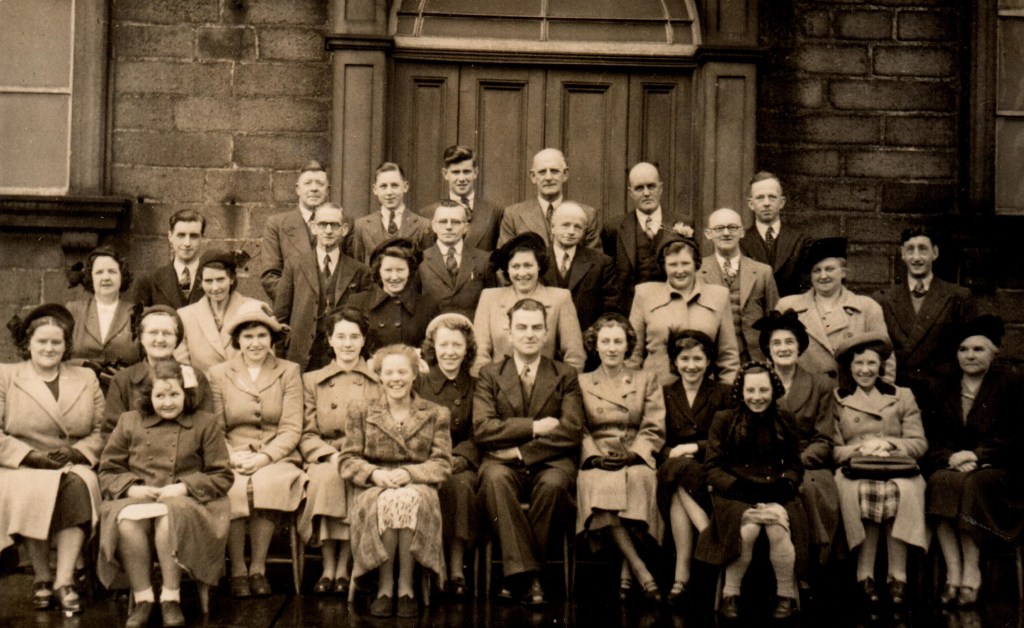
Choirmaster Raymond Ashworth is front centre, but the names of the other members of the choir are not recorded. If anyone can date the photo or put names to any of the people in it, please let us know.
The chap on the back row, second from the right, looks like Harry Haigh. Fourth row, second and third from left are almost certainly Fielden Hirst and Tommy Jones. Kenneth Crowther is far right on the second row, and sitting in front of him is Mrs Horsfall. Sitting next to Raymond Ashworth is Marjorie Jackson (who may by now be Marjorie Crowther – she married Kenneth in 1952).
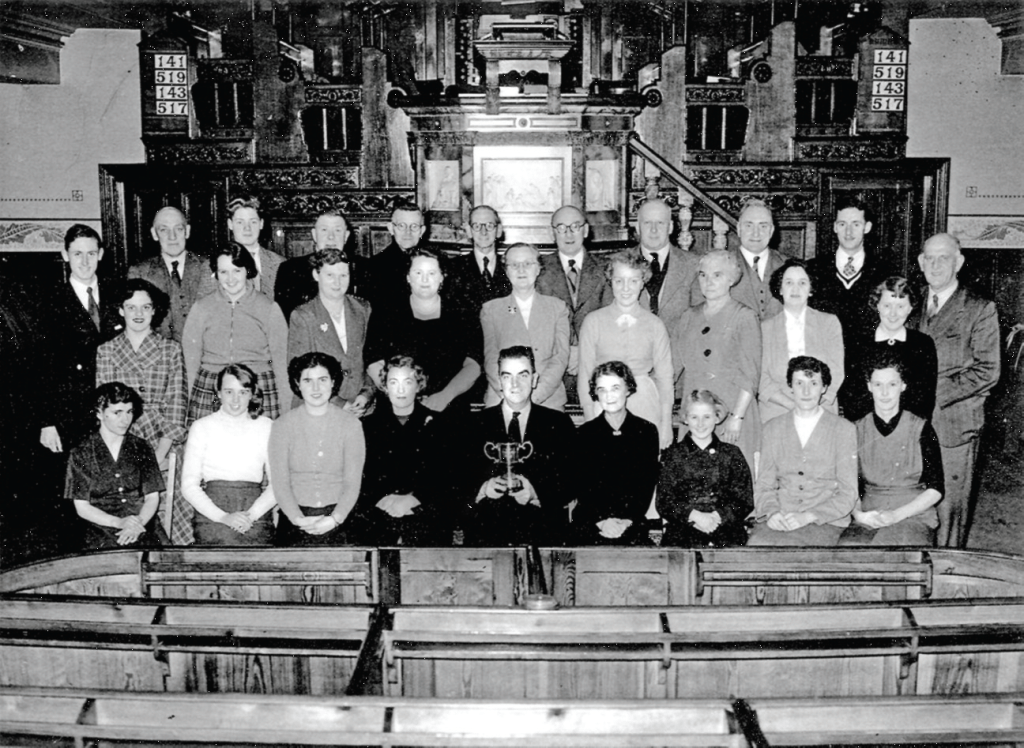
Wainsgate choir 1956: Conducted by Raymond Ashworth, the choir was very popular, singing at most of the chapels in the area, and winning several trophies.
Back row: Raymond Gibson, George Hall Greenwood, Richard Gibson, John Charnley, Tommy Jones, Fielden Hirst, Wilfrid Cotton, Tom Sutcliffe, Norman Brooks, Ken Crowther, Herbert Horsfall. Middle row: Kathleen Lumb, Judith Crossley, Eva Gibson, Florrie Varley, Dorothy Greenwood, Marjorie Jackson, Jane Horsfall, Mabel Crossley, Mary Mortimer. Front row: Lily Harley, Margaret Speight, Dorothy Young, Lumina Edmonson, Raymond Ashworth, Cissie Vian, Sylvia Gibson, Edith Storey, Edna Storey.
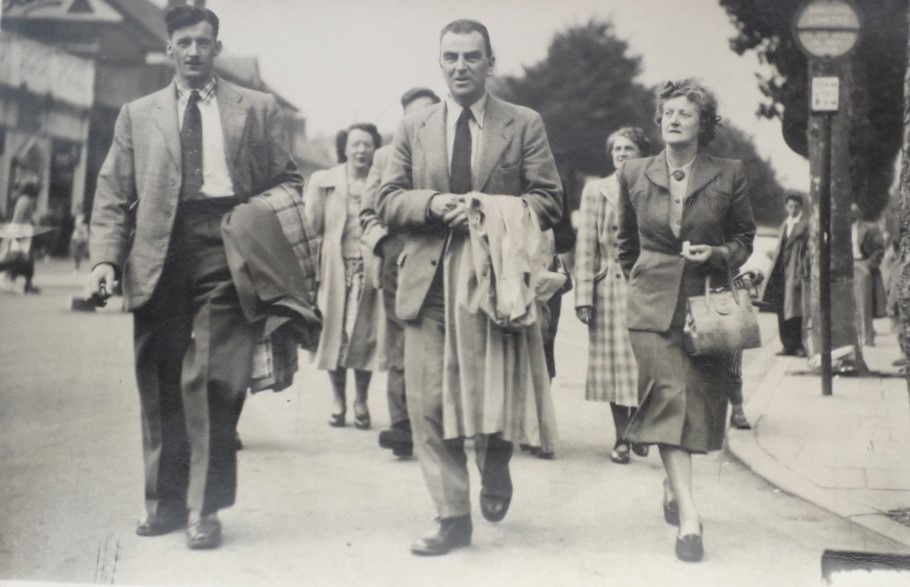
The choir travelled to Blackpool and other towns on several occasions to take part in concerts and competitions: this photograph was taken at either Blackpool or Skegness (possibly on one of these trips, or maybe it was just a jolly to the seaside), but the date is unknown. Raymond Ashworth is in the centre, Kenneth Crowther on the left, and Marjorie Crowther behind them.
(Thanks to Kay Deighton for the photograph).
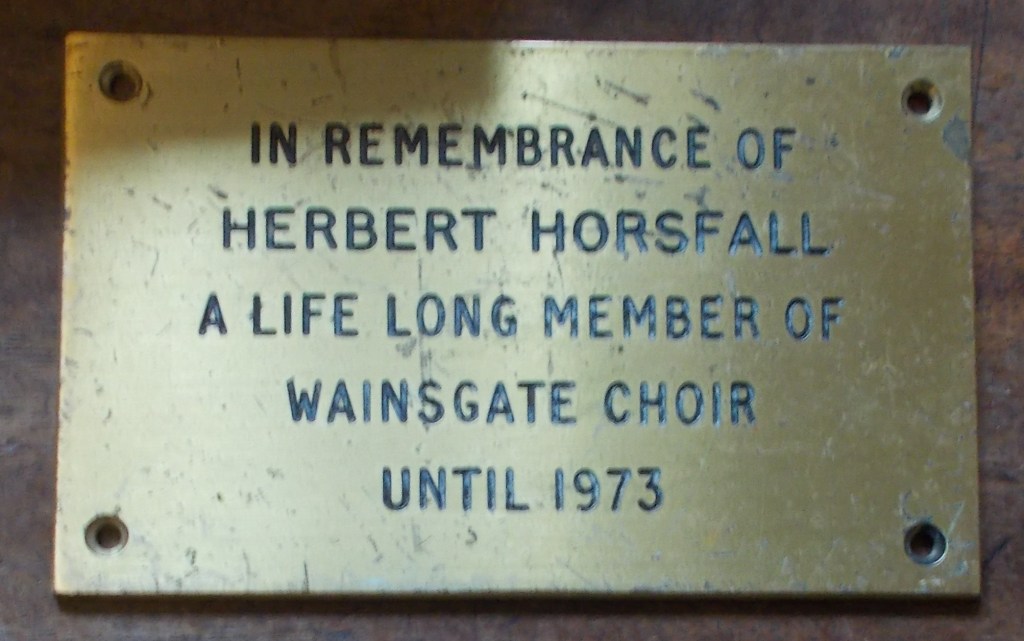
Herbert Horsfall appears in the 1956 choir photograph above, and was also a member (bass) of the choir which made the HMV recording in 1951. Although he is not buried at Wainsgate, he is commemorated by a small brass plaque (not fixed, but found amongst the Wainsgate documents and artefacts retrieved from the Historic Chapels Trust in 2018).

Another photograph of the choir, led by Raymond Ashworth. A framed copy hangs in the Sunday school at Wainsgate, but the date and names of the choir members are not recorded. If anyone can date the photo or put names to any of the people in it, please let us know.
Second from the left standing in the pulpit looks like George Hall Greenwood, and the chap with glasses on the pulpit steps is Fielden Hirst.
The 1951 HMV RECORDING
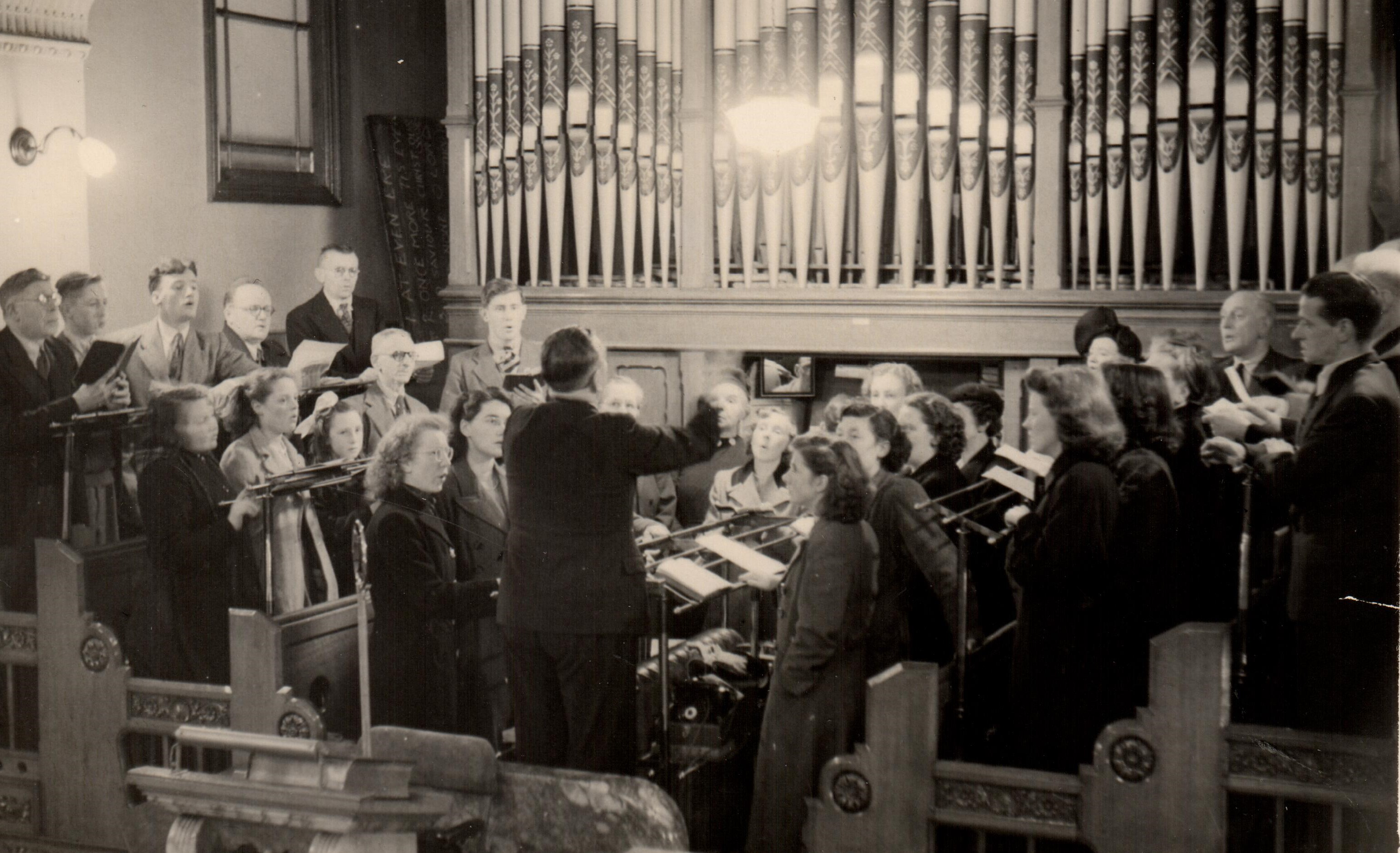
In 1951 a mobile recording unit from HMV visited Wainsgate and recorded two 78 rpm records of the choir singing four pieces ‘carefully chosen to display the choir’s finely blended tone’.
A 12″ disc (C4096) with John Fawcett’s‘Blest is the tie that binds’ and the hymn ‘At even ere the sun was set’ by Henry Twells included a short introduction (reported to have been written by Raymond Ashworth) read by Rex Palmer. A 10″ disc (B10084) contained the anthem ‘Come unto Him’ by Gounod and the hymn‘Now, on land and sea descending’ by Samuel Longfellow and G.F. Handel.
(A copy of the 12″ disc and a digital copy on CD are kept at the HBLHS Birchcliffe archive).
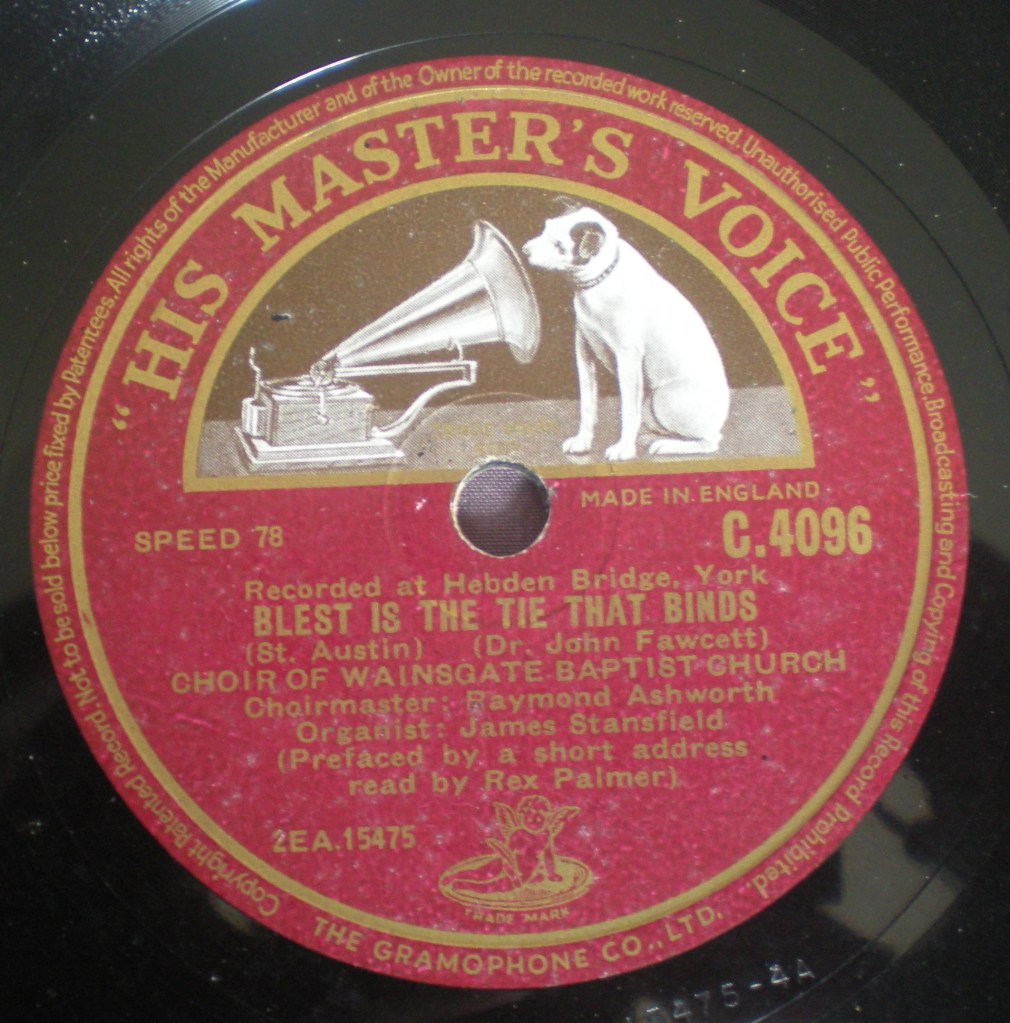
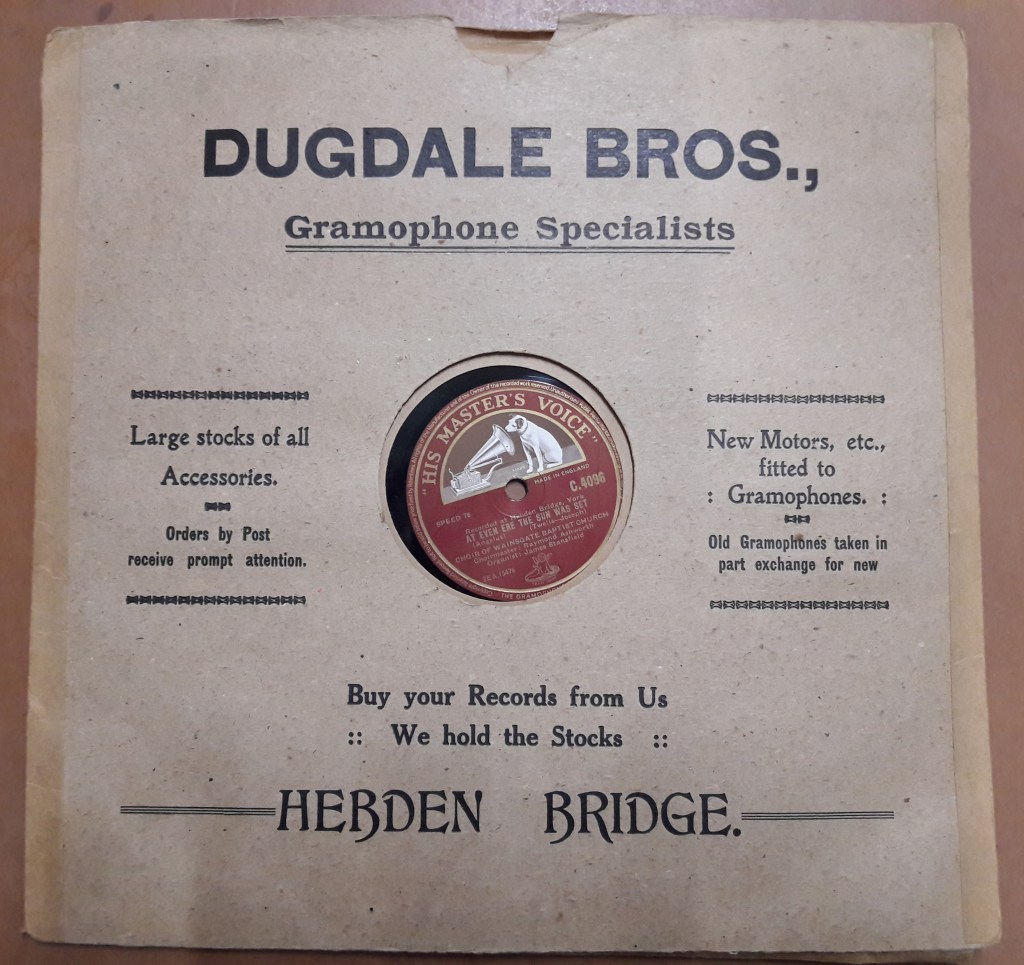
Listen to the 12″ disc here:
The recordings were made using two microphones in the chapel (visible in the photos below) and the master tapes were recorded in a van parked in Wainsgate Lane (pictured right), supervised by HMV’s musical director Lawrance Collingwood.
Each recording took a few attempts, and the whole recording session lasted over three hours, although the total running time of the two discs amounts to only about 17 minutes in total.
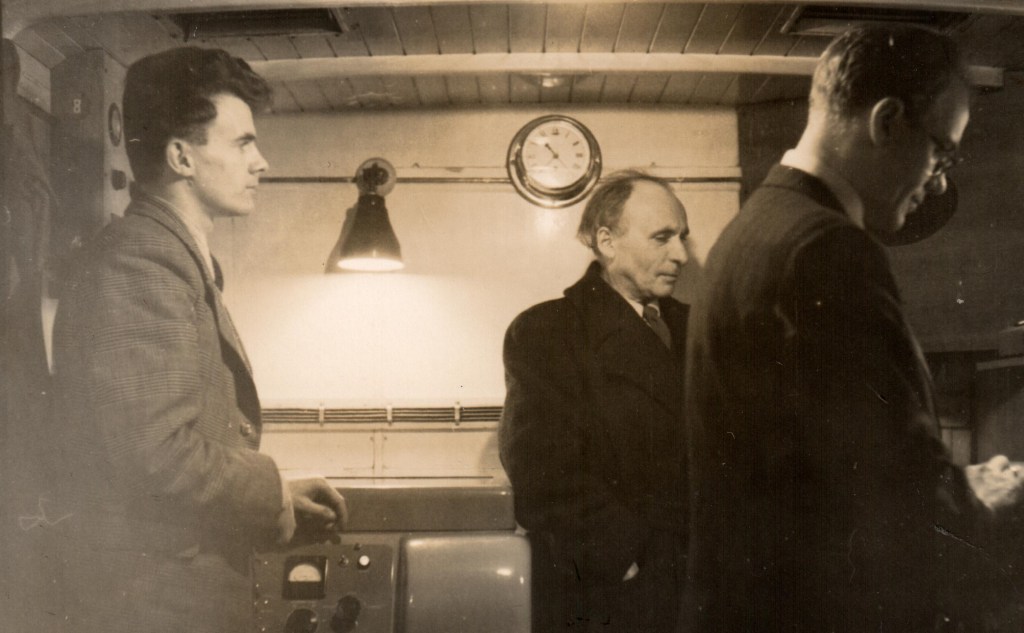
In those days the time limit for a recording on each side of a 10-inch record was 3 minutes 42 seconds, and for a 12-inch record, just under five minutes per side.
The local paper reported that:
‘The choir sang one of the hymns for trial purposes, and were somewhat surprised to learn they had taken too long. However, with their able and energetic conductor, Mr Raymond Ashworth, to lead them, the choir adjusted themselves creditably and contrived to perform the exacting task of singing near perfection in a specified time’.
His Master’s Voice Record Review (June 1951) described the Wainsgate choir in glowing terms:
‘The thirty members of the Wainsgate choir are non-professional, rehearsing in the evenings after their work. They have not only good voices but possess that inner understanding which converts a hymn into a profound spiritual experience’.
The members of the choir were listed in the local paper as:
Basses: H.Haigh, H.Horsfall, H.Dewhirst, A.C.Durrant, W.Cotton, J.Butterworth, S.Butterworth, T.Sutcliffe. Tenors: J.W.Charnley, R.Gibson, F.Hirst, T.Jones, L.M.Goldthorp, K.Crowther, B.Sutcliffe. Contraltos: M.Crossley, M.Mortimer, A.Sutcliffe, L.Edmondson, E.Longbottom, M.G.Greenwood. Sopranos: L.Harley, J.Young, D.Young, F.Varley, C.Vian, G.Durrant, J.Horsfall, P.Horsfall, I.Smith, D.Sowden, M.Jackson, P.Lumb, J.Crossley, L.Durrant.
The choir was conducted by Raymond Ashworth and the organist was James Stansfield.

John William PARKER (1874-1954)
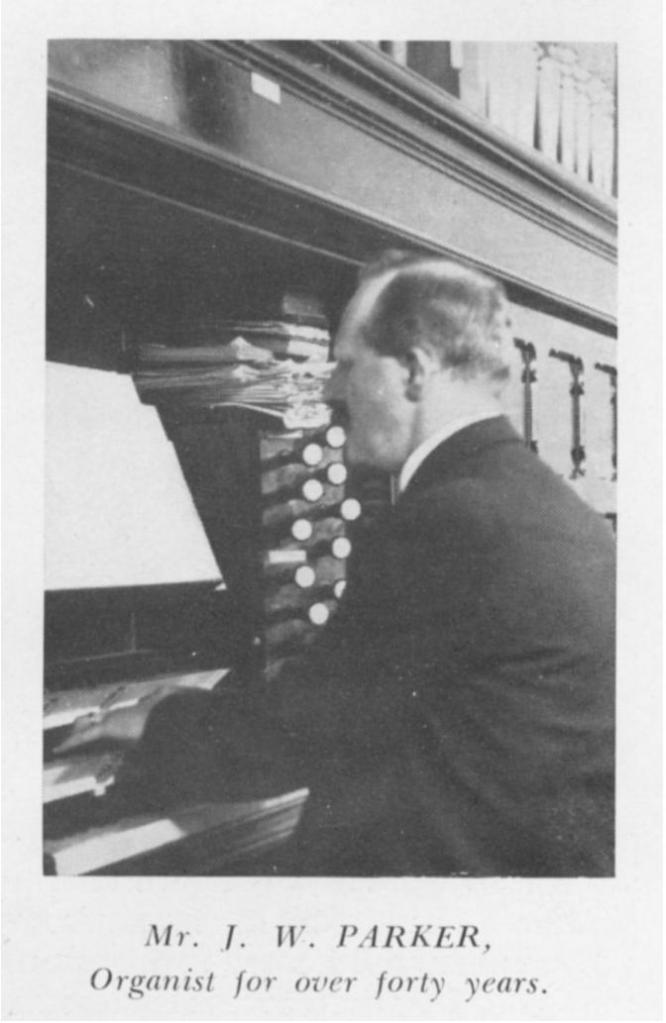
Organist at Wainsgate from 1894, when he took over from Albert Richard Ashworth, until 1932, when he was replaced by eighteen year old James Stansfield. He had been involved with the church and Sunday school from an early age, and was taught the organ by Tom Parker of Todmorden. He accompanied the choir at their prize winning 1908 Crystal Palace performance, and also came out of retirement to cover for his successor when he was called up for war service. He served under five ministers, and it is estimated that he played at over 4,000 services. He was also a Trustee of the chapel, Treasurer of the General Repairs Fund and a member of the Graveyard Committee.
He is buried in plot B1172/177a with his parents John and Ann Parker, his wife Sarah (born Greenwood), daughter Greta Mary Whiteley and son William Roy Parker who died in 1912 at the age of four.
The occasion of his retirement was marked by a presentation in the Sunday school room. The presentation coincided with the Operatic Society’s annual performance, and was presided over by Dennis Collinge. It had been agreed at the last church meeting that J. W. Parker should be made an ‘honorary life organist’, and he was presented with a key so he could have free access to the organ at any time. He was also presented with a timepiece, engraved with the inscription:
‘Wainsgate Baptist Church, March 5 1932, presented to Mr J. W. Parker, as a token of appreciation for his services as organist for the past 37 years.’
The timepiece was presented by veteran choirmaster Albert Richard Ashworth, who quoted Charles Lamb in his presentation speech:
‘He has done more than achieve success: he has deserved it’.
James Stansfield (who was also a piano teacher and music teacher at Calder High School) was succeded as organist at Wainsgate in 1948 by Colin Charnley, who in 1949 was replaced by Raymond Nash (who died in 2015, aged 96). George Hall Greenwood was subsequently organist for over twenty years until 1974.
The organist from 1974 is believed to be Alan Littlewood, who died in 2023 aged 86. He is buried at Wainsgate in Plot I893, with his wife Christine and their son Charles Edward Littlewood, who died in 1872 aged just eight months.
George Hall GREENWOOD (1892-1974)
Born in Hebden Bridge, his father Thomas Greenwood was a Fustian manufacturer whos company, T. Greenwood & Co Ltd was one of the clothing firms that in 1901 combined with local dyers Moss Bros. Ltd to form the English Fustian Manufacturing Co Ltd. The individual companies continued to be run by their original owners, and the ex-owners of the larger companies formed the board of directors of the parent company.
George started working at John Hiltons, Salem Mill, as an office boy, in 1908, and spent his entire working life with firms that were part of the English Fustian Manufacturing Co Ltd until his retirement in 1968 – he had been a director of the company since 1931.
Photo from the Alice Longstaff Collection, Pennine Horizons Digital Archive.
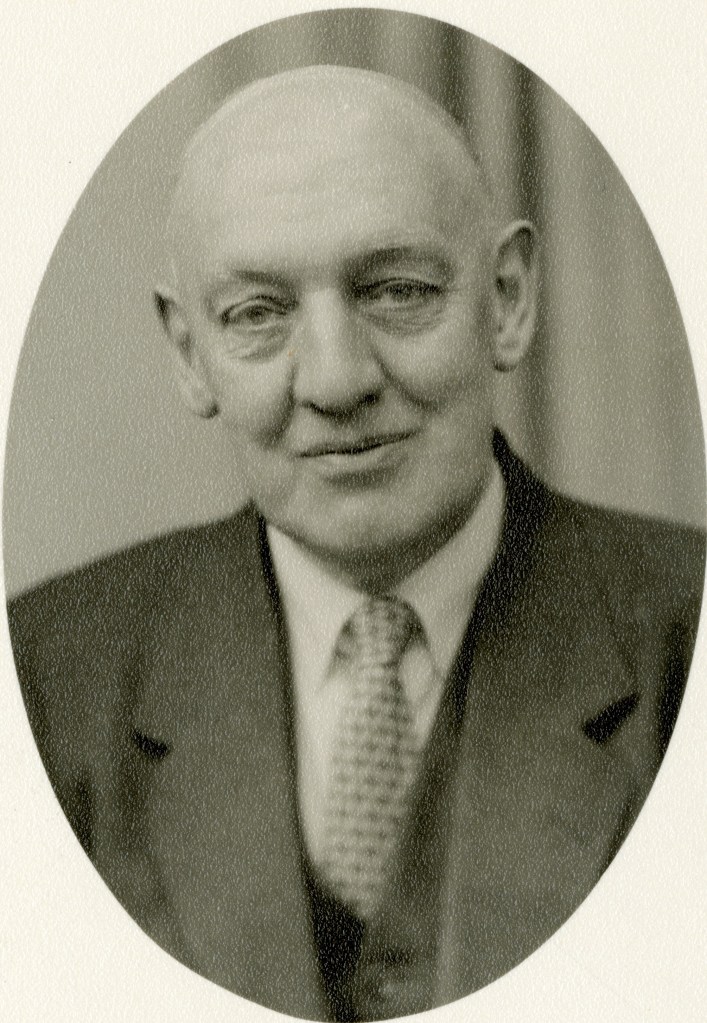
He served in France as a corporal with the Royal Artillery during WW1, and after being demobilised in February 1919 joined R. Sutcliffe & Co, Melbourne Works as a commercial traveller, later becoming sales manager. In April 1919 he married Lilian Hodgson at Nazebottom Baptist Chapel.
Following his retirement in 1968, he wrote a brief history of the English Fustian Manufacturing Co Ltd and his experiences of working there, which is published in The Clothing Industry of Hebden Bridge: selected texts – Edited by Nigel Smith & Diana Monahan (Hebden Bridge Local History Society, 2018).
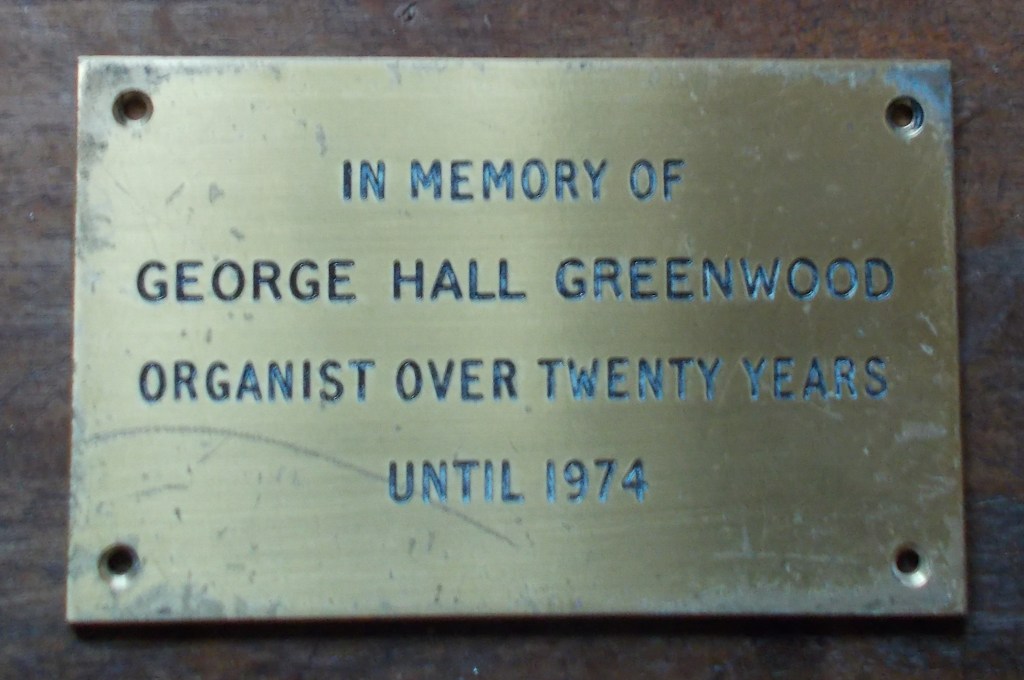
George Hall Greenwood was organist at Wainsgate for twenty years until his death, aged 81, in January 1974. He also appears in a photograph of the choir dated 1956 and also in another undated choir photograph. Although he is not buried at Wainsgate, he is commemorated by a small brass plaque (not fixed, but found amongst the Wainsgate documents and artefacts retrieved from the Historic Chapels Trust in 2018).
Hird THOMAS (1870-1942)
The son of John and Ann (born Hird) Thomas, he was brought up at Old Hold and Dick Ing farms. He was the organ blower at Wainsgate, a position he held devotedly from the installation of the organ in 1891 until its electrification 46 years later in 1937. He was almost blind (the 1921 census records him as being ‘of no occupation – totally blind’), and was said to have a ‘complete and childlike faith which supported him all his days’.
When on his death bed he was asked about his attitude to approaching death, his confident reply was apparently ‘It’ll nowt be like dorfin’ mi coit’. He didn’t marry, and is believed to be buried with his parents, although the grave (plot F734) is unmarked.
THE WAINSGATE ORGAN
The magnificent organ at Wainsgate is unusual for a Nonconformist chapel, and reflects the importance of Wainsgate’s musical tradition. It was installed in 1891 and built by Wordsworth & Co. of Leeds (founded in 1866 as Wordsworth & Maskell) at a cost of over £500. A newspaper report of the unveiling of the organ described it as follows:
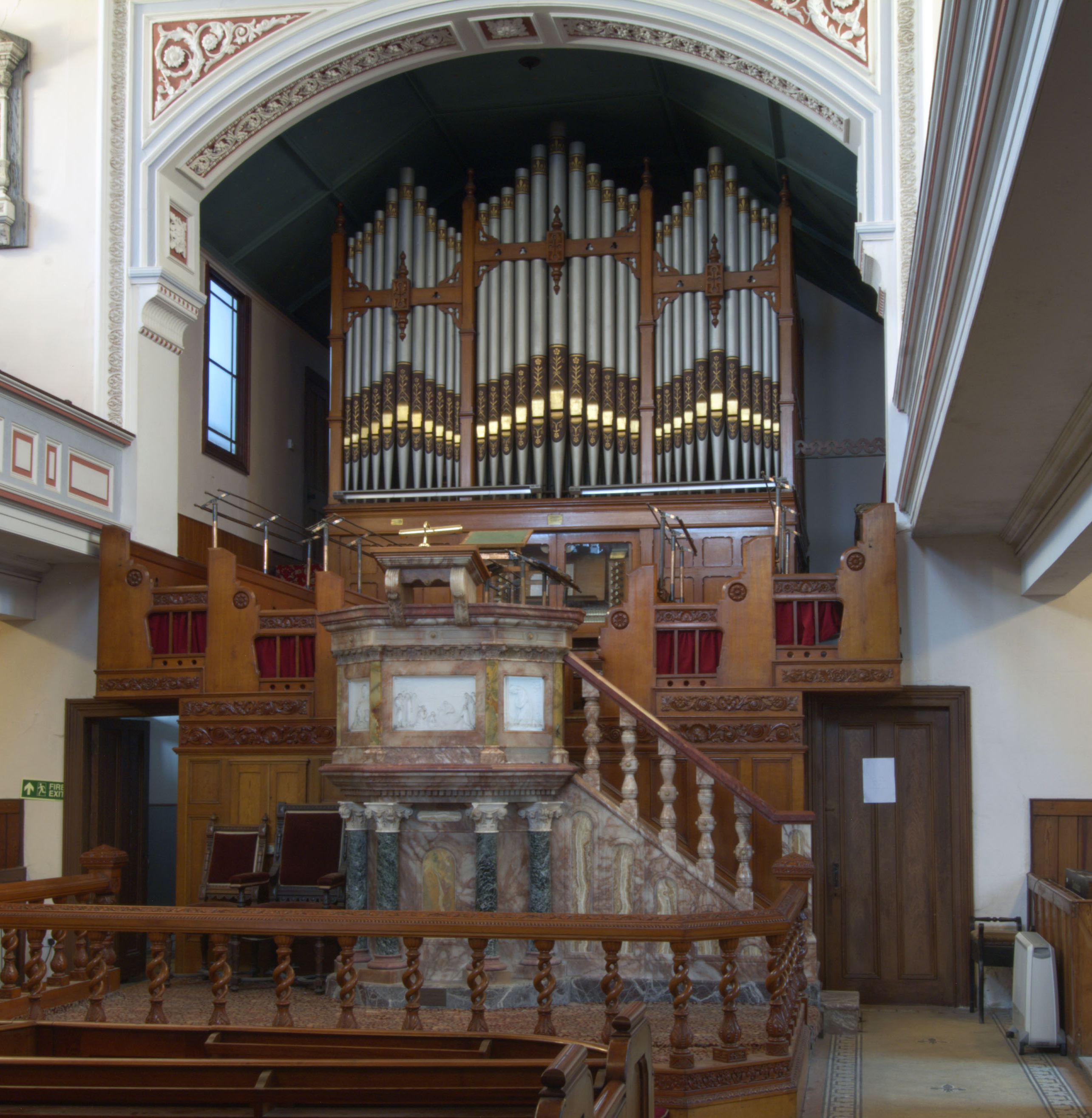
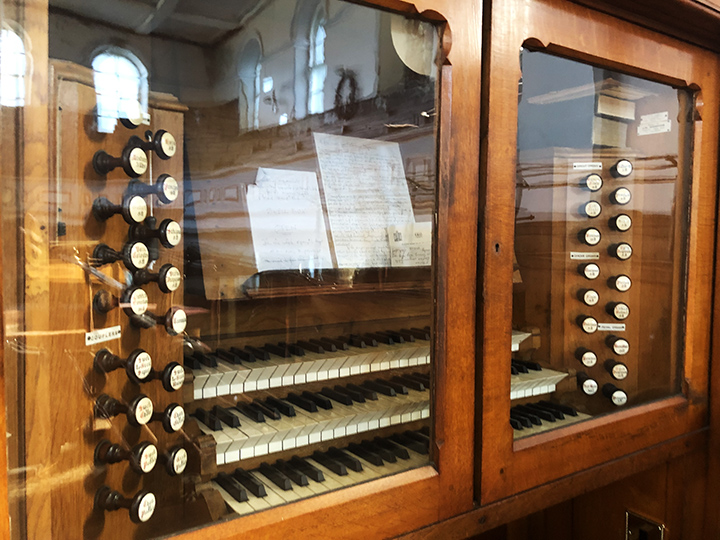
‘The case is of polished oak, and the front is beautifully picked out with gold embellishments, and presents a very ornate and chaste appearance…….The keys are of the best ivory and ebony, and the names of the stops are engraved on ivory shields inserted in rosewood knobs…….the pipes are of carefully adjusted proportions and finely voiced, being tuned on the system of equal temperament, and have purity as well as sweetness of tone. The metal pipes are of the best spotted metal, and the front pipes of the best Belgian zinc…….the ground tone is full and sweet, and the solo stops are devoid of shrillness, and are beautifully soft imitations of their orchestral prototypes’.
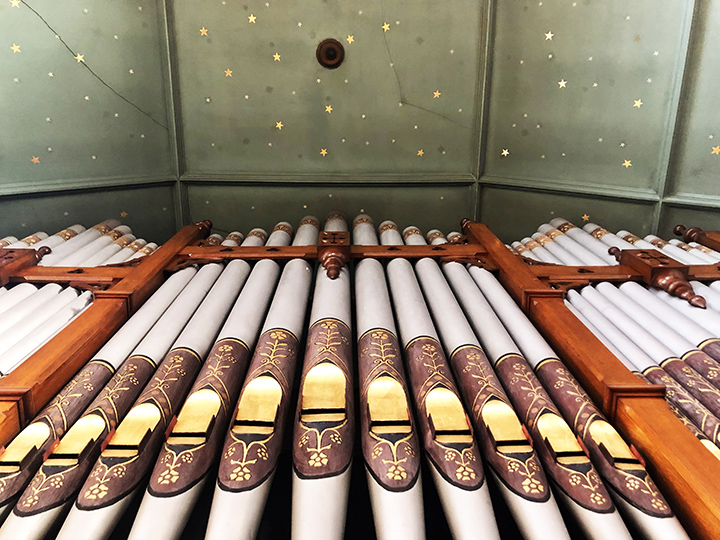
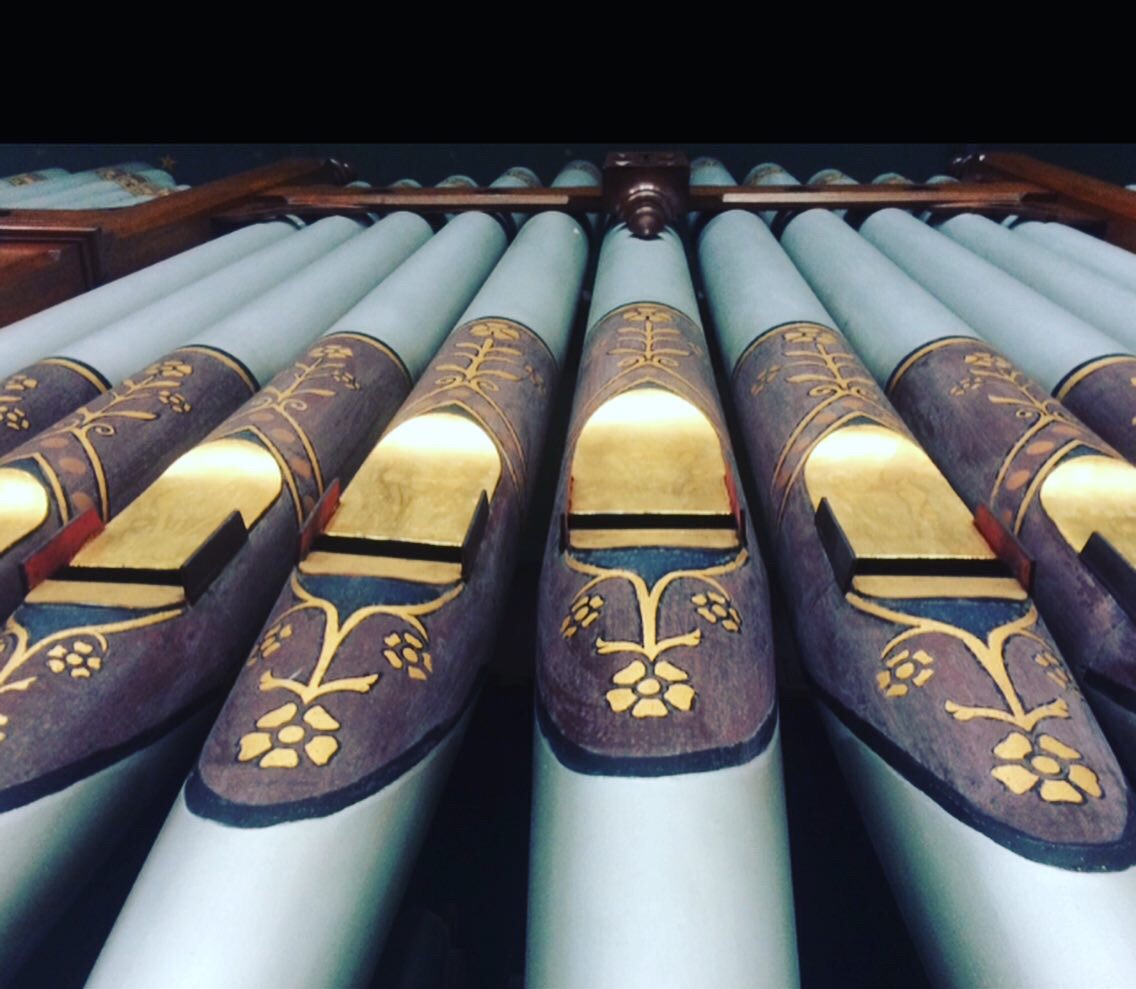
Photos of the organ by Charlie Morrissey and Geoff Matthews
In 1900, Wordsworth & Co. became Wood Wordsworth & Co. Ltd, which in 1981 became Peter Wood & Son Organ Builders Ltd., based in Harrogate. The firm still tunes and maintains the Wainsgate organ, and perhaps one day there may be money available for them to carry out a full restoration to bring the organ back to its former glory.
Before the organ was installed, the choir was originally accompanied by stringed instruments, which were replaced by a harmonium, installed in 1866 and played by James Ashworth and his brother Albert Richard Ashworth. The new organ was initially played by Albert Richard Ashworth until 1894 when he resigned in order to devote more time to his duties as Choirmaster and was replaced by John William Parker. The installation of the organ involved remodelling the north end of the chapel to form a large organ loft in a recess between the chapel and the Sunday school, which contained the organ and new choir stalls. The remodelling meant that the minister’s accommodation was largely demolished, and a new manse (‘Cousinville’) was built for Wainsgate by the Mitchell family.
The opening of the new organ in March 1891 was marked by a recital and a musical service. The organist for the recital was Irvine Dearnaley, a renowned organist from Ashton-under-Lyne: his repertoire included his own composition ‘Jerusalem the Golden’, Meyerbeer’s ‘Santa Maria‘ and Bach’s Toccata and Fugue in D minor. The choir was conducted by James Ashworth, with Mrs Carter as solo vocalist. The recital, which lasted about two hours, and was attended by around 230 people, was brought to a close by Rev. George W. Wilkinson pronouncing the benediction. The musical service the following day was also well attended, despite the wet weather, and on this occasion the organ was played by Mr E. R. Dickenson. The choir was conducted by James Ashworth, and the soloists were Miss Ashworth, Mr E. Ashworth, Mr William Ashworth and Mrs Sutcliffe. The recital and service raised around £30 for the organ fund.
* * *
The detailed specification of the organ below is taken from Wainsgate Baptist Chapel West Yorkshire: a History and Guide (Appendix III). See BIBLIOGRAPHY for details.
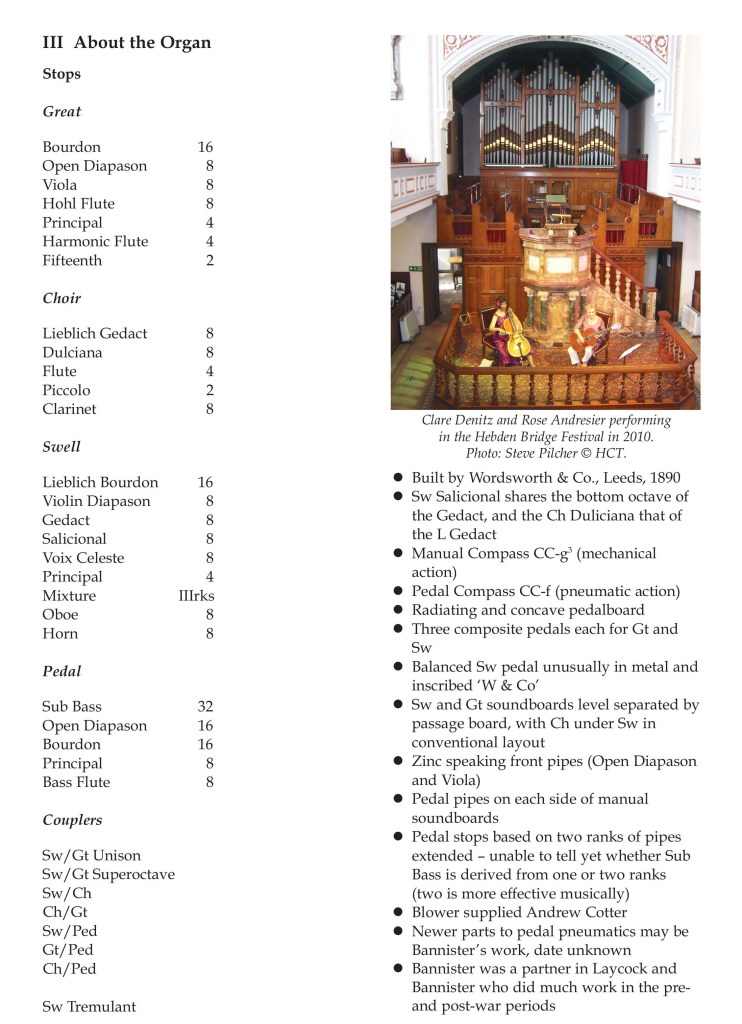
The organ was inspected by John H. Bowles, organ adviser to the Historic Chapels Trust in September 2007. He produced the notes and list of stops (above), and his report included the following comments:
‘This is quite a substantial instrument with 26 speaking stops. The touch of the keys is light and responsive even when all manuals and pedals are coupled together. The tone of many ranks is very good – as one would expect from this builder, and what one would expect a church with as strong a musical tradition as Wainsgate to buy’.
‘The organ benefits from its excellent position, with its Swell box close to the plaster ceiling’.
‘A feature of interest is the series of handwritten notes by a former organist pasted onto the music desk of the console, which explain which are the solo stops and when not to use them, and reminding organists to leave the Swell box open etc. All very sound advice which must be kept’.
‘This is an organ which deserves attention and to be regularly played It would certainly handle most of the repertoire convincingly. It is one of those organs which invite you to play it!’
The following recordings are of local organist Ted O’Hare playing the Wainsgate organ in 2020. The organ is regularly tuned, but is in need of repairs and refurbishment (likely to cost well in excess of £100,000) to bring it up to concert standard and restore it to its former glory.
The organ has been played several times at funeral services, open days and other events by renowned organist Darius Batiwalla, Leeds City Organist, soloist with the Hallé and London Philharmonic Orchestra and teacher of improvisation at the Royal Academy of Music.
John KITCHEN (1825-1895)
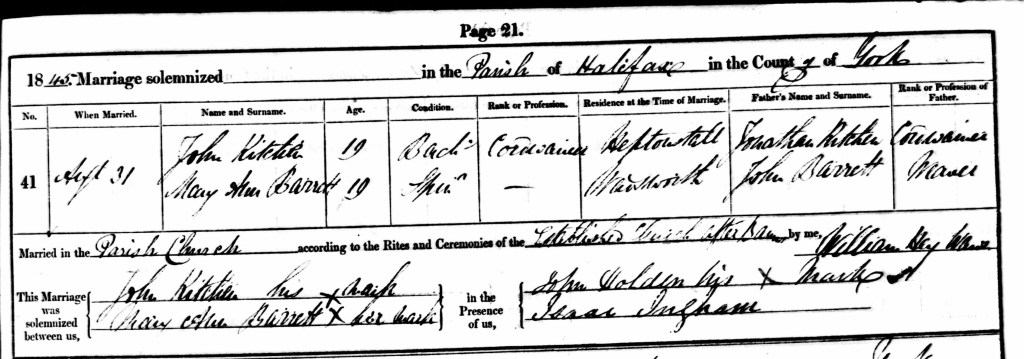
John Kitchen was the son of Susey and Jonathan Kitchen, a shoemaker from Heptonstall. John initially followed his father’s trade: he married Mary Ann Barrett in 1845 aged 19, and the marriage certificate describes John and his father as cordwainers (a cordwainer is traditionally someone who makes new shoes, as opposed to a cobbler who repairs shoes). Interestingly, both John and his wife signed the marriage certificate with a mark, implying that both were illiterate.
The 1871 census records him as a ‘shoemaker and teacher of music’ living in Foster Mill Lane, in 1881 he was a ‘music seller’ living in Carlton Street, and in 1891 he was a ‘shoemaker and music teacher’ living at 14 Albert Street. John and Mary Ann had no children of their own, but brought up a neice, Phoebe Sutcliffe. John Kitchen died aged 69 on 28th June 1895 at 14 Albert Street, and is buried at Wainsgate (plot B276a) with Mary Ann and Phoebe. His funeral service at Wainsgate was attended by around 200 people.
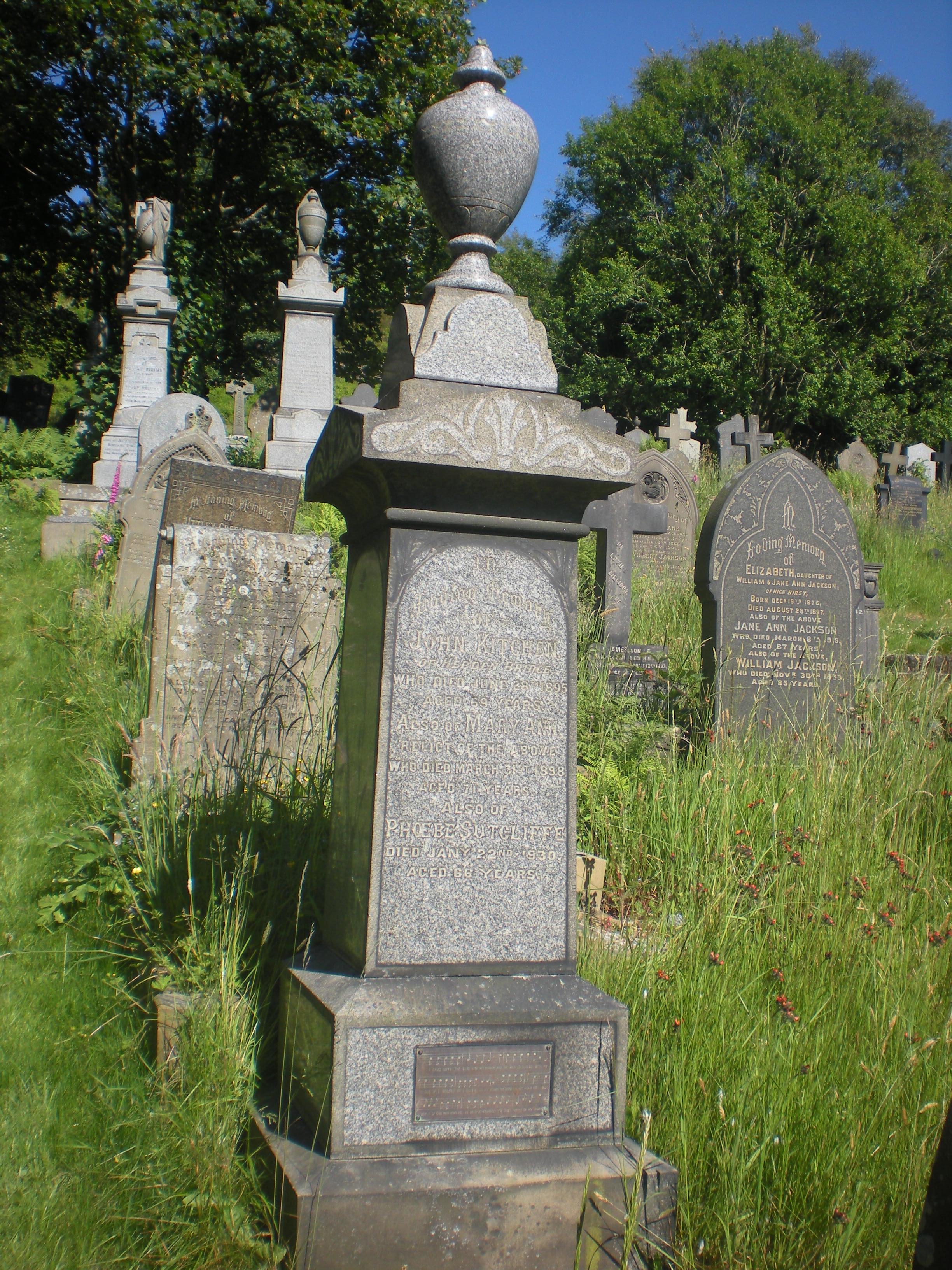

Their grave is marked by an imposing granite monument which has a brass plaque fixed to the base engraved with text from Psalms 66 : 17-19 and notation for a simple musical accompaniment (presumably written by John Kitchen).
‘I cried unto the Lord with my mouth, and he was extolled with my tongue. If I regard iniquity in my heart, the Lord will not hear me: but verily God hath heard me: he hath attended to the voice of my prayer’.
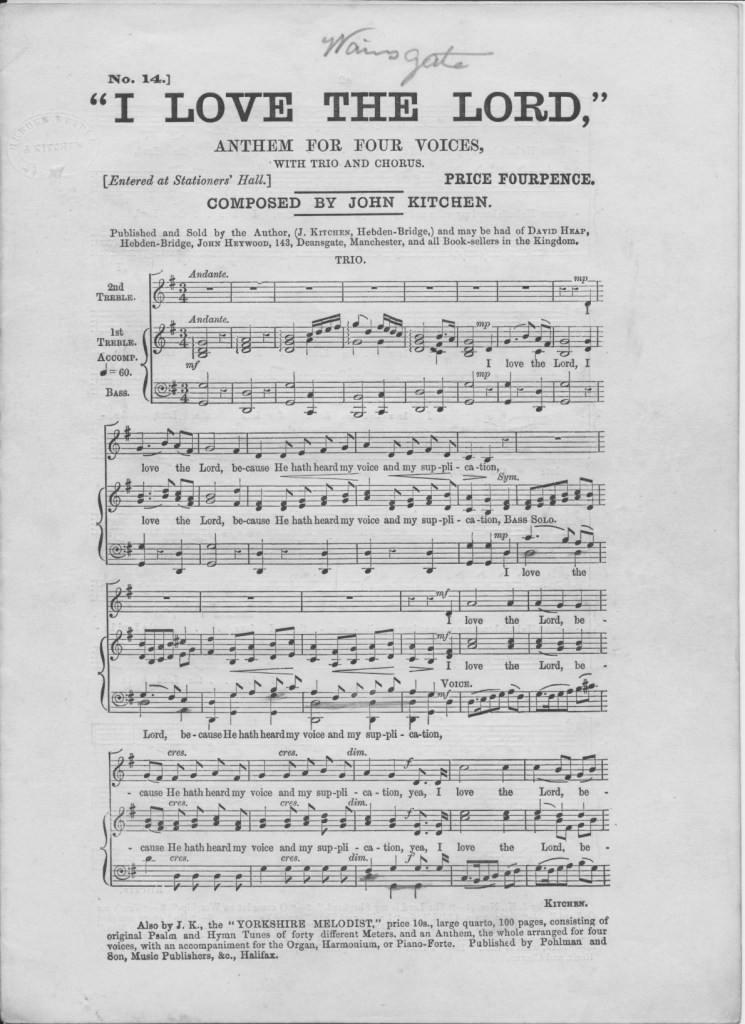
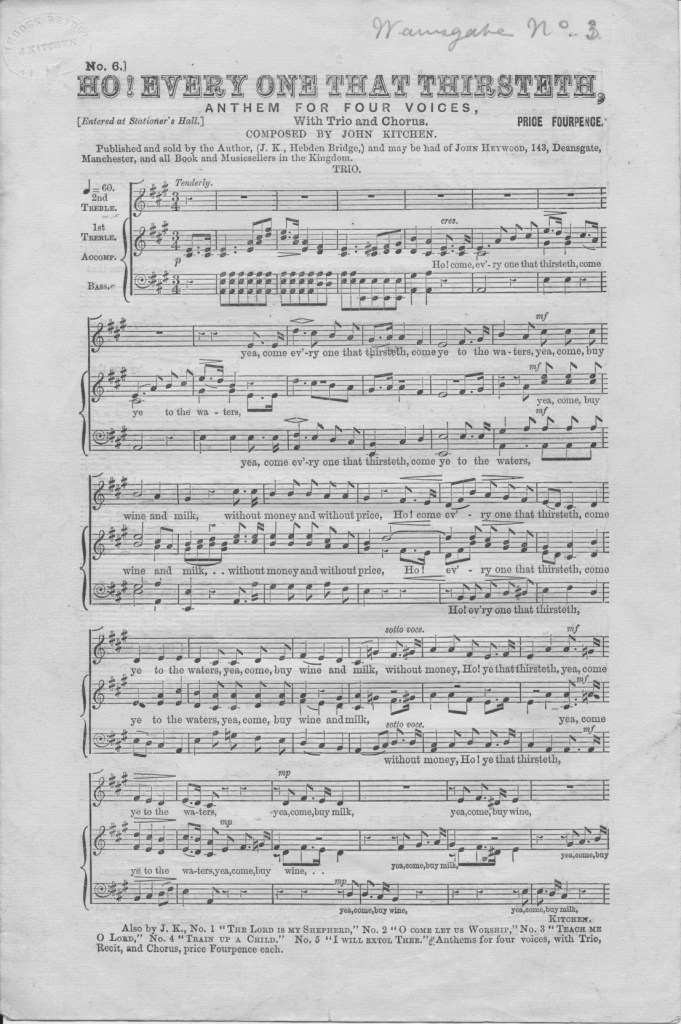
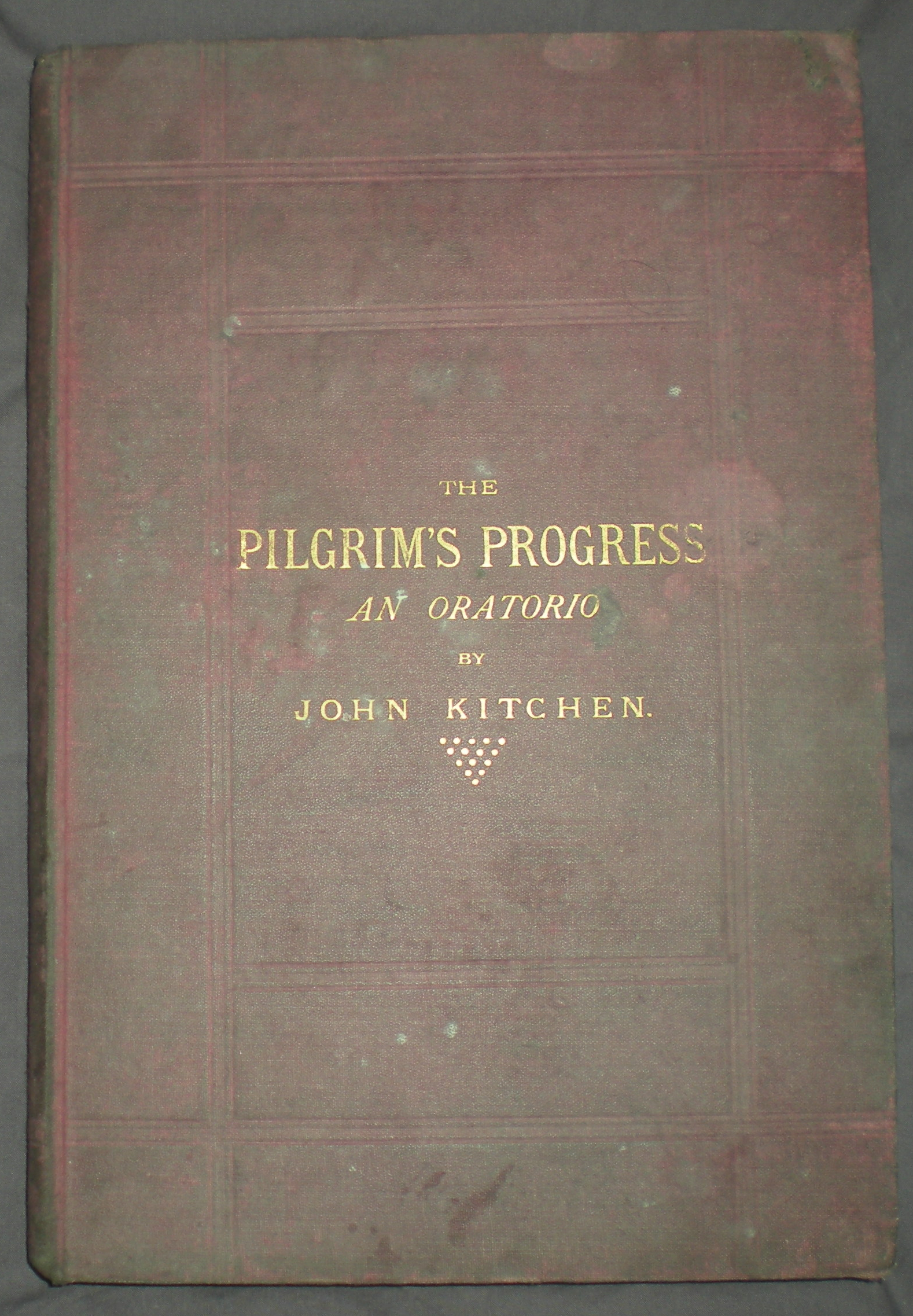
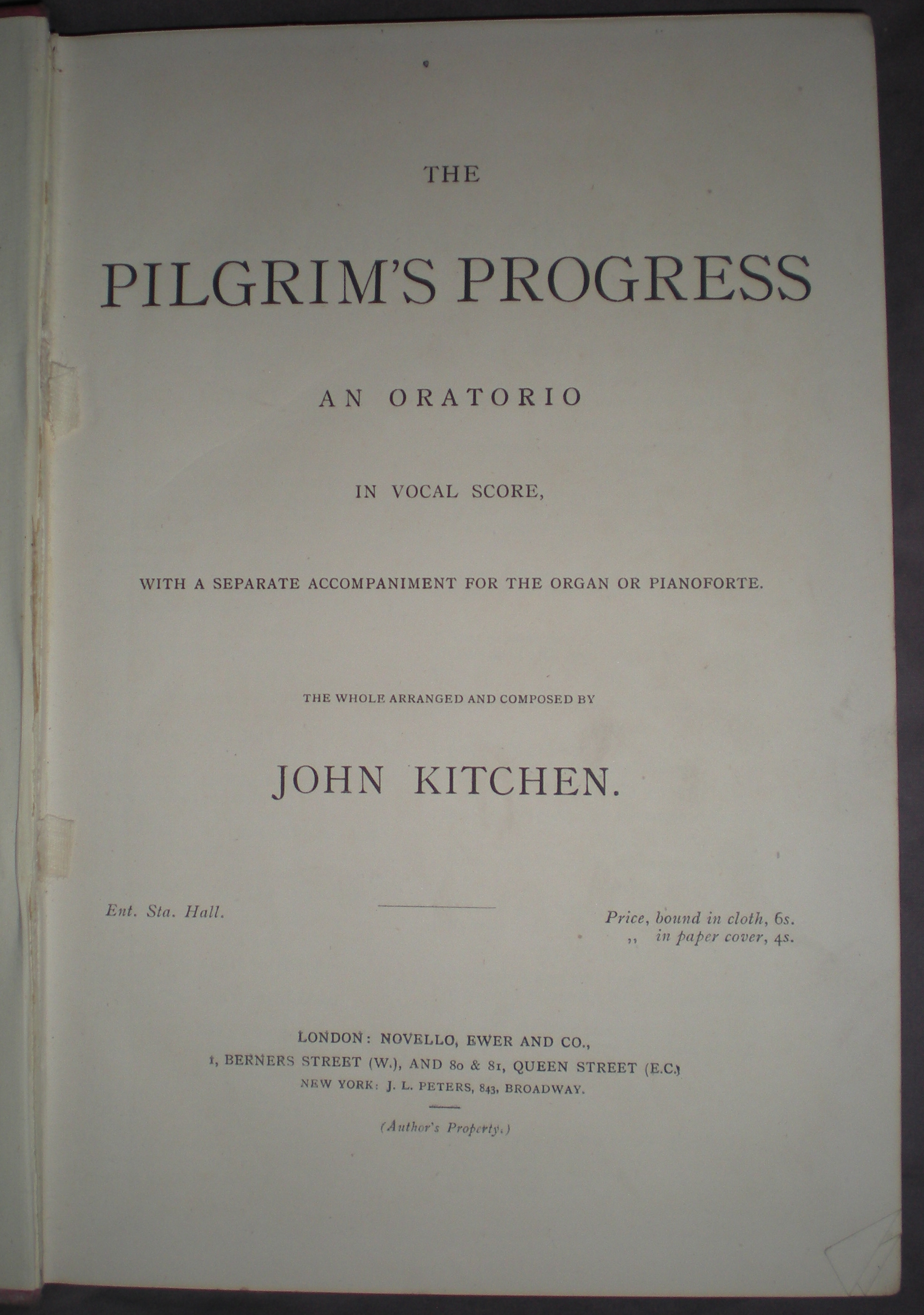
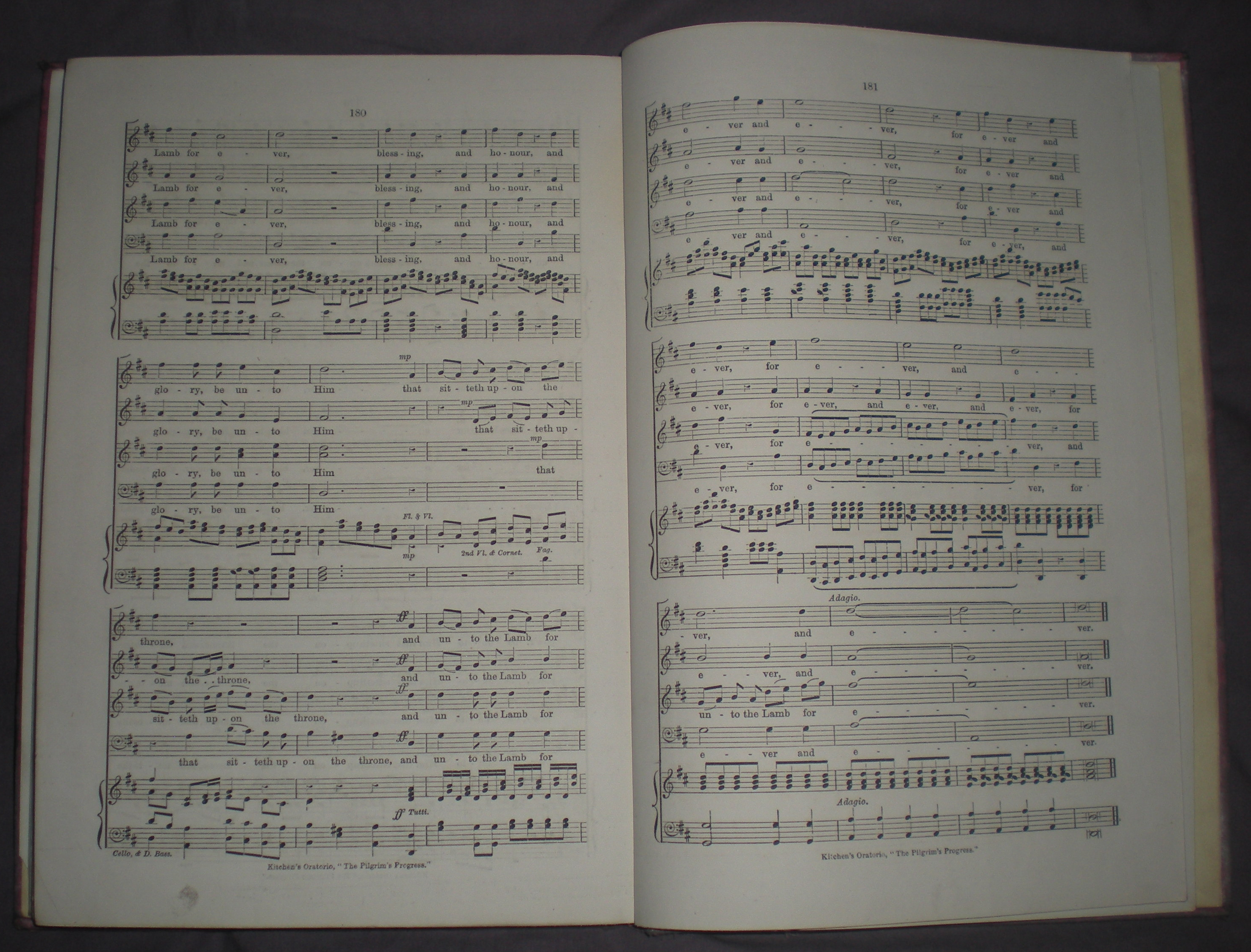
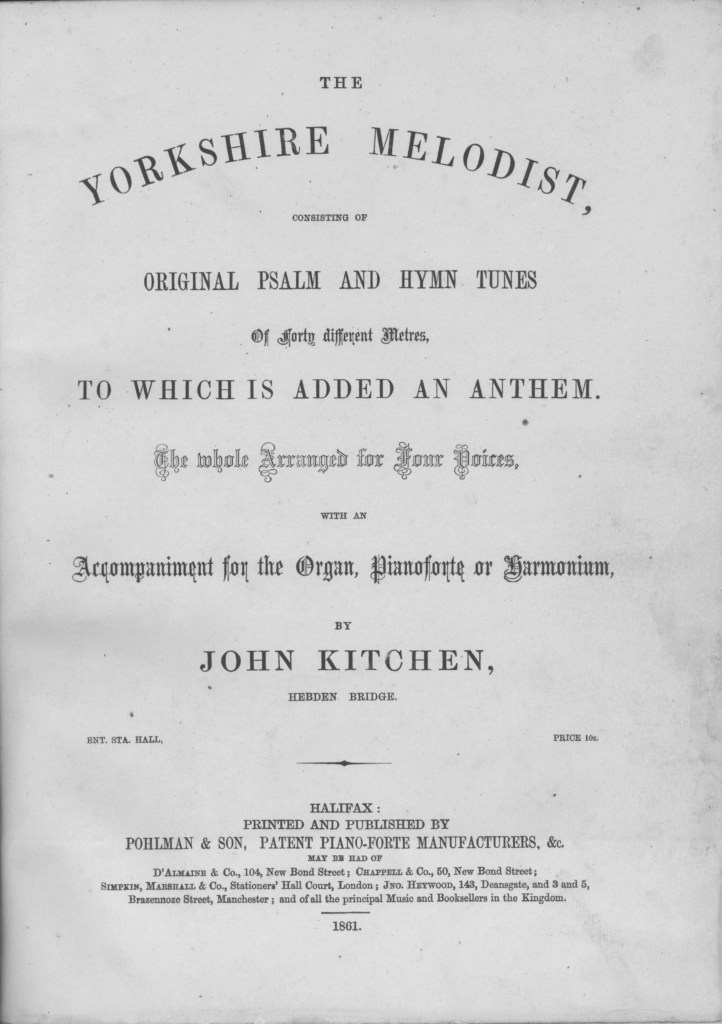
John Kitchen was a prolific composer of hymn tunes, anthems and an oratorio ‘The Pilgrim’s Progress’, published in 1877. He published The Yorkshire Melodist a collection of ‘original psalm and hymn tunes’ in 1861, and it is likely that his compositions were performed regularly by the various Wainsgate choirs.
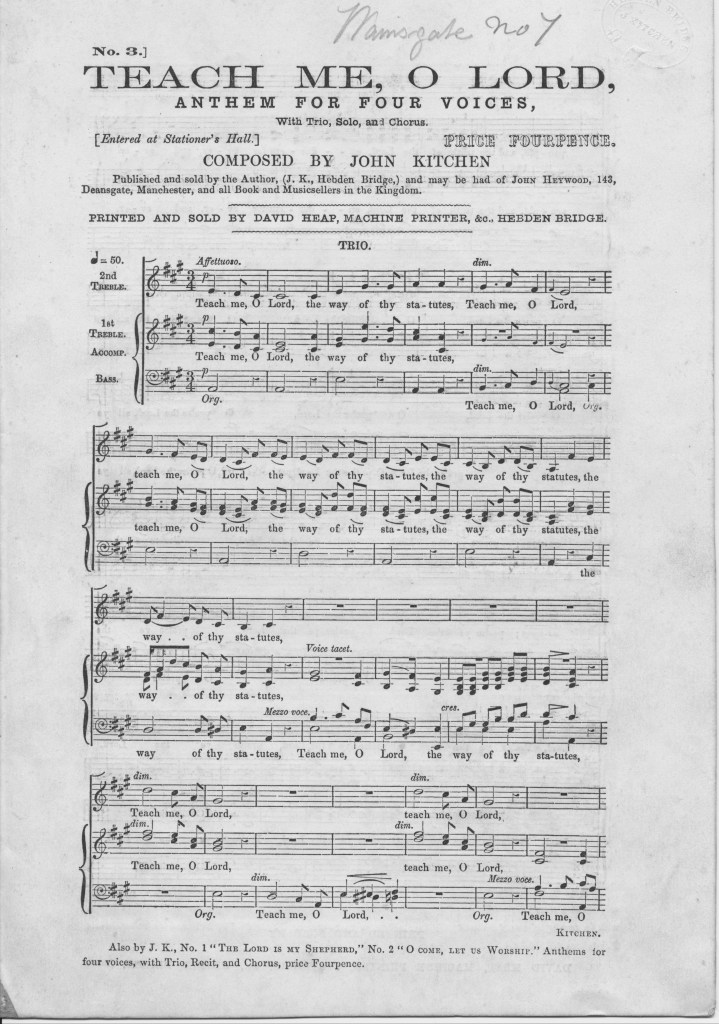
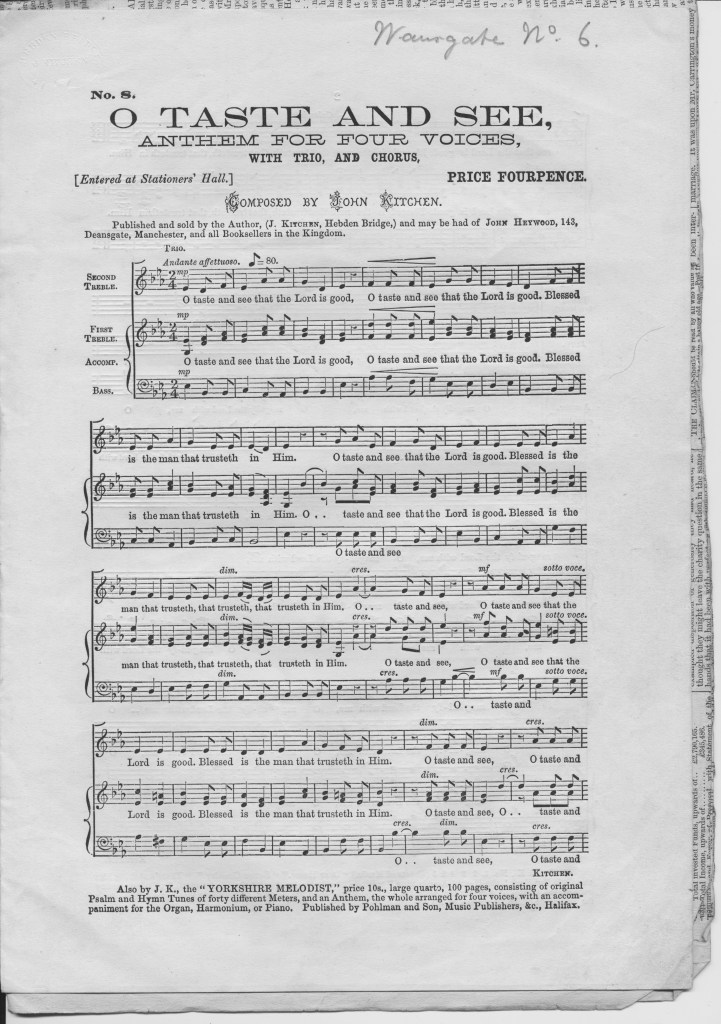
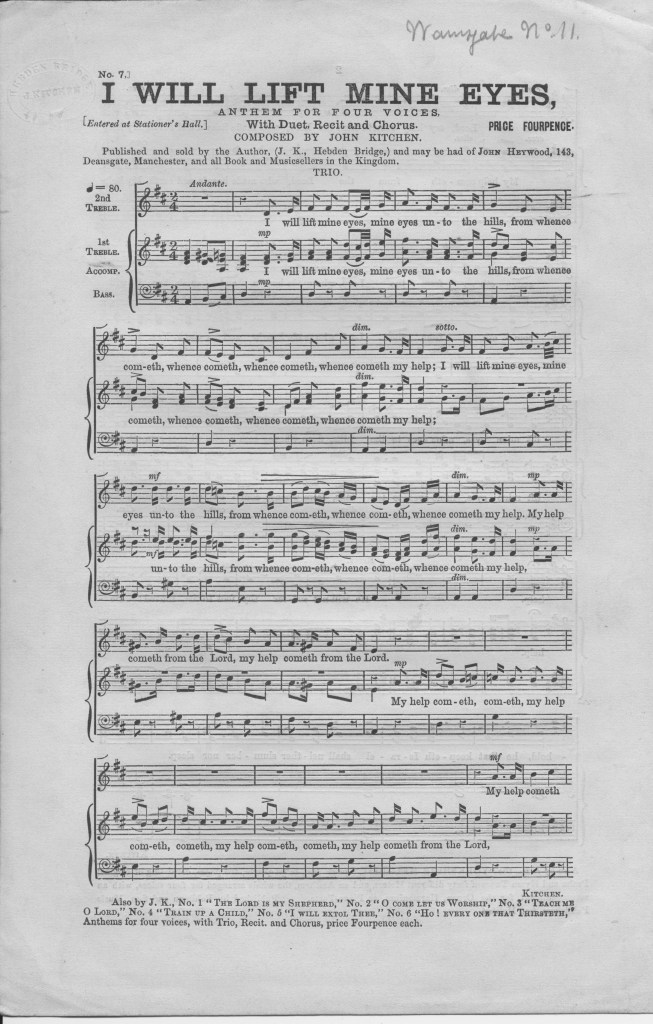
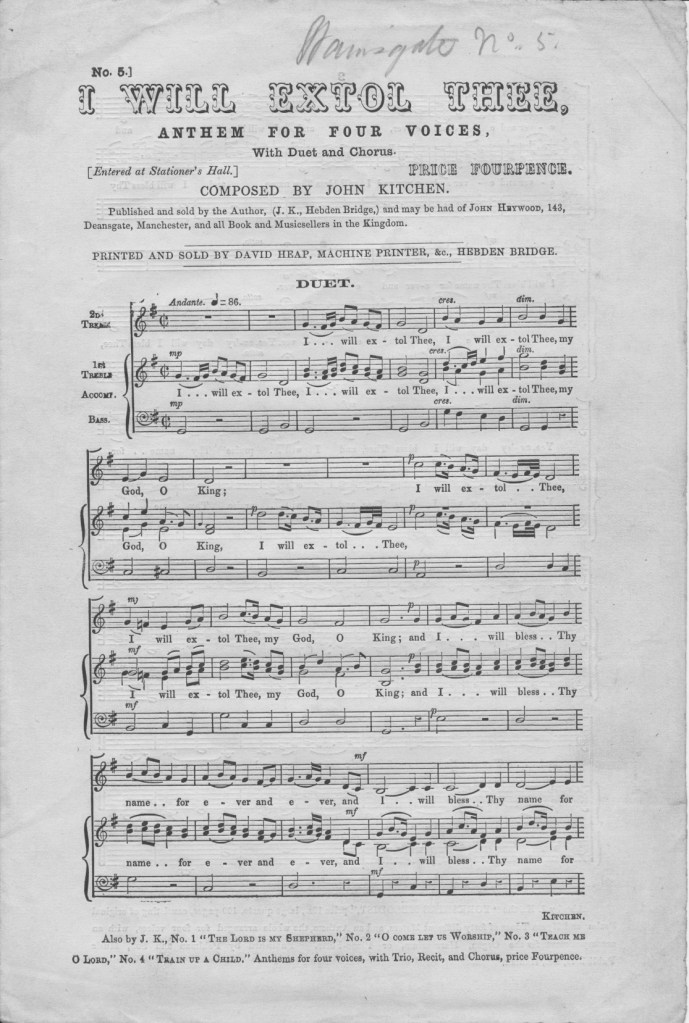
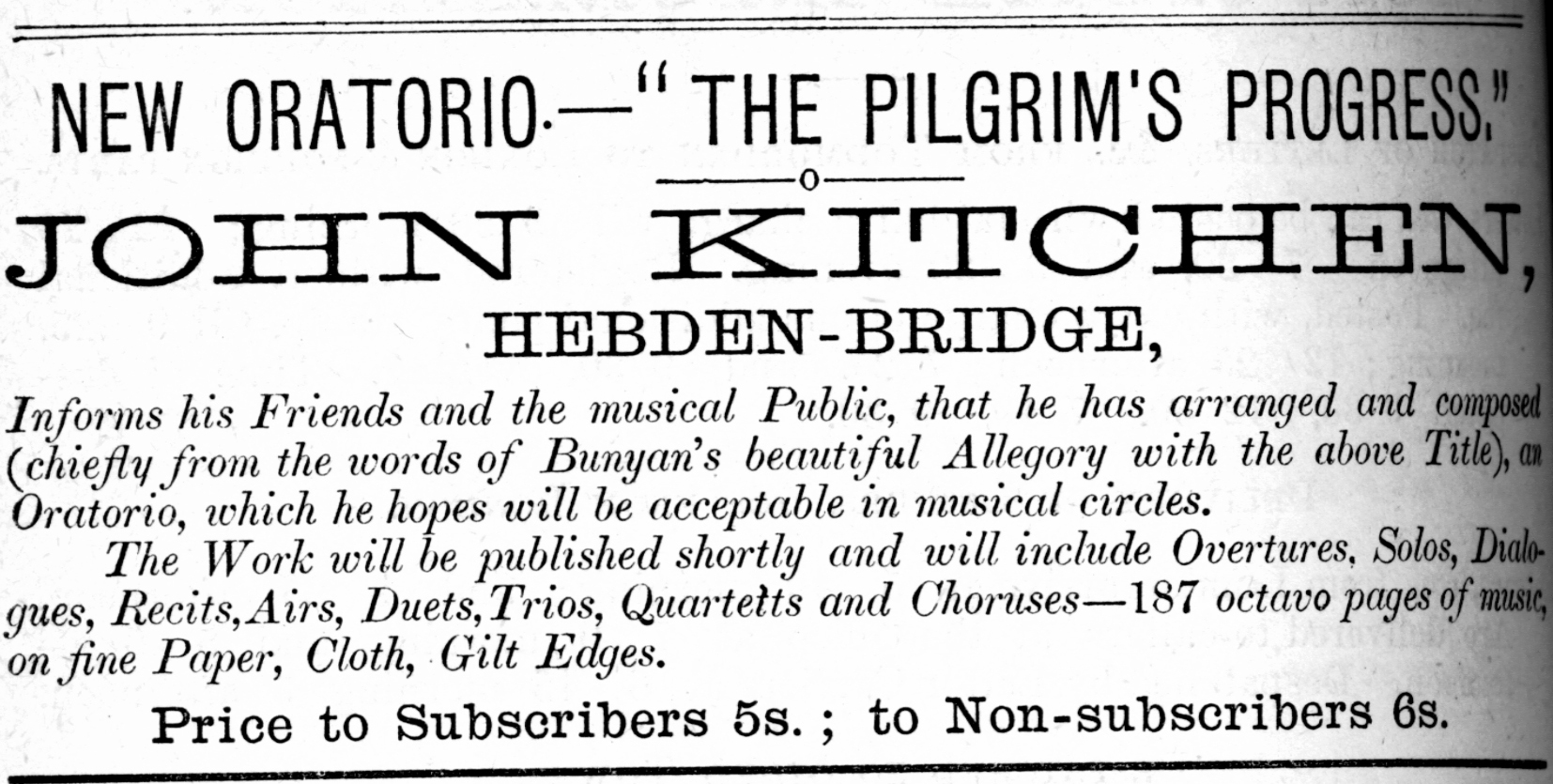
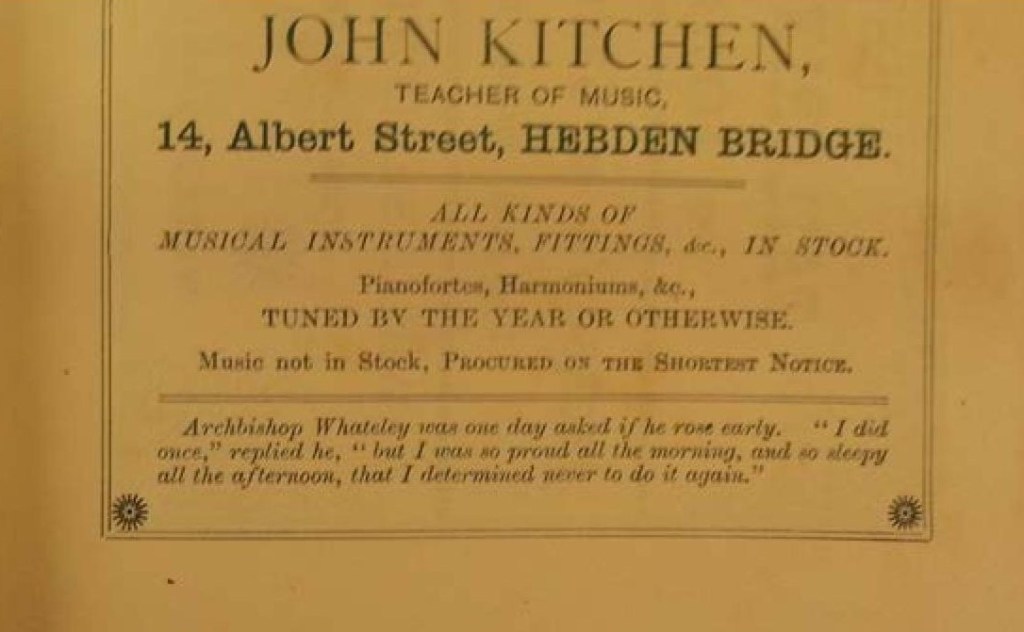
An advertisement for John Kitchen’s music business (from Heap’s Hebden Bridge Household Almanack, 1884) included the following quotation from Archbishop Richard Whately:
Archbishop Whately was one day asked if he rose early. “I did once,” replied he, “but I was so proud all the morning, and so sleepy all the afternoon, that I determined never to do it again.”
Richard Whately (1787-1863) was an English academic, philosopher, economist, theologian and social reformer (and ancestor of actor Kevin Whately), and also served as a reforming Bishop of Dublin from 1831 to 1863 – once referred to as ‘possibly the strangest archbishop Ireland has ever known’. He was a prolific and combative author and a flamboyant (some would say eccentric) character. He was a supporter of religious liberty, civil rights and freedom of speech, and had a passionate commitment to ending slavery.
We don’t know whether John Kitchen shared Whately’s views on early rising, but he was obviously familiar with his writing.
The JENKINSONS
Three sons of Samuel Jenkinson (1825-1895), master tailor and woollen draper of Commercial Street, Hebden Bridge, and himself an accomplished amateur musician, were all known to have been musicians or music teachers. The eldest, Henry Jenkinson, was the son of Samuel’s first wife Esther Ann (born Crabtree), who died in 1863 aged 37. His half-brothers, Herbert Edward Jenkinson and Ezra Jenkinson were the sons of his second wife Hannah (born Kitchen). Hannah’s brother was John Kitchen – shoemaker, piano dealer, composer and music teacher.
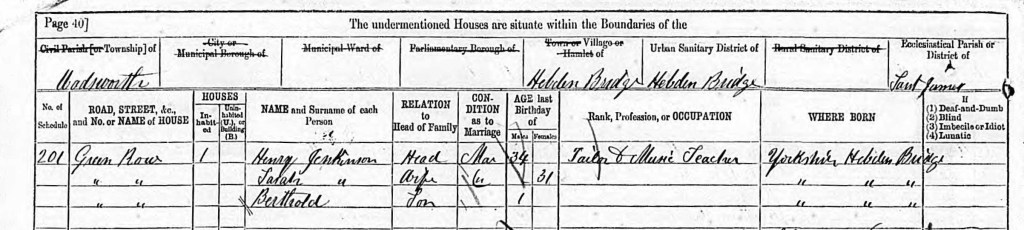
Henry Jenkinson (c1847-1919) was, like his father a tailor, but in the 1881 census he is described as a ‘Tailor & Music Teacher’. Henry and his wife Sarah (born Harwood) had three children: their first-born, Harwood Henry only lived for a year, and they had a daughter Henrietta who died in Scarborough aged 66.
Their other son, born in 1880, was named Berthold, not a common name for a boy born in Hebden Bridge at that time (only two other births of boys named Berthold are recorded for England & Wales in 1880 – both were in London and probably born into Jewish families). Perhaps he was named after the German composer, pianist, conductor, music educator and critic Berthold Damcke (1812-1875), someone his father may have admired. Berthold Jenkinson died in Scarborough in 1959, aged 79.
1881 census
Henry’s half-brother, Herbert Edward Jenkinson (1870-1940) worked as a fustian cutter and warehouseman, but the 1921 census records his occupation as ‘Musician’, and his place of work as ‘Co-op Hall, Hebden Bridge’. His employer is recorded as ‘Greenwoods (cinema proprietors), Co-op Hall, Hebden Bridge’.
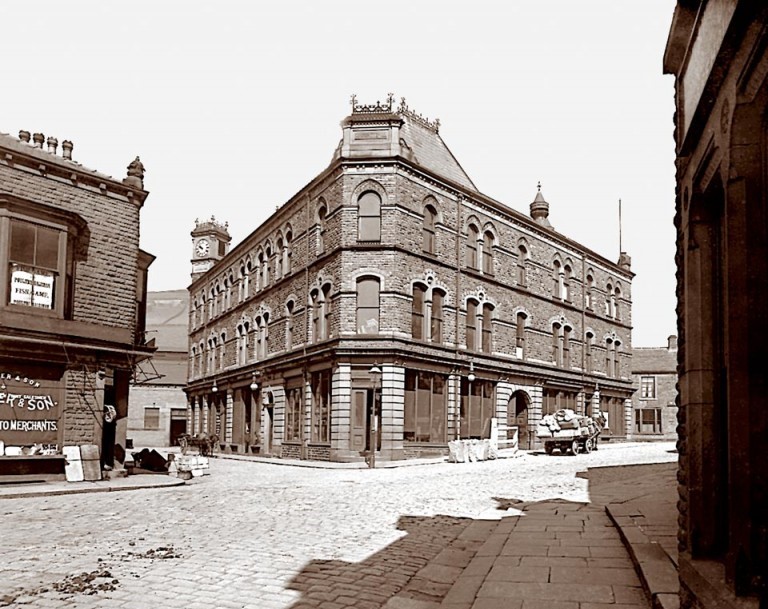
The Co-operative Hall in Hebden Bridge used to have a cinema, and it seems that Herbert probably played as an accompanist to the silent films that were shown there, presumably playing piano or organ.
The release of the first ‘talkie’ (The Jazz Singer) in 1927, the first feature-length movie with synchronized dialogue, brought the age of the silent movie to an end, and Herbert and other musicians would no longer be employed in cinemas.
The cinema in the Co-operative Hall is believed to have closed in 1930.
The photograph above (from the Alice Longstaff Collection, Pennine Horizons Digital Archive) shows Carlton Buildings, Hebden Bridge, and is thought to have been taken in 1890. The building was built by the Hebden Bridge Co-operative Society in 1876, and the Co-operative Hall was on the top floor.
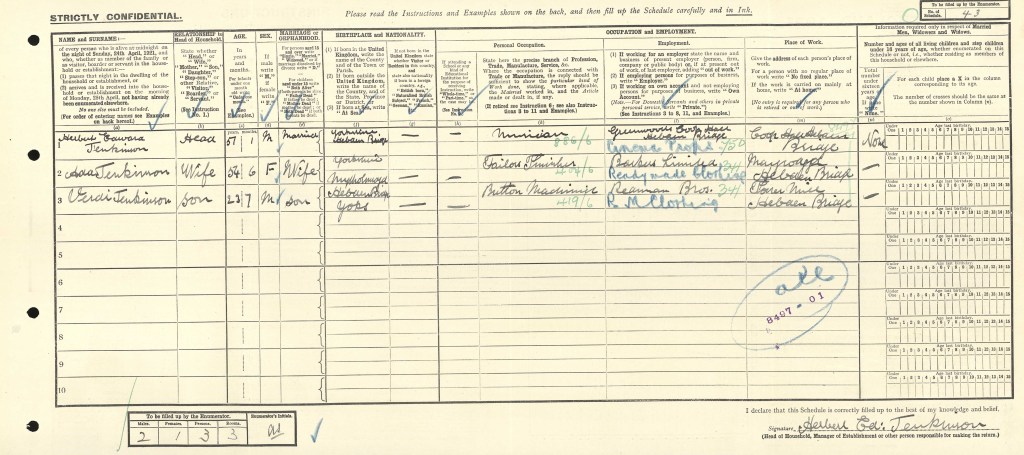
1921 census
The 1939 Register describes him as ‘Musician, Retired‘. Herbert and his wife Ada (born Wilcock) had two children – Florence, born in 1893 and Verdi, born in 1897. Once again, an unusual name for a boy born in Hebden Bridge (only two others were recorded in England & Wales in that year), and it seems likely that he was named after the famous Italian composer Giuseppe Verdi (1813-1901), best known for his operas.
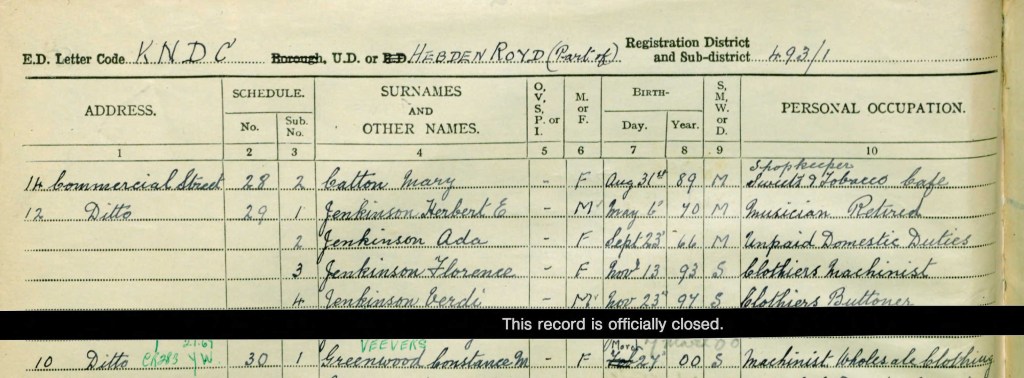
1939 Register
* * *
The three Jenkinson brothers are all buried at Wainsgate. Henry Jenkinson is buried in plot B280a, with his wife Sarah, daughter Henrietta and infant son Harwood Henry Jenkinson.
Herbert Edward Jenkinson is buried in plot E941, with his wife Ada, daughter Florence and son Verdi.
The headstone has a later inscription – ‘Anthony Stevens, dear husband of Margaret, born Nov 20th 1928, died Jan 25th 1992′. Anthony almost certainly married Margaret Jenkinson in 1954, and Margaret was almost certainly born in 1934 – her birth was registered in Todmorden registration district, and her mother’s maiden surname was recorded as Jenkinson.
It seems likely that Florence, who never married, was Margaret’s mother. The 1939 Register records Florence and Verdi, both single, living with their parents at 12, Commercial Street, Hebden Bridge. The details of a fifth person at that address are redacted, which usually means that they were born less than 100 years ago: this person could well be Margaret.
Margaret Stevens died at Waterside Lodge, Todmorden on 24th March 2020, aged 85. She had no known surviving family, and her ashes were interred in plot E941 later that year by a friend, Sally Harris.
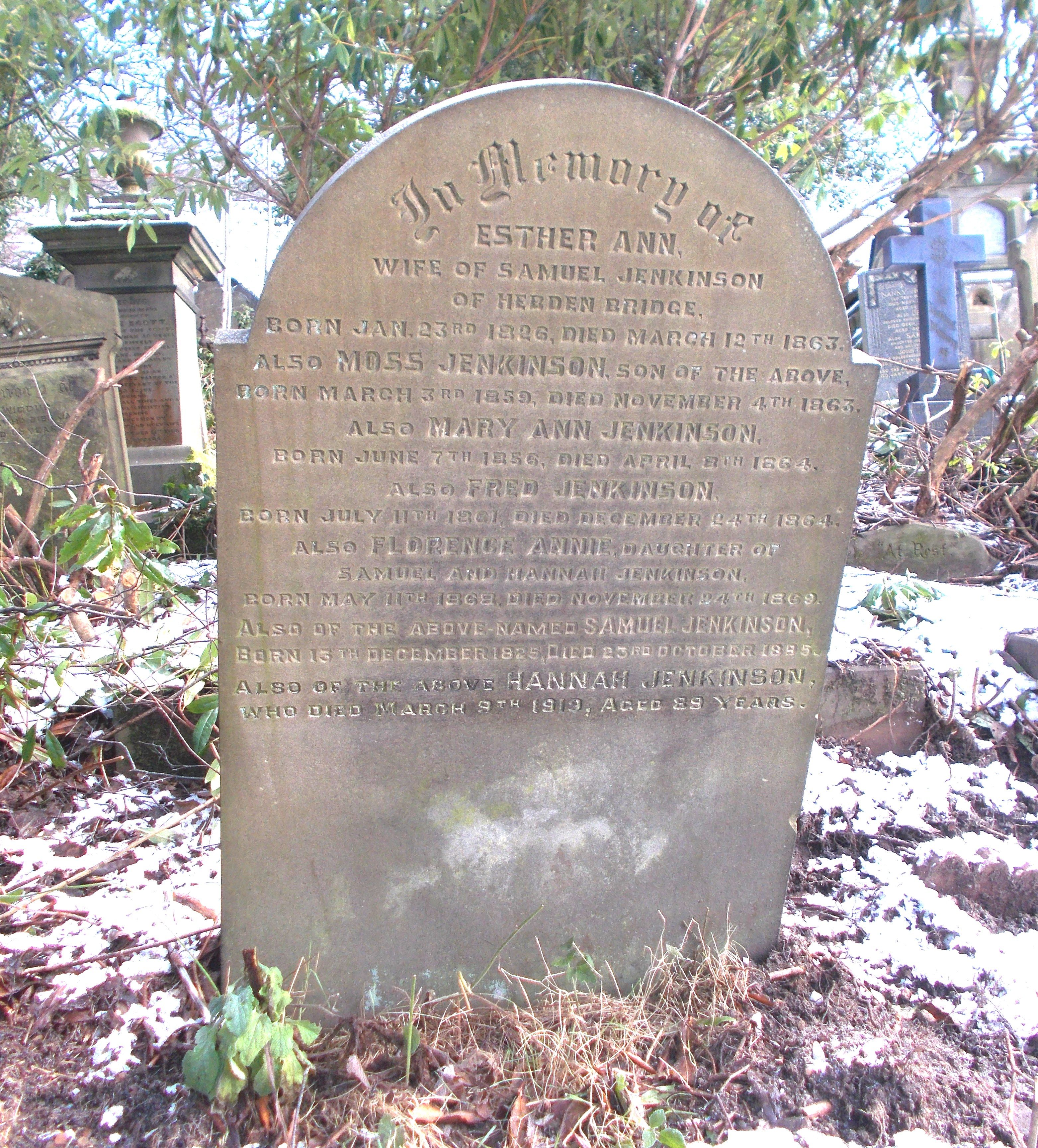
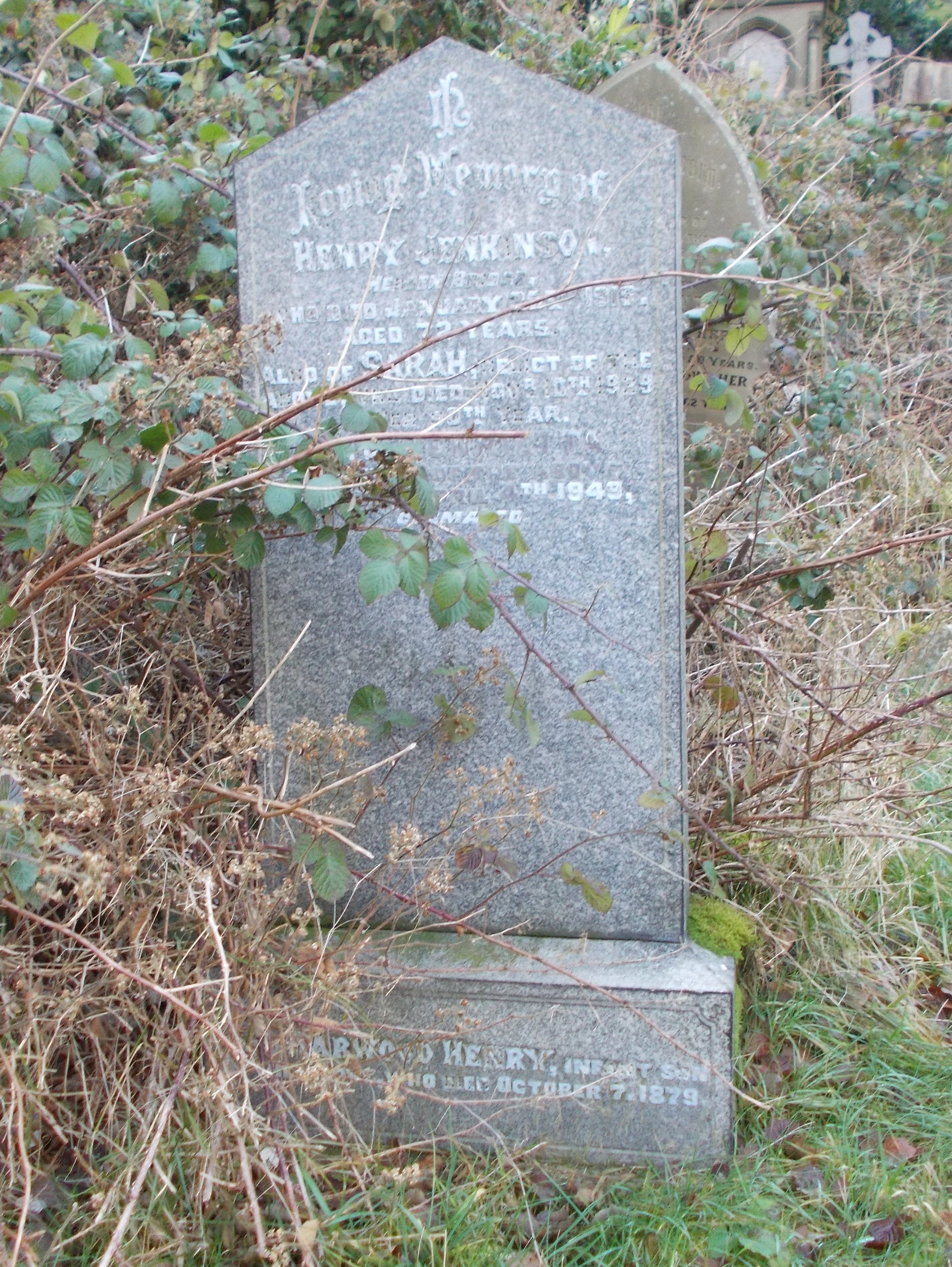
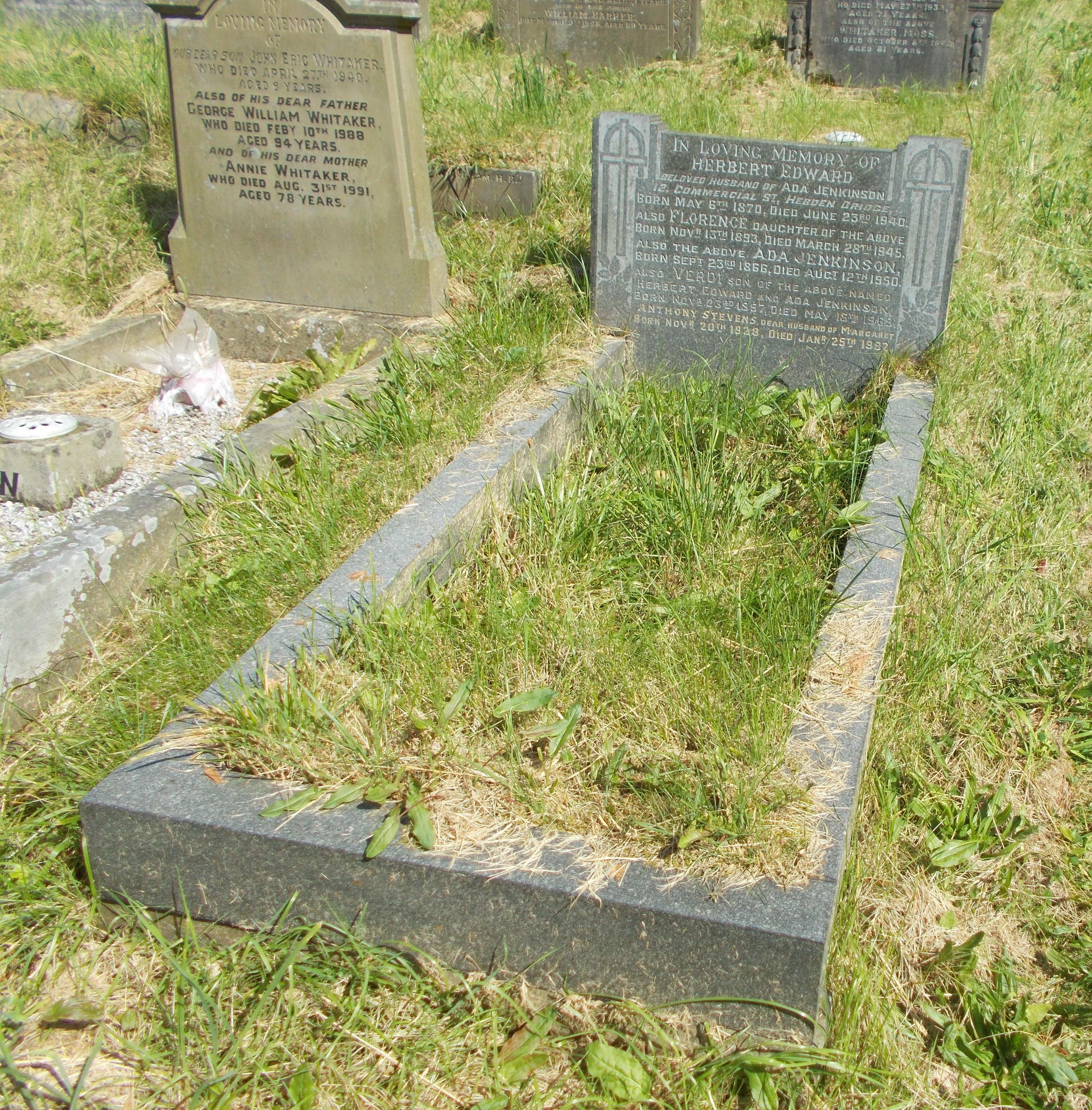
The Jenkinson graves at Wainsgate: A524/B284a, B280a & E941.
Ezra JENKINSON (1872-1947)
Samuel Jenkinson’s youngest son Ezra was born in Commercial Street, Hebden Bridge. From an early age he showed exceptional talent as a musician, and was taught as a child by Joseph Grindrod of Todmorden. His main instrument was the violin, but he also played piano, piccolo and trumpet. In 1885, aged just thirteen, he came close to being awarded a scholarship at the Royal College of Music in London, and in 1888 he succeeded at the second attempt, but decided that he would rather study at the prestigious Königliches Konservatorium der Musik zu Leipzig – the Royal Conservatory of Music of Leipzig.
He managed to attract sponsorship from local benefactors to pay for seven years at Leipzig, where he was tutored by the German composer, pianist and conductor Carl Reinecke, who himself had studied at Leipzig under Felix Mendelssohn, Robert Schumann and Franz Liszt.
Founded as the Conservatorium der Musik by Felix Mendelsshon in 1843, and now known as Hochschule für Musik und Theater “Felix Mendelssohn Bartholdy” Leipzig – the Felix Mendelssohn Bartholdy College of Music and Theatre, it is the oldest university school of music in Germany. Its alumni include Frederick Delius, Edvard Grieg, Leoš Janáček, Sir Arthur Sullivan and Sir Adrian Boult.
After completing his studies in Leipzig, Ezra returned to Hebden Bridge, and his first professional performance was at Todmorden Town Hall on 1st March 1898, when he was still only twenty-six. His performance was well received, and it seemed that a bright future as a professional musician lay ahead. At his next public performance, on 12th March at the Co-op Hall in Todmorden, disaster struck – a string of his violin broke just as he was finishing his performance, which unsettled him so much that he nearly withdrew from the next night’s concert: he was persuaded to play, and his performance was outstanding, but it proved to be his last public performance. He would play privately and for friends, but he never again played in public.
We know that for the next forty years he lived alone in a one room cottage at 4, Tanpits, Hebden Bridge (the site of an old tannery at the junction of Albert Street and New Road) from 1906 until at least 1939. The 1921 census records him living there on his own, and his occupation as ‘Teacher of Music (own account)’ – place of work ‘at home’. The 1939 Register also records him living there, aged 67, and his occupation is listed as ‘Musician’. Interestingly, the other five dwellings in Tanpits are recorded as being vacant, and the whole development would be demolished in 1940 when Ezra moved out.
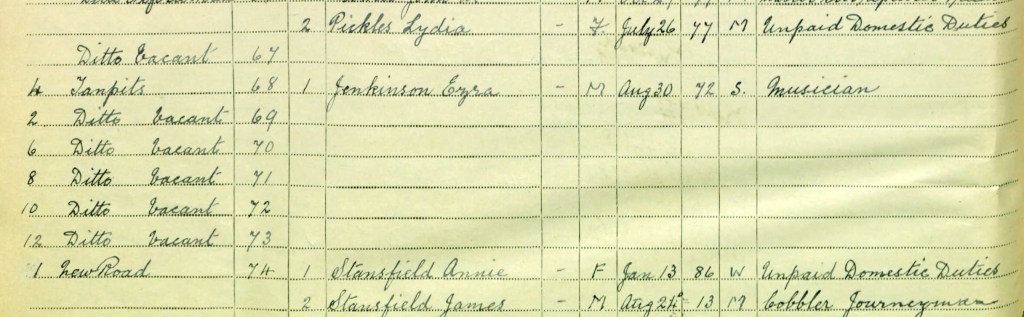
1939 Register
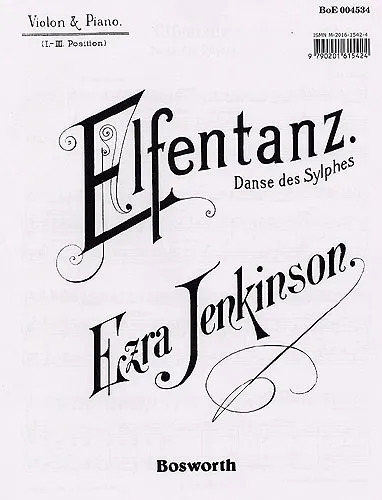
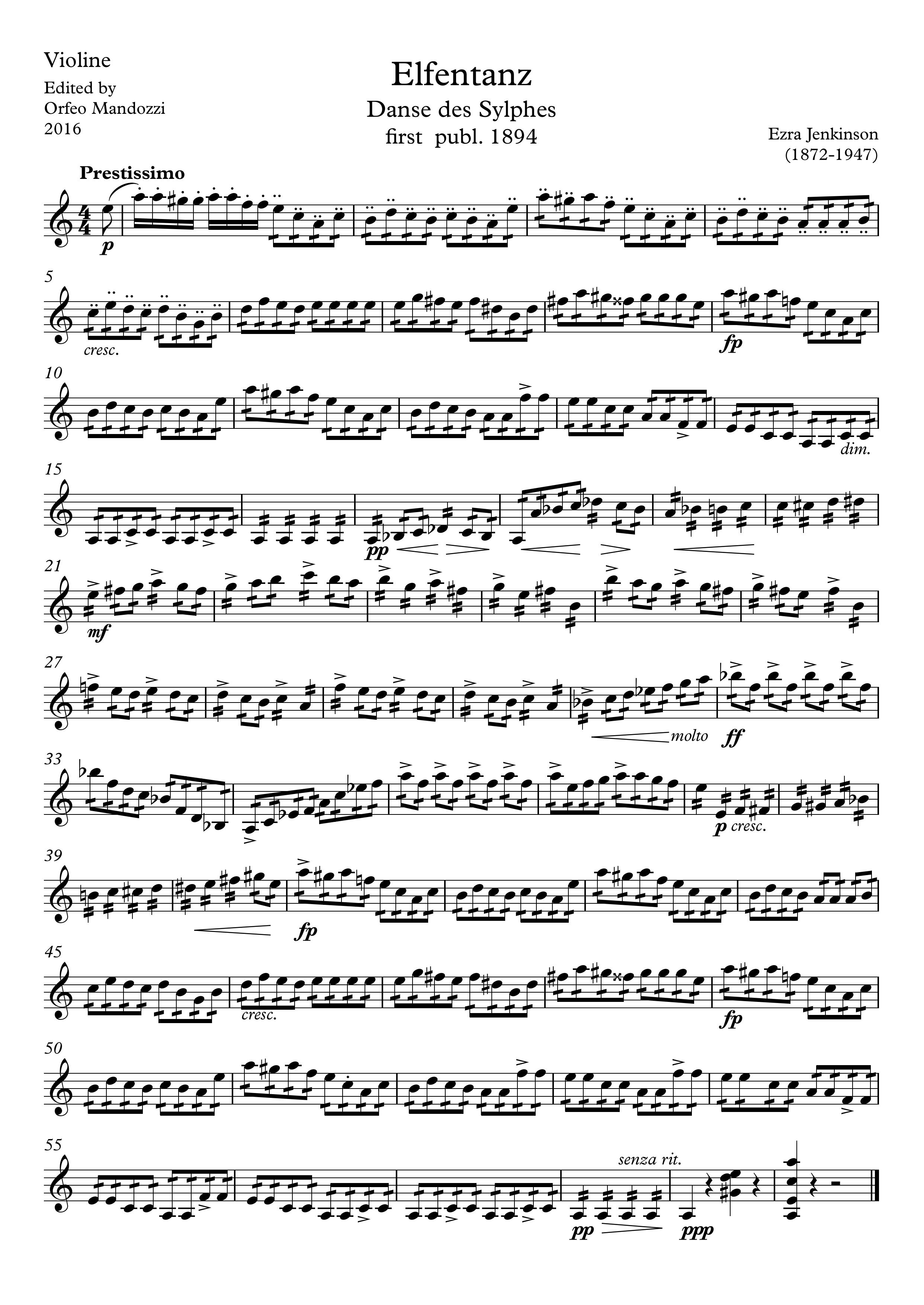
As well as making what appeared to be a rather meagre living from teaching, Ezra also composed music for violin and piano. His most famous composition Elfentanz (Elves’ Dance), with its challenging spiccato bowing technique, is still a popular piece used by violin teachers and students around the world.
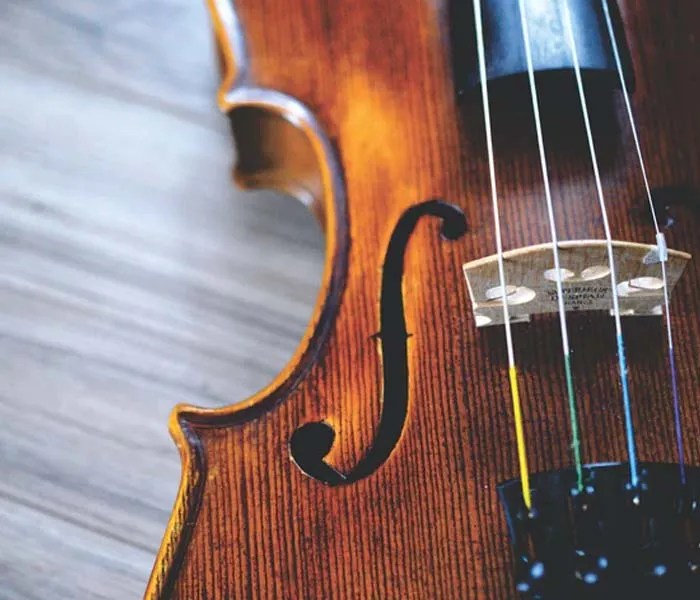
When his home in Tanpits was demolished in 1940, Ezra moved to Stansfield View on the hillside above Todmorden – opened in 1878 as Todmorden Workhouse, becoming a Public Assistance Institution in 1930, and finally becoming Stansfield Hospital in 1948, providing care for ‘the mentally handicapped’ as its patients were then known. We don’t know exactly why he was admitted to Stansfield View, but the move indicates both poverty and mental or physical illness. Ezra died of bronchitis at Stansfield View in February 1947, aged 74. He never married and had no known children.
His funeral took place in one of the worst winters in living memory: after his memorial service at Hope Chapel, the hearse had to be abandoned at Pecket Well, and the coffin carried through deep snow to Wainsgate, where he was buried. There were only seven mourners present at his interment, one of whom was the well known local writer and artist William Holt.
Ezra Jenkinson is recorded in the Wainsgate burial register, but there is no record of exactly where he was buried and no gravestone inscriptions recording his burial. It is likely that he was buried in plot A524/B284a with his father Samuel, his mother Hannah, and Samuel’s first wife Esther Ann. Also buried in this plot are four more of Samuel’s children: Moss, who died aged 4, Mary Ann aged 7, Fred aged 3 and Florence Annie who was just 18 months old.
Thanks to Matt and Tom of The Dark Side of the Moor for their well researched and very entertaining film about Ezra Jenkinson’s life, which you can watch here:
THE SACRED HARP
Nothing is weirder than Sacred Harp. Its favored subject matter – the pilgrim, the grave, Christ’s blood – is stark; its style – severe fourths and otherworldly open fifths – has been obsolete for more than a century. Its notation, in which triangles, circles and squares indicate pitch, looks like cuneiform. Yet it exudes power and integrity. Five people sound like a choir; a dozen like a hundred. It is one of the most democratic choral forms: no audience, no permanent conductor – just people addressing one another and God.
David Van Biema – Give Me That Old-Time Singing, Time Magazine, 2008.
* * *
Sacred Harp singing is a tradition of sacred choral music that originated in New England and later took root in the American South, particularly Alabama and Georgia. The name is derived from The Sacred Harp, a songbook published in 1844 by Benjamin Franklin White and Elisha J. King and subsequently distributed in several different versions.
The Sacred Harp uses the shape note style of musical notation popular in America in the 18th and early 19th centuries, a simplified form of notation designed to facilitate congregational and social singing.

From The Original Sacred Harp, Denson edition, 1936 (Library of Congress)
Sacred Harp groups always sing a cappella, with the singers arranged in a hollow square, with one side assigned to each of the four parts: treble, alto, tenor, and bass. The treble and tenor sections are usually mixed, with men and women singing the notes an octave apart. There is no single leader or conductor: the participants take turns in leading. The leader for a particular round selects a song from the book, and ‘calls’ it by its page number. Leading is done in an open-palm style, standing in the middle of the square. The pitch at which the music is sung is relative: there is no instrument to give the singers a starting point. The leader, or another singer assigned to the task, finds a good pitch with which to begin and intones it to the group. The singers reply with the opening notes of their own parts, and then the song begins.
Sacred Harp singing normally occurs not in church services, but in special gatherings or ‘singings’ (sometimes called conventions) arranged for the purpose. Sacred Harp singers view their tradition as a participatory one, not a passive one. Those who gather for a singing sing for themselves and for each other, and not for an audience.
In recent years, Sacred Harp singing has spread far from its heartland in the American South: the UK has had an active Sacred Harp community since the 1990s.
Read more about Sacred Harp singing here: an excellent piece from the Bitter Southerner website, with beautiful photographs and some audio clips.
The videos below show two very diferent Sacred Harp performances. The first is Cork Sacred Harp, with Christopher Kain leading, at the Eighth Ireland Sacred Harp Convention in 2018. The second was recorded in Kalamazoo, Michigan in 2013, led by Judy Hauff.
‘Get enough people singing weird harmonies at the top of their voices and you start feeling a little sorry for the devil’
* * *
Wainsgate is linked to Sacred Harp singing by John Fawcett, who has two of his hymns included in The Sacred Harp songbooks:
Blest be the Tie That Binds, first published in 1782, is 330b, FELLOWSHIP in the 1991 Denson edition, and 95b, THE CHRISTIAN’S LOVE in the Cooper edition.
Religion is the Chief Concern, also published in 1782, is 205, PLEASANT HILL in both the Denson and Cooper books.
There have been two visits to Wainsgate by Sacred Harp groups: in 2007, Wainsgate was included in the UK Sacred Harp Heritage Tour, and again in June 2024, when the visit was hosted by Chris Brown, a Sacred Harp singer from Elland. Among the group was David Ivey, renowned American Sacred Harp master and founder director of the Sacred Harp Musical Heritage Association.
The group was small in number and lacking in male voices, but they sang both of John Fawcett’s hymns, one in the chapel and one at his graveside.
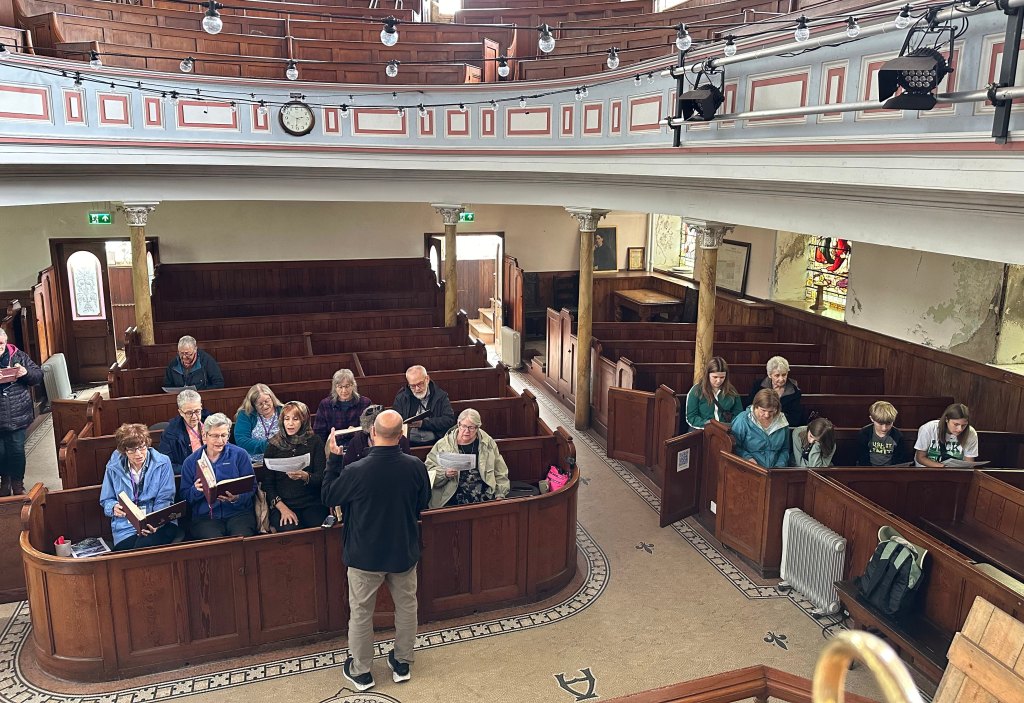
David Ivey leading at Wainsgate, June 2024. Photo by Helen Plaice.
Sacred Harp singing has gradually moved away from its home in the American South, and there are now singings throughout the US and Canada and around the world, particularly the UK, Ireland Germany, Poland and Australia. It has also to some extent moved away from its exclusively Christian (particularly Baptist) roots: singers of all beliefs or none are welcomed at virtually all singings, and many people take part purely for the joy of singing and the comradeship of the Sacred Harp community.
Tim Eriksen is an American musician, singer, composer and ethnomusicologist (and possibly the only musician to have shared a stage with both Kurt Cobain and Doc Watson) who has helped to bring Sacred Harp singing to a wider audience. He worked with David Ivey and T Bone Burnett on the soundtrack of the 2003 film Cold Mountain, which included two songs from The Sacred Harp – I’m Going Home and Idumea.
OTHER MUSICIANS:
Duncan Bruce SMETHURST (1957-2019)
Duncan Smethurst was a stalwart of Hebden Bridge Trades Club, where he was involved for over thirty years, working at various times as Sound Engineer and later in the office. He also played guitar with Owter Zeds, the legendary ska/rock band (sounding a bit like Madness, The Specials and UB40, but only ever playing songs they wrote themselves), formed in 1984 and still going strong today.

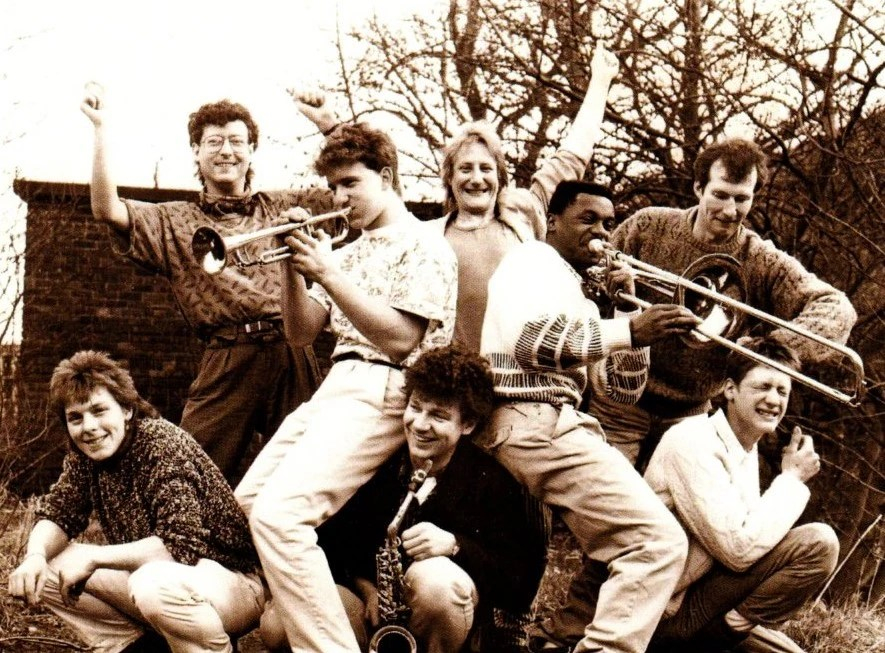
Duncan was a founder member of the band, who played their first gig at the Ground Floor Project in Hebden Bridge. The band was formed by musicians associated with the Trades Club, and has always been known for doing benefits for worthy causes, starting with the 1984 Miners’ Strike.
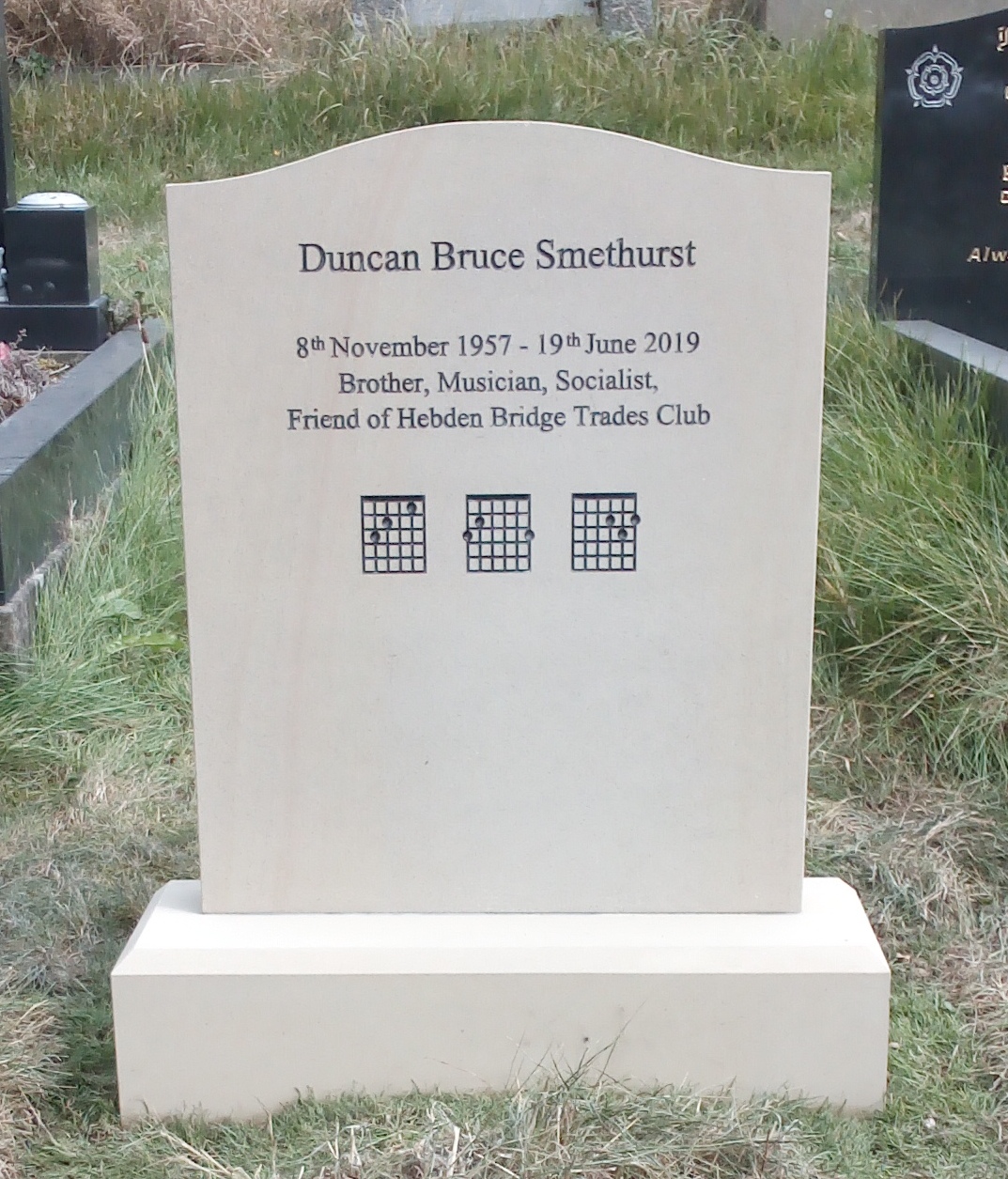
Duncan’s headstone is one of only two at Wainsgate which have inscriptions showing musical notation (the other one is that of John Kitchen). The headstone depicts guitar chord shapes for C, G and D in standard tuning.
Chris YATES (1957-2013)
Coming shortly…..
Charles Francis HENESY (1907-2000)
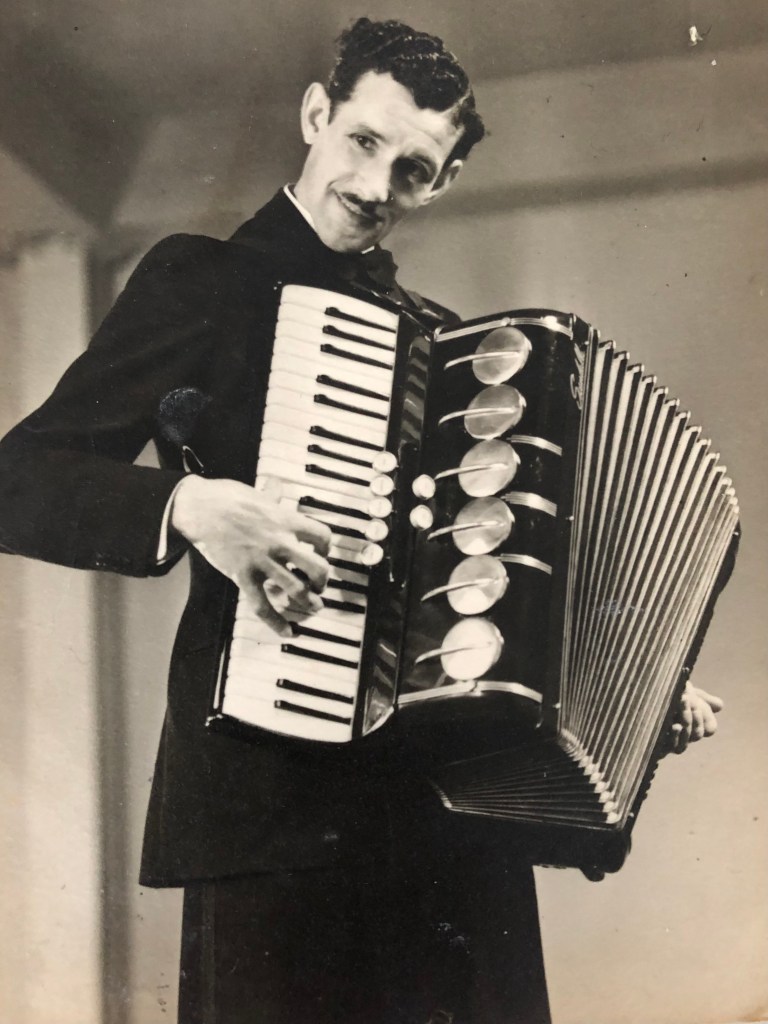
Charles was born in Liverpool, the son of Charles Henesy, a tram driver, and his wife Rebecca. In 1911 the family were living in Alverstone Road, Penny Lane, Wavertree.
Penny Lane was home to a major tram and bus terminus, which was regularly used by John Lennon and Paul McCartney as they travelled between each other’s houses. The terminus had a shelter with waiting room and toilets – ‘the shelter in the middle of a roundabout’. The building was later converted into the ‘Sgt. Pepper Bistro’, which closed over 20 years ago and has yet to re-open.
The instrument in the photograph appears to be a Scandalli, with distinctive ‘hub cap’ grill mutes. Scandalli have been making high quality accordions in Castelfidardo in Italy since the early 1900s.
In 1934 Charles married May Salmon, also from Liverpool. In September 1939 he was living with his family in Liverpool, and his employment is recorded as ‘Male Nurse (Hospital)’. May was living with their young child (or children?) in Bangor, North Wales. As well as working as a nurse, Charles served as a firefighter in Liverpool during the war – quite possibly more dangerous than serving in the armed forces.
The evacuation of children (Operation Pied Piper) at the start of WW2 was a pre-emptive measure to save the population of urban or military areas from German aerial bombing. The evacuations in Liverpool, organised by Liverpool Corporation, saw 8,500 children, parents and teachers moved from the city to rural areas and small towns in Lancashire, Wales, Cheshire, Shrewsbury and Shropshire.
As months went by with no signs of an air-raid by the Luftwaffe, many parents brought their children back to Liverpool and, by January 1940, 40% of the evacuated children were back in the city. The Liverpool Blitz started in August 1940, and Liverpool became the most heavily bombed area of the country outside London. By the end of the war, German bombs had killed 2,716 people in Liverpool, 442 people in Birkenhead, 409 people in Bootle and 332 people in Wallasey.
The photograph above was probably taken in the 1940s: Charles was a professional musician, playing the piano and piano accordion, and was leader of the Charles Henesy Sextet. He had a residency at the Ocean Club in Liverpool, and in 1949 at the Rex Ballroom, Stockport. The Sextet took part in a local radio series called ‘Music Goes Round’, which led to their appearance in 1950 on the popular radio programm ‘Music While You Work’, which was broadcast nationally on The Home Service (which became Radio 4) and the Light Programme (precursor of Radios 1 & 2).
Music While You Work was a daytime radio programme of continuous live popular music broadcast nationally by the BBC twice daily on workdays from 1940 until 1967. The programme began during World War II with the idea that playing non-stop popular / light music at an even tempo would help factory workers become more productive.
Although the programme became very popular with domestic audiences and later with motorists, it was aimed primarily at factory workers, and strict rules were applied: predominantly familiar pieces, nothing lethargic, consistent volume, avoidance of overloud drumming (which could sound like gunfire), and generally cheerful programmes to which workers could whistle or sing. Jazz was discouraged as, by its very nature, it often deviates from the melody, which had to be clear at all times. The song Deep in the Heart of Texas was banned from the show, because of the potential danger of production line workers taking their hands away from their work or banging their spanners on the machinery to perform the four hand-claps in the chorus.
You can listen to the Charles Henesy Sextet on this YouTube video, illustrated with some evocative old photographs of Liverpool:
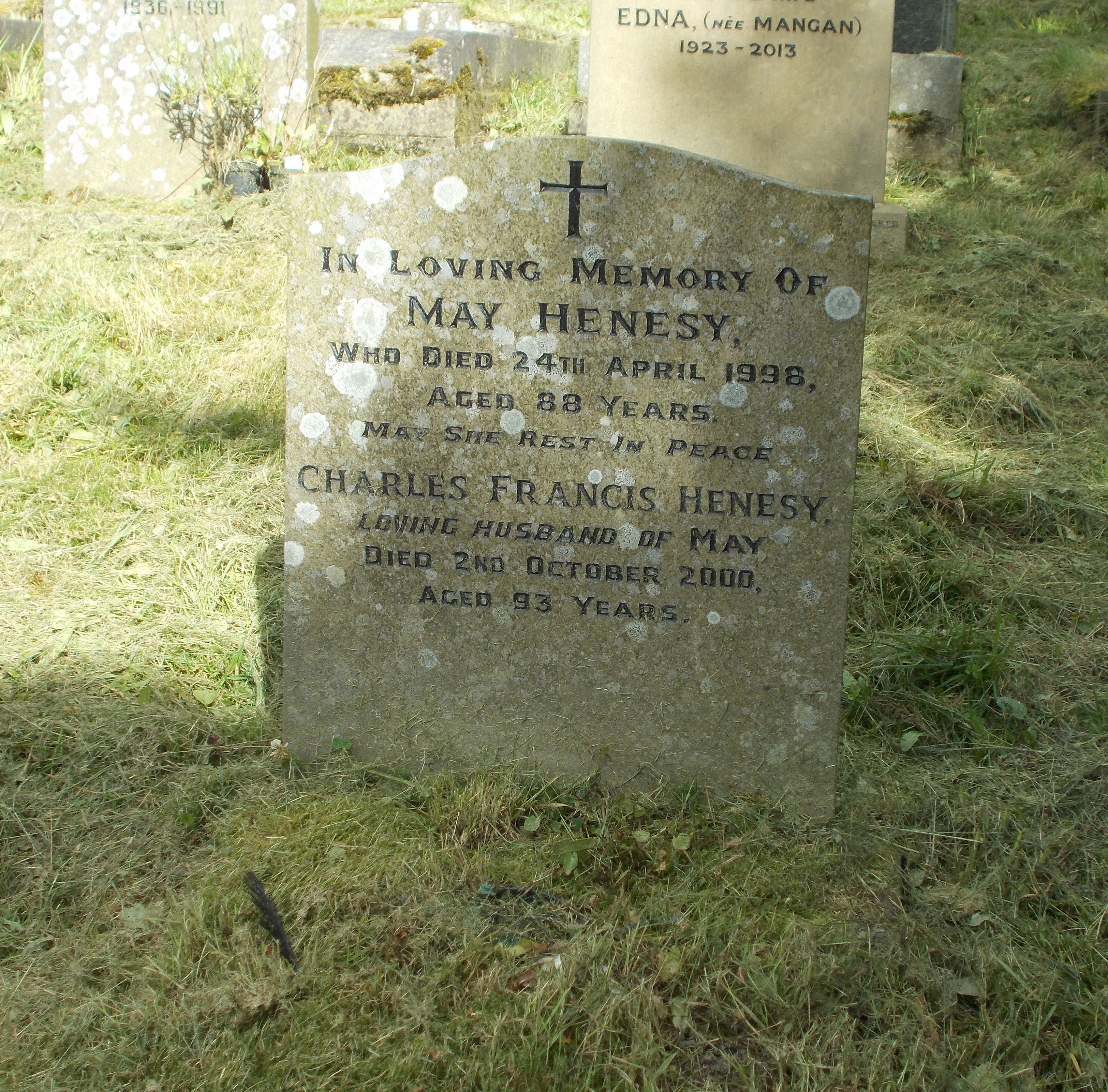
Charles and May moved to Leeds in the early 1950s, and later to moved to Hebden Bridge (possibly in the early 1990s?) to be near their daughter. May died in 1998, aged 88, and Charles died in 2000 aged 93. Their deaths were registered in Halifax, but the burial register records them both living at Moorfield, Old Town. Charles and May both came from Roman Catholic families – they are buried in plot I946 at Wainsgate, and their funerals were conducted by the local Catholic priest, Father John Gott.
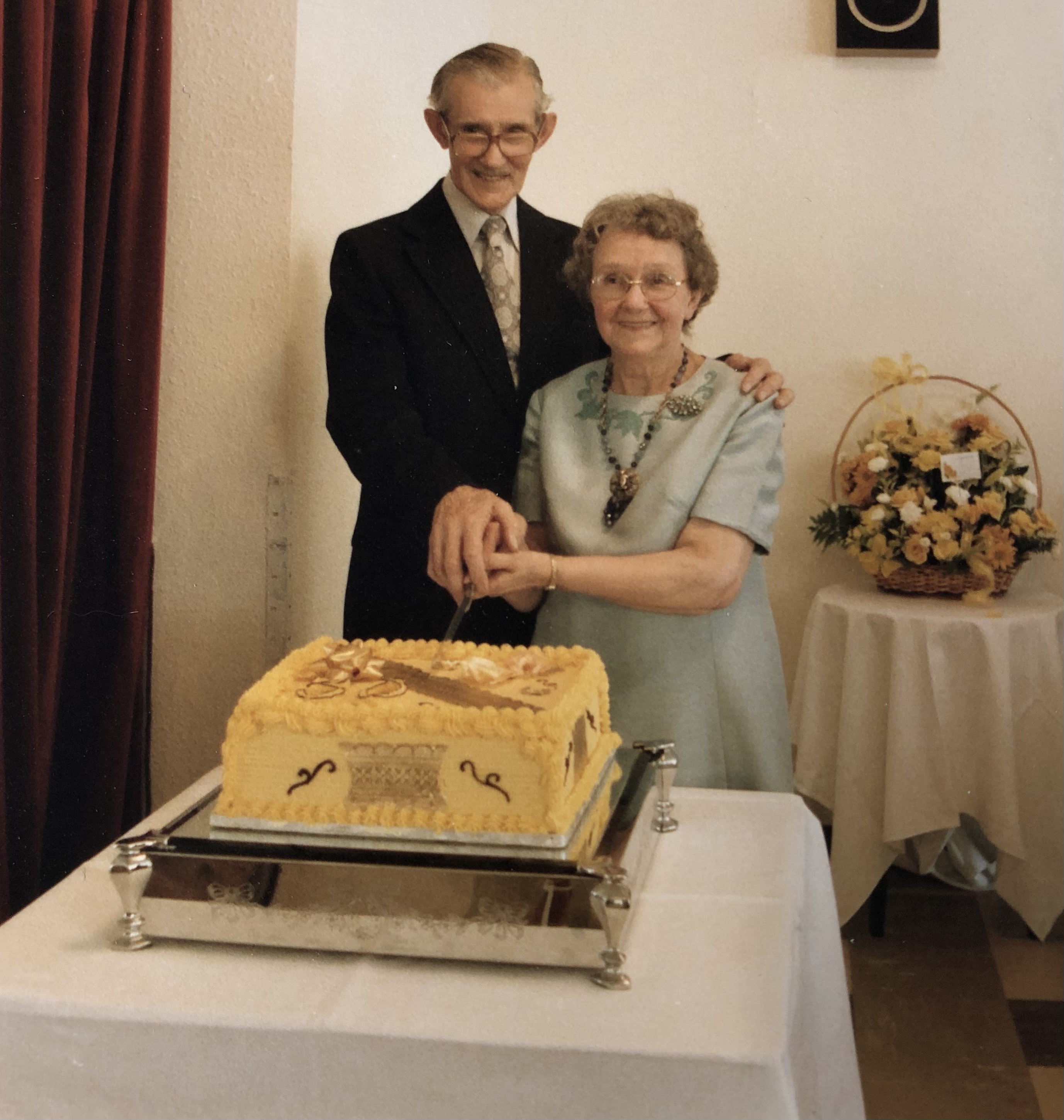
Charles and May Henesy on their golden wedding anniversary (1984)
(Thanks to Julia Baldwin, Charles and May’s granddaughter, for the photos and much of the information).
THE MUSIC NEVER STOPPED…..
Apart from the occasional wedding or funeral service, there is very little hymn singing at Wainsgate these days, but the tradition of singing, playing and listening to music continues. Wainsgate has hosted concerts, recitals and spoken-word events for the past few years, presenting all types of music in the chapel’s near-perfect acoustic environment. The highlight of Wainsgate’s programme of concerts, hosted by local pianist Dave Nelson, was the Piano Weekend in September 2024, which featured renowned pianists Charles Owen, Zoe Rahman and Noriko Ogawa.
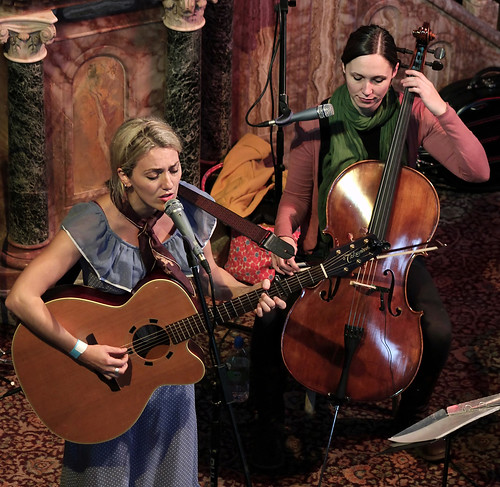
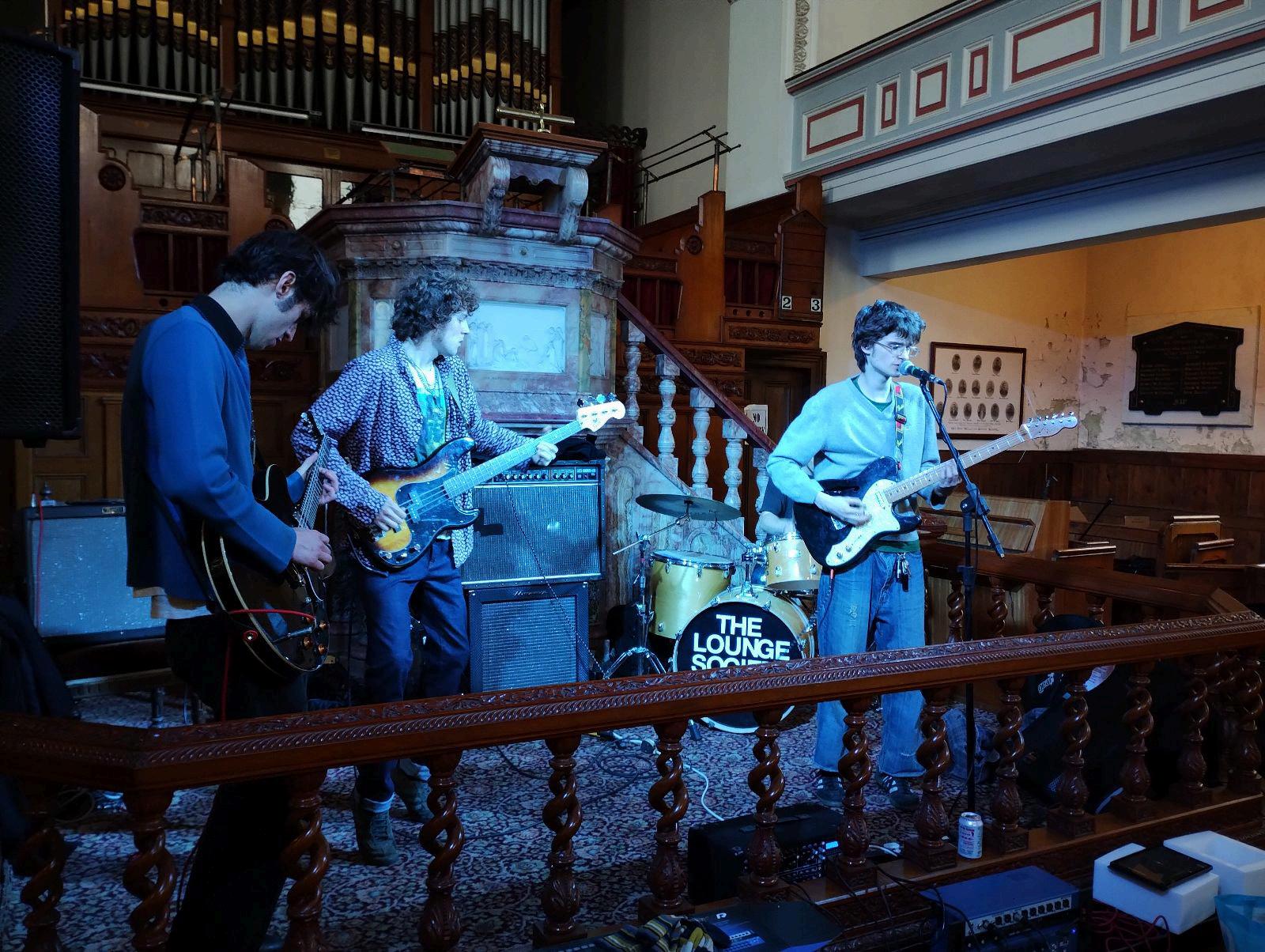
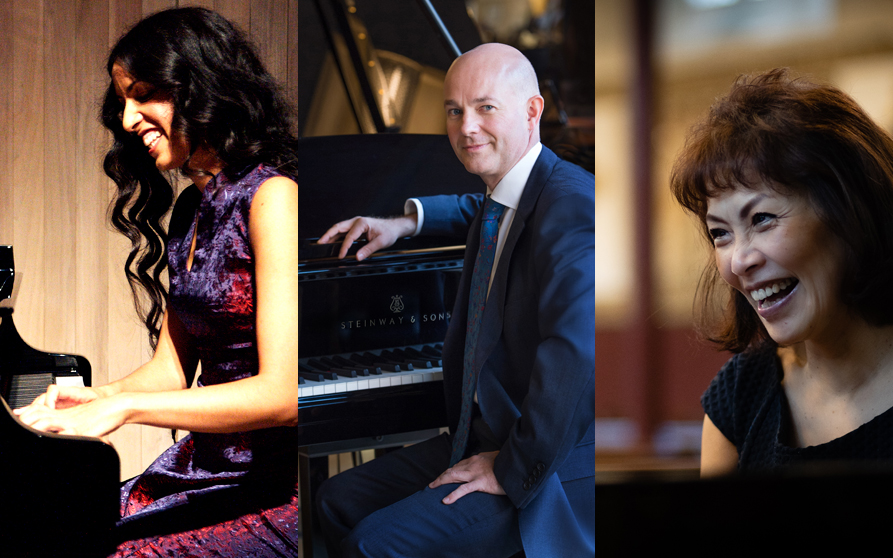
The seats (Victorian wooden pews) are not the most comfortable, and the chapel is usually pretty chilly (although we are hoping to have a new heating system installed in 2025), but audiences appreciate Wainsgate’s intimate atmosphere and superb acoustic qualities. The chapel will be closed until April 2025 for essential repair works, but the concert programme will resume after that.
To find out what’s on, go to the Wainsgate Chapel website.
* * *
Say, it might have been a fiddle
Or it could have been the wind
But there seems to be a beat now
I can feel it in my feet now
Listen, here it comes again…
From The Music Never Stopped (John Perry Barlow / Bob Weir)
* * *
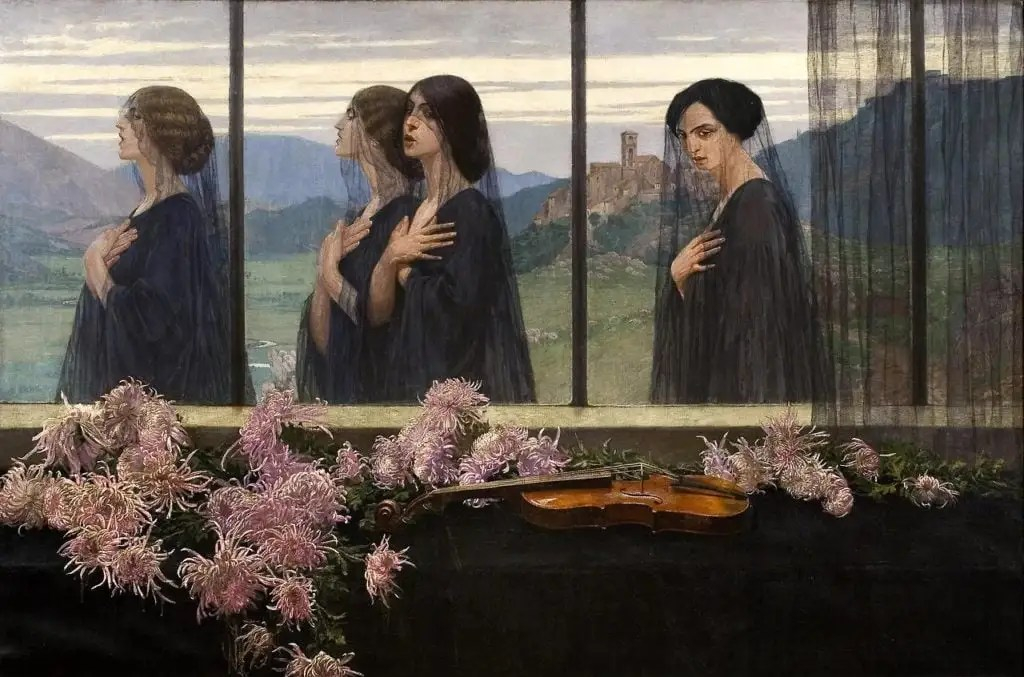
Four Strings of the Violin by Edward Okuń (1914)
 WAINSGATE GRAVEYARD PROJECT