Once we had a country and we thought it fair,
Look in the atlas and you’ll find it there:
We cannot go there now, my dear, we cannot go there now.
From Refugee Blues (1939) by W. H. Auden
Click on the LINKS to find out more…..
BELGIAN REFUGEES in WW1
Around 300 refugees were settled in the Calderdale area, with at least 30 in the Hebden Bridge area.
Eugene PARMENTIER
Belgian refugee buried at Wainsgate. Died in 1918, aged 36.
Rosalia GORREBEECK
Belgian refugee buried at Wainsgate. Died in 1914, aged 14 months.
Berhane WOLDEGABRIEL
Born in Eritrea, came to this country as a refugee, commemorated at Wainsgate.
EVACUEES in WW2
Children evacuated from London came to Hebden Bridge – Children evacuated from Brighton came to Old Town, and were lodged with local families with connections to Wainsgate – Rev. Arnold Bingham: billeting officer.
* * *
BELGIAN REFUGEES in WW1

When Germany invaded Belgium on 4th August 1914, more than 1.5 million Belgians (about 20% of the population) fled to The Netherlands, France and Britain.
There is no doubt that dreadful atrocities were committed by German troops as they invaded Belgium (such as the killing of hundreds of civilians at Dinant and Leuven), although they were often exaggerated by the British for propaganda purposes, to encourage men to enlist and to try and persuade the United States to enter the war.
The number of Belgian refugees who came to Britain is uncertain, but is probably around 250,000 in total – the largest single influx of refugees in Britain’s history. Most returned to Belgium when the war ended, but a few settled here. Belgian men were not conscripted into the armed forces, but around 60,000 supported the war effort by working in munitions factories and other vital industries.
The refugees were, initially at least, welcomed by the British people, and great efforts were made by government, local government, voluntary groups and individuals to help and support them. Sadly the initial welcome often turned to resentment as the war dragged on, and at the end of the war the government was keen to encourage the refugees to return to Belgium.
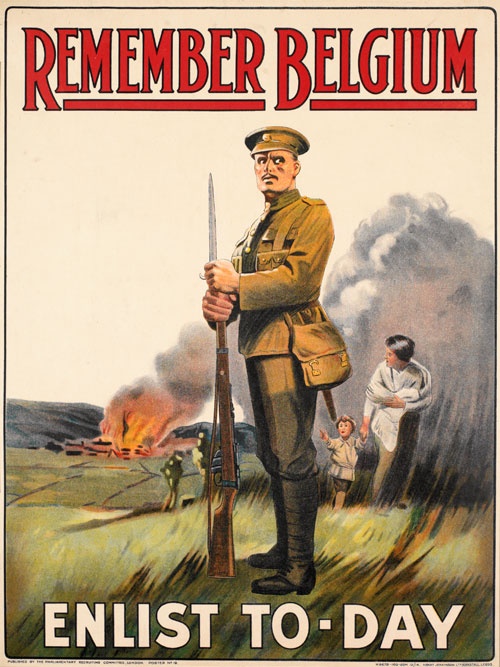
Around 300 refugees were settled in the Calderdale area, with at least 30 in the Hebden Bridge area, and at least one family lived in Old Town. Seven local women were awarded the Medaille de la Reine Elisabeth for their services to Belgian refugees: Miss M. Lord (who taught English), Miss Alice Barker (who acted as interpreter), Mrs Ingham, Mrs Frederick Lee, Mrs A. F. Thomas, Mrs Sandbach and Mrs Tatham.
The minutes of a Wainsgate Church Meeting on 27th October 1914 note:
‘That a collection be made on the 2nd Sunday in November in aid of Belgian Refugees, and that boxes be placed in the Chapel and School entrances Sunday by Sunday for voluntary contributions to same fund.’
‘That the Secretary and Treasurer of the Belgian Refugee Committee be asked to take charge of the money collected per above resolution.’
The minutes of the Meeting on 1st December 1914 note:
‘That the money collected for Belgian refugees be handed over to the Treasurer of Hebden Bridge Local Fund.’
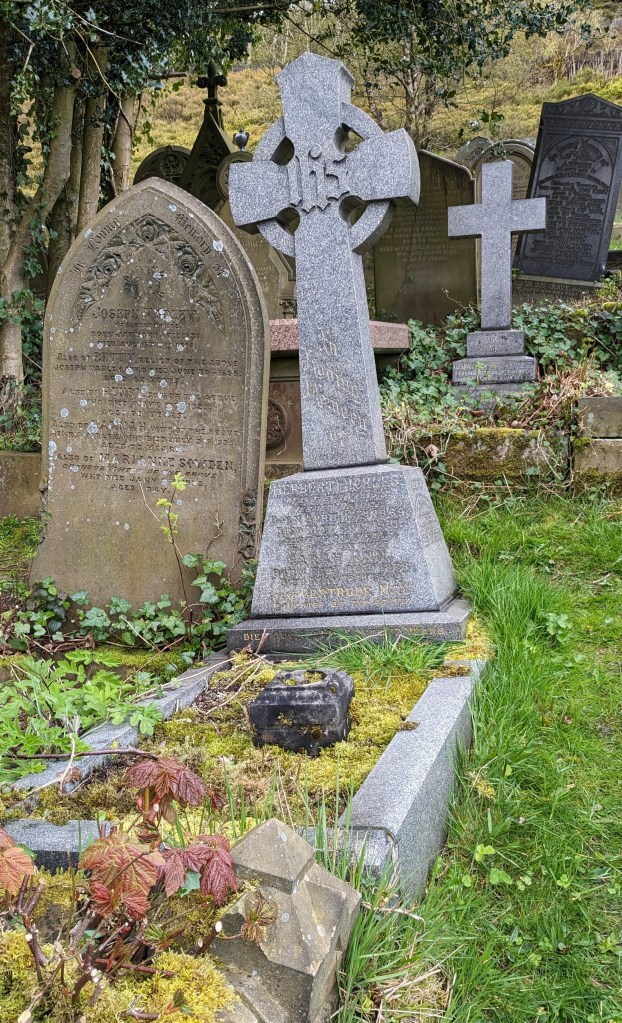
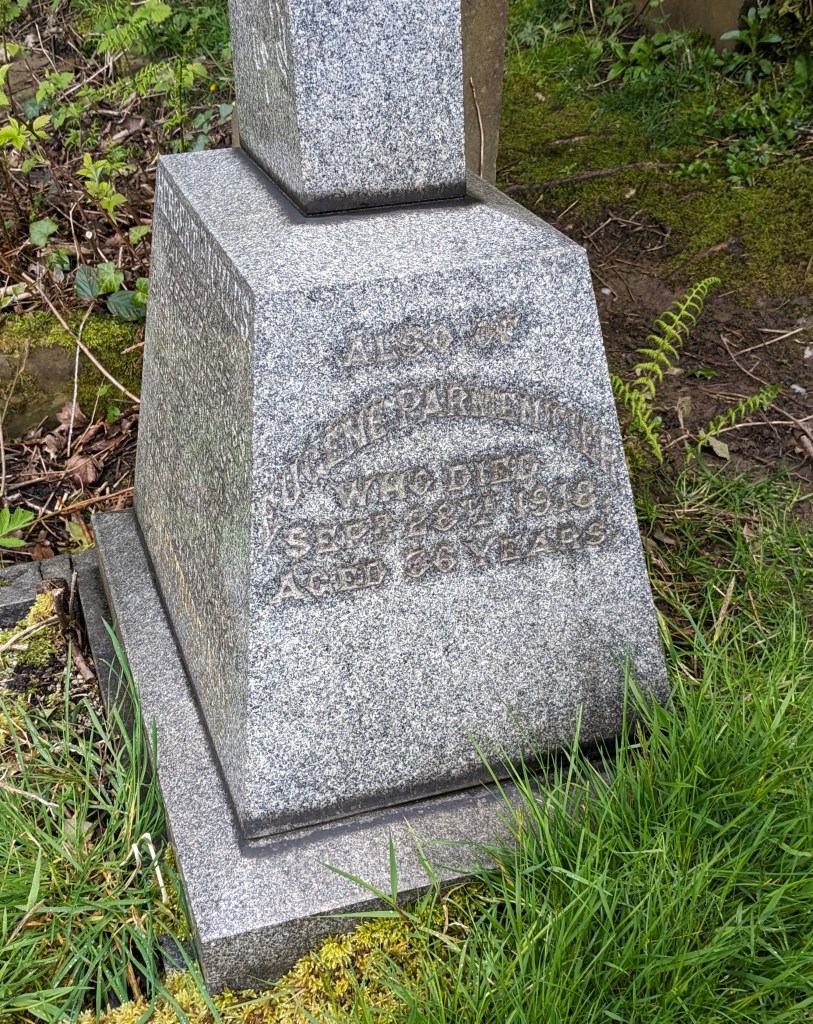
There are two Belgian refugees known to be buried in the graveyard at Wainsgate: Eugene Parmentier, who died in 1918 aged 36, and Rosalia Gorrebeeck, who died in 1914 aged 14 months.
Eugene PARMENTIER
Eugene Parmentier was living with his wife Henriette at 1, Callis Cottages, Charlestown at the time of his death. He died on 27th September 1918, aged 36: his death certificate records his occupation as munitions worker and the cause of his death as tuberculosis (larynx and lungs).
He was buried on 1st October in plot B206a at Wainsgate, which was bought in 1891 by Herbert Pickles (a fustian clothing manufacturer and Freemason) of Stubbins, Hebden Bridge, probably for a child who died in infancy. Herbert died in 1931, and is buried in this plot, together with his wife Sarah Ann, who died in 1949, and their daughter Gertrude May Pickles, who died in 1964.


What was the connection between Eugene Parmentier and Herbert Pickles, and why is he buried in the Pickles family grave?
We don’t know anything about his background or his time in Hebden Bridge (apart from a newspaper report in February 1916 that he was refused a leaving certificate to go to London by the Halifax Munitions Tribunal). Eugene died a few weeks before the Armistice in November 1918: his widow Henriette appears to have returned to Belgium at the end of the war.
Rosalia GORREBEECK
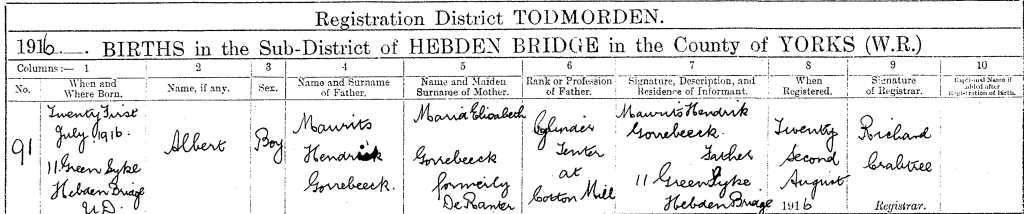
Rosalia Gorrebeeck was the daughter of Maria Elisabeth Gorrebeeck (born De Ranter) and Maurits Hendrik Gorrebeeck, and would have been less than a year old when the family fled from Belgium. They were living at Crabtree Fold, Old Town when Rosalia died on New Year’s Eve 1914, aged 14 months. Her death certificate gives the cause of death as ‘Measles and Dentition Convulsions’, and gives her father’s occupation as ‘fabric worker’.

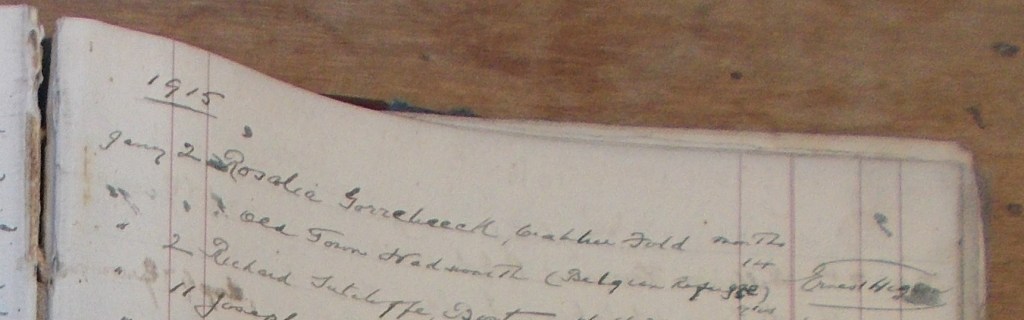
Rosalia was buried at Wainsgate on 2nd January 1915 (the burial register describes her as ‘Belgian refugee’), but there is no record of exactly where in the graveyard she was buried. It is likely that she was buried in an unmarked ‘public’ or ‘common’ grave: there are several plots which were purchased by Wadsworth Township which were probably used for what used to be known as ‘pauper’s burials’.
We know very little about the family and their background, although their names suggest a Dutch heritage. A local newspaper reported Rosalia’s death:
‘DEATH OF A REFUGEE BABY. Widespread sympathy has been evoked on the Wadsworth hillside and extended to the family of Belgian refugees, residing in a cottage at Old Town, who on Wednesday evening, lost their one-year-old child. Driven from their home in Belgium by the Germans, this family has met with much sickness since they came to Hebden Bridge, and now death has entered their home. These poor people are surely getting more than their share of misfortune.’
The Halifax Weekly Courier reported on 11th March 1916:
‘Marion Garrebeck (sic), a Belgian, of Old Town, Hebden Bridge, was fetching some milk on Monday when she slipped and fractured her leg. She was conveyed to Halifax Infirmary.’
On 21st July 1916, Maria (now living with Maurits at 11, Green Syke, Hebden Bridge) gave birth to a son, Albert. As far as we know they returned to Belgium at the end of the war: they left their daughter buried in the graveyard at Wainsgate, but returned home with a young son born in Hebden Bridge.
* * *
There is documentary evidence of a few other Belgian refugees who came to Hebden Bridge: the details below are mostly taken from Tracing the Belgian Refugees – a digital project run by the universities of Leeds, Leuven and UCL – belgianrefugees.leeds.ac.uk. Some of the names may be incorrectly spelled, something which seemed to be quite common in Brtish documentation of Belgian surnames:
Josef FLENCK – Hebden Bridge.
Jean & Anna Maria Alphonsine LENS (daughter) – 15, Bridge Gate, Hebden Bridge.
Philemon & Joseph T. MORTIER (son) – 30, King Street, Hebden Bridge.
Mme PERCY – Hebden Bridge.
Joseph PETERS – Heath House, Hebden Bridge. From the town of Lier, near Antwerp.
Saylor PETREUS – Heath Bank, Hebden Bridge. Head of a family of six.
Silvesin & Carolina PEYNSHAERT (daughter) – 14, King Street, Hebden Bridge.
Pierre SETOR – According to newspaper reports (Halifax Weekly Courier 24.3.1917), he left Hebden Bridge Secondary School to go to sea. On his first voyage his ship was reported wrecked or torpedoed with all hands lost, but his parents were later informed that their son and other survivors had landed on an island in the West Indies.
M. SUPONTIER – applied to leave Hebden Bridge to enlist with the Belgian army (Halifax Weekly Guardian 6.5.1916).
Mme Van GERVEN – Cliffe House, Hebden Bridge, with her son and daughter.
Mme VERBEIST – left Hebden Bridge for London with her two daughters (Halifax Weekly Guardian 4.12.1915).
Gerard Joseph & Victoria Francisca VERMIER (or VERNIER?) – children of Karel Camile VERMIER of 26, Green Syke.
M. BERNHARD (or possibly BERNARD, BRENARD or BERNHARDI) attended the funeral of 2nd Lt Vernon Harcourt Clay MC, who was mortally wounded during the battle of the Somme in July 1916, and died of his wounds in London in October, aged 21. His funeral service was held at Hope Chapel and he was buried at Wainsgate.
Some other surnames occur in the records, but we know nothing about them:
Syter, Carpentier, Castus, Smetz, Ghesquira, Lyter, Moorthamer, Rosseel, Verreyken and Zeilman.
* * *
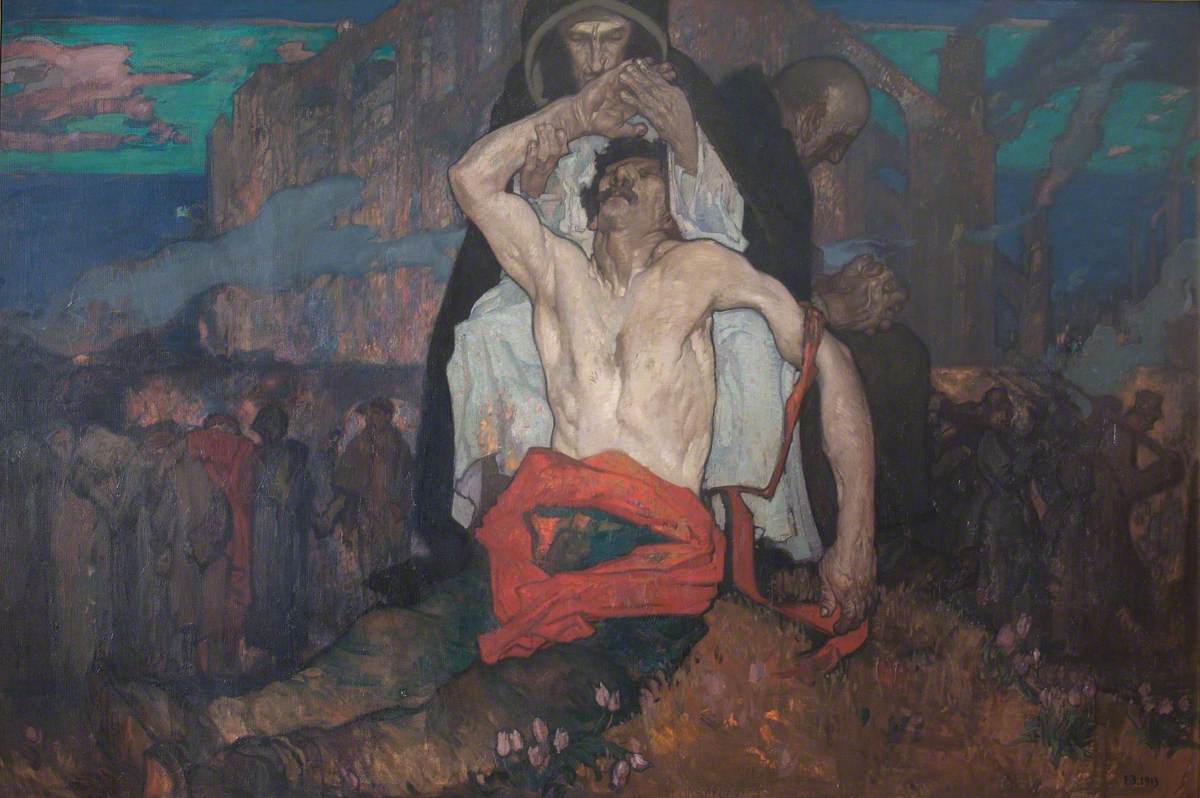
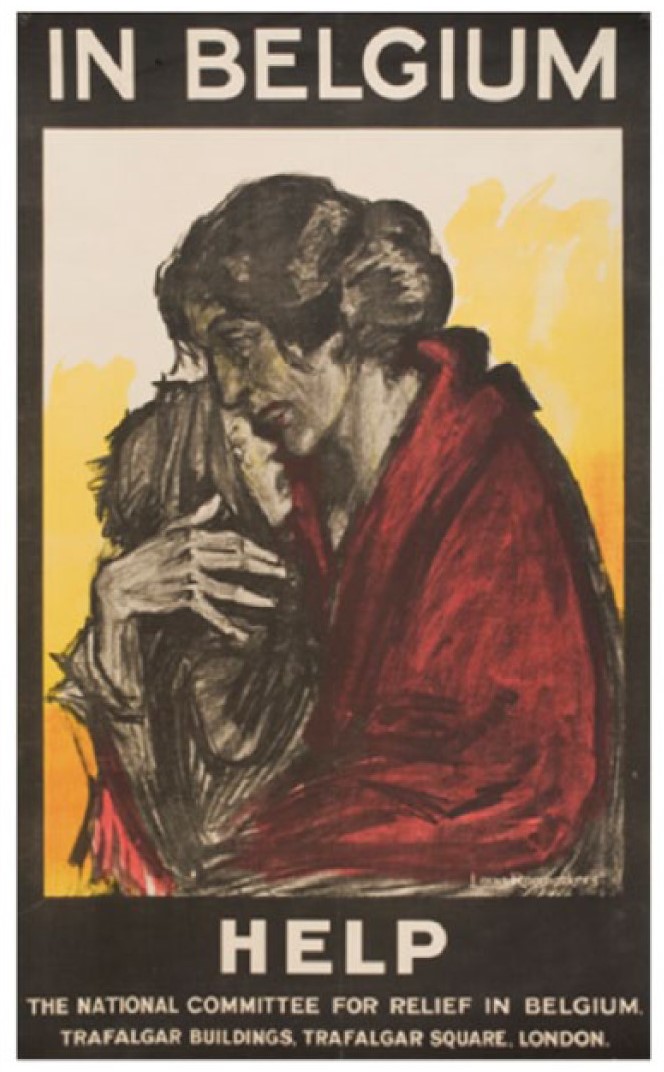
Mater Dolorosa Belgica (1915) by Frank Brangwyn (1867–1956)
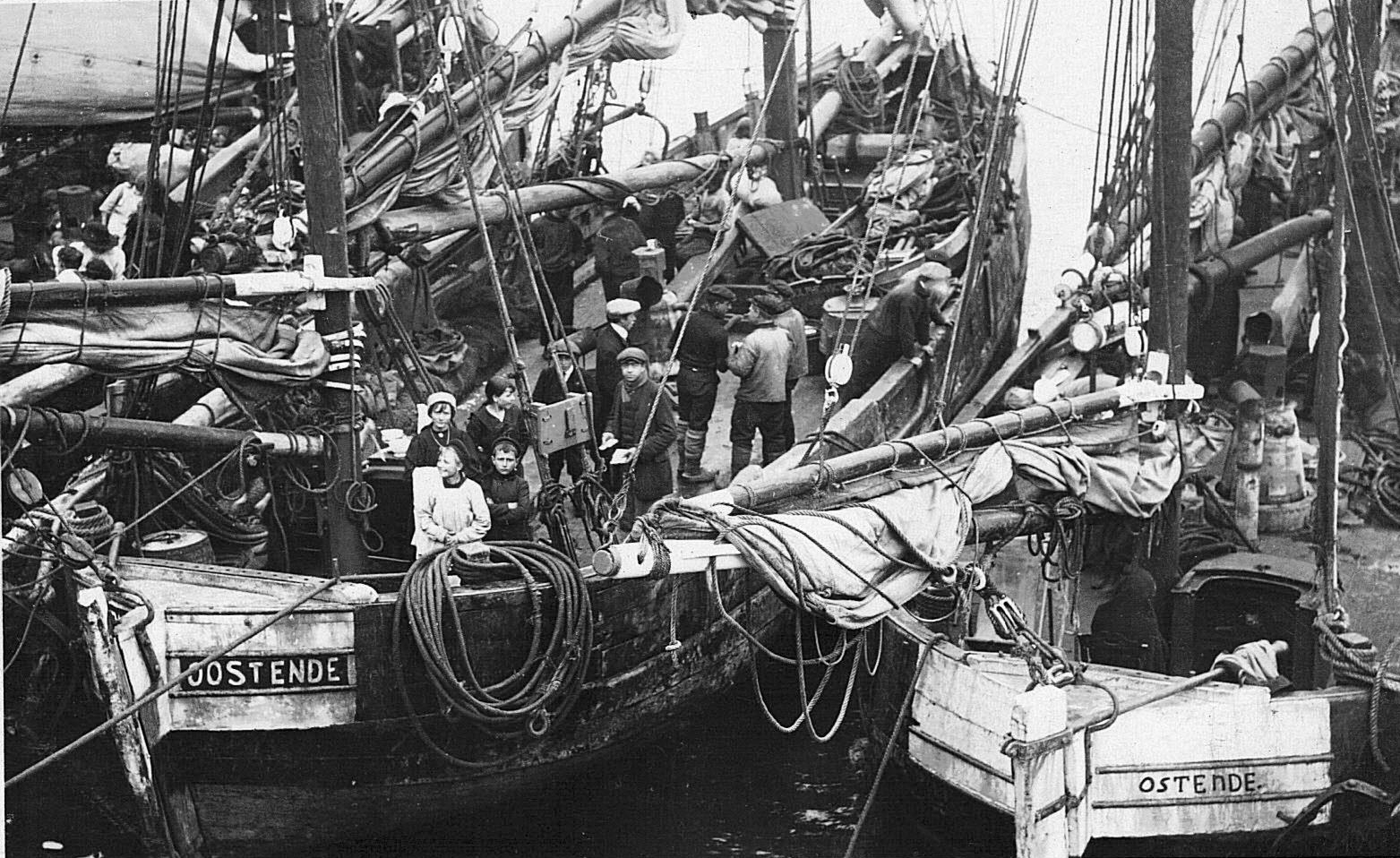
Despite the large number of Belgian refugees who came to this country in such a short period of time (over 16,000 arrived in Folkestone on 14th October 1914), they left little legacy and their story is largely forgotten in Britain. Within a year of the war ending, more than 90% of the refugees had returned to Belgium.
One of the best known Belgians to most British people is Hercule Poirot, the fictional detective created by Agatha Christie, and it is said that she based the character on a Belgian refugee she met in Torquay, possibly Jacques Hornais, a retired police officer.
Another well known (and real) Belgian was the comic strip artist Georges Remi (1907-1983), better known as Hergé, the creator of Tin Tin. His first cartoon character is believed to have been a young boy who stood up against the German occupation of 1914-1918, but these were drawings in his school books which have been lost. In 1944 he was accused of being a collaborator by the Belgian Resistance on account of his work for the Belgian newspaper Le Soir, which was under Nazi control and which supported the German war effort and espoused anti-Semitism.

* * *
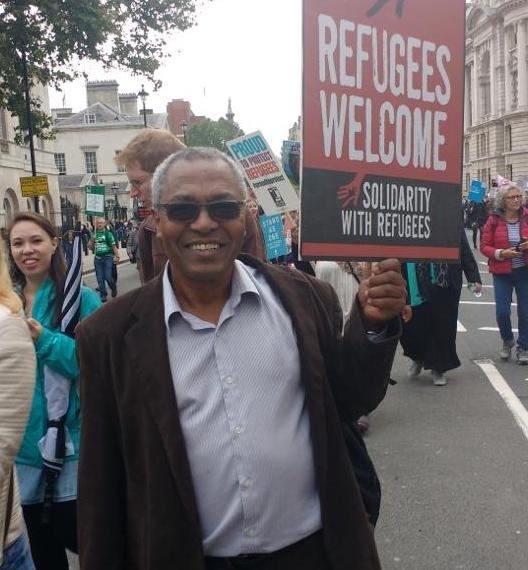
Berhane WOLDEGABRIEL
Berhane Woldegabriel was born in Eritrea in 1946, moving to Ethiopia to train and work as a teacher. War and political upheaval meant that he could not return to Eritrea permanently, and he escaped the repressive regime in Ethiopia by walking 1,000 miles to Sudan. After 13 years in Sudan, where he worked for the UNHCR helping with the settlement of Eritrean refugees he was once again forced to flee from his adopted country, and sought sanctuary in the UK.
From 1993 Berhane lived in London, where he worked at SOAS, University of London, whilst assisting refugees to the UK from Eritrea and other countries. In 2017 he left SOAS to undertake expeditions with Save the Children, helping refugees who were making the dangerous sea crossing from Africa to Europe.
Before his death in 2020 he had expressed a wish to be buried at Wainsgate, but this was not to be, and he was buried in London, but a headstone in his memory was erected in the graveyard at Wainsgate. To find out more about his life, click here.
EVACUEES in WW2
At the outbreak of the Second World War, fear that German bombing would cause civilian deaths prompted the government to evacuate children, mothers with infants and the infirm from British towns and cities, under the codename ‘Operation Pied Piper’. Evacuation took place in several waves. The first came on 1st September 1939 – the day Germany invaded Poland and two days before the British declaration of war. Over the course of three days 1.5 million evacuees were sent to rural locations considered to be safe.
By the end of 1939, when the widely expected bombing raids on cities had failed to materialise, many parents whose children had been evacuated in September decided to bring them home again. By January 1940 almost half of the evacuees returned home.
Further evacuations from coastal towns in south and south-west England took place in June 1940, following the fall of France, and the consequent fear that Britain would be invaded, as well as evacuations from cities affected by the Blitz, which started in September 1940. Yet another wave of evacuations took place in June 1944, when Germany launched V-weapon attacks on towns and cities in the east and south-east of England
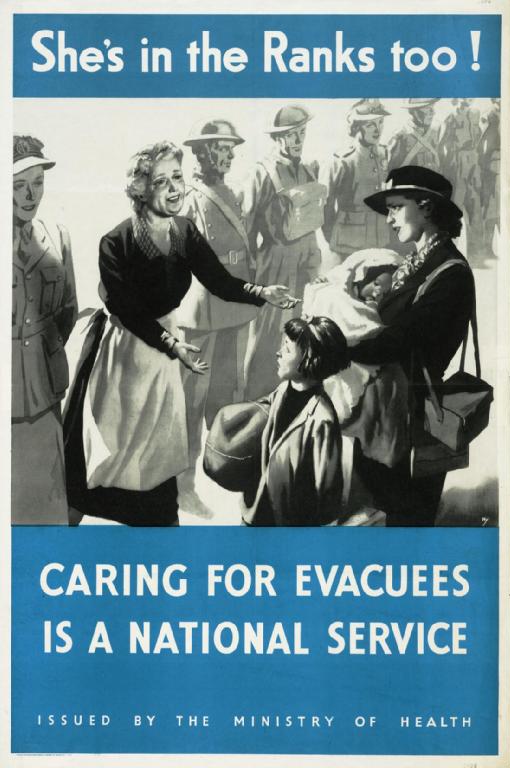
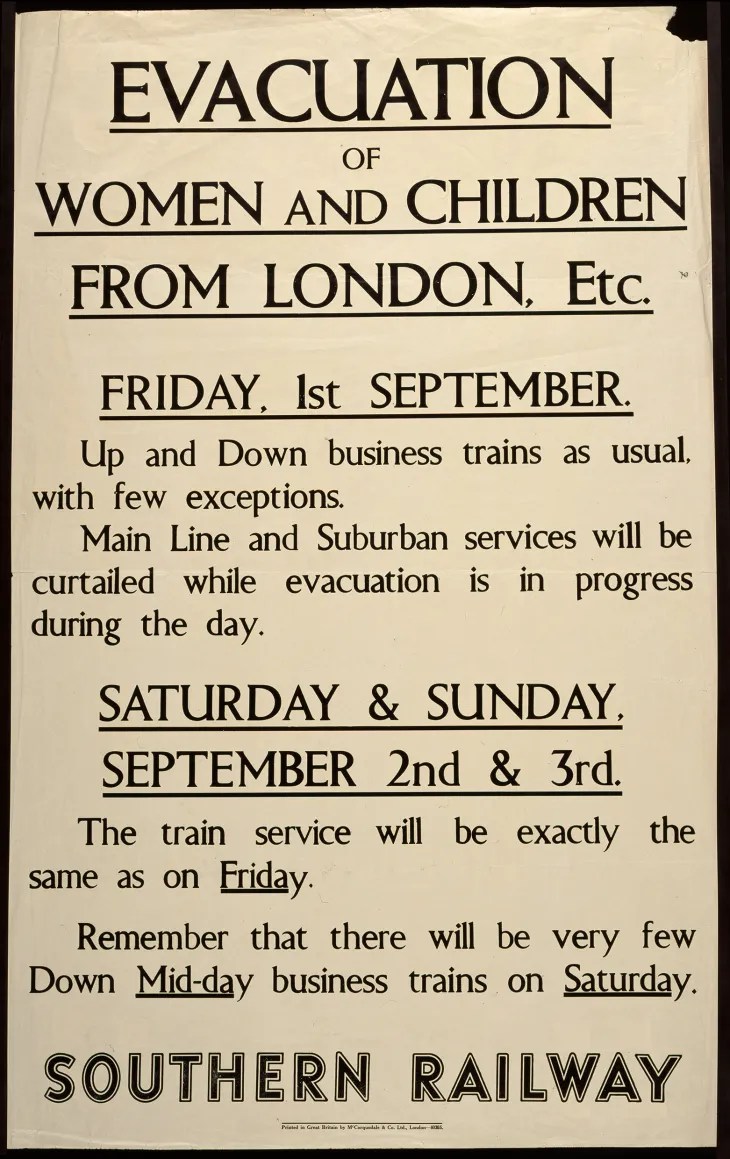
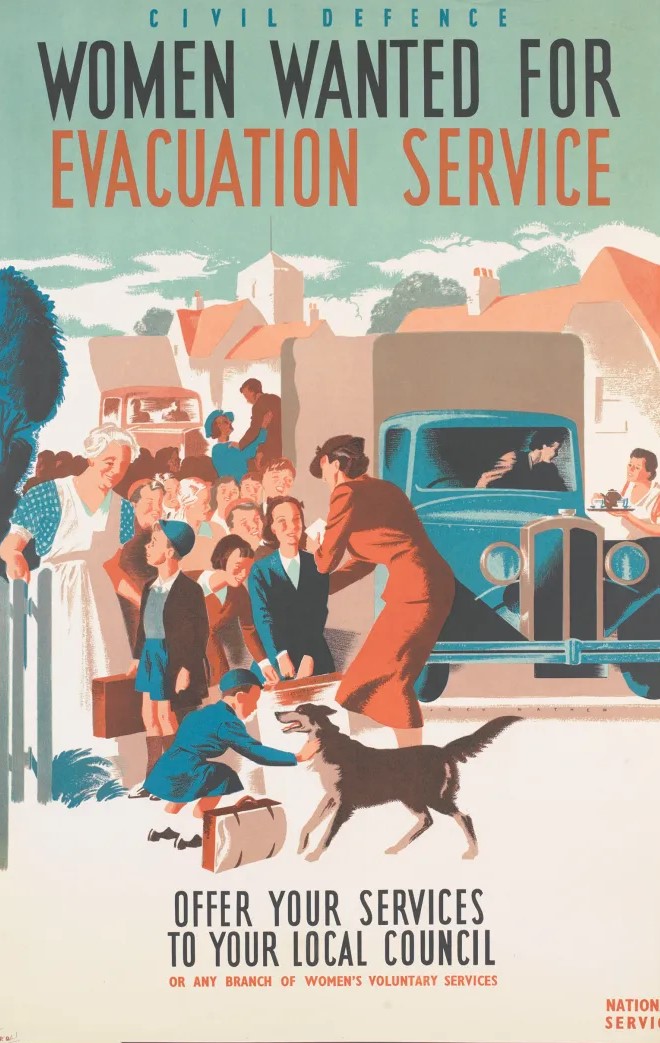
Posters from the Imperial War Museums collection.
We know that evacuues from London, and perhaps other towns and cities, came to the Hebden Bridge area. We also know that several children from Brighton were evacuated to Old Town in 1940, including a seven year old boy called David Blackford who was billeted with the Sager family, who lived at 6, Waterloo Bank.
I was about 7 years of age when I was evacuated to Hebden Bridge from Brighton by train, with my gasmask, label and my clothes in a haversack. The only thing I remember about the journey was that we stopped overnight somewhere which was a bit scary. I think it must have been workhouse place or something with a lot of old men. I was billeted with Mr & Mrs Sager in Old Town at the top of the hill, on the edge of the moors. They had a son Edward who I got on very well with and I enjoyed my time there very much. However, after about 9 months my mum came and took me home. Apparently I had a strong Yorkshire accent! I’ve never been back to the area but looking at it on Google Earth, it brings back many memories.
The words of evacuee David Blackford, from My Brighton and Hove website, 2009/2010.
The Sager family consisted of the widowed John Sager, a house painter and plasterer who had served in the Carrier Pigeon Service in WW1, and his unmarried adult daughters Sarah Ellen and Lilian (later Lilian Booth).
David Blackford’s account of his time in Old Town mentions their son Edward, who was in fact John Sager’s grandson, born in January 1935, the son of Joe Sutcliffe Sager, who was living just down the road at 1 Ayre View.
John Sager, his wife Grace (who died in 1922), their son Joe Sutcliffe Sager, his wife Elsie and their son Edward Beaton Sager, and John and Grace’s daughters Agnes Nash and Sarah Ellen Sager are all interred at Wainsgate, in plot C636/637.
Another evacuee from Brighton recalls his experience of coming to Hebden Bridge:
I remembered going to Brighton Station and standing there with a brown label round my neck and going to Hebden Bridge I think it took all day and I thought it was the end of the world with strange people with clogs. I lived with Mr and Mrs Greenwood at 5 Stoodley View, the most genuine and kind people I have met. He was a manager down the mill in Hebden Bridge and made me a suit of worsted. I went to school up Heptonstall? Did anybody attend this school? Some of the boys rode their horses to school.
The words of evacuee ‘tony‘, from My Brighton and Hove website, 2009.
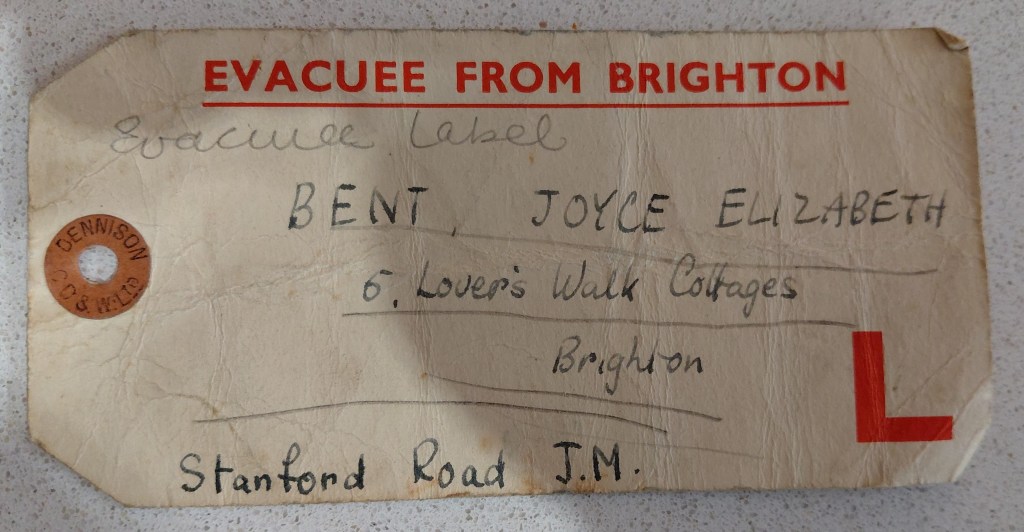
Also from Brighton was Joyce Elizabeth Bent, who lived at 6, Lover’s Walk Cottages, a historic (and now very desirable) street near Preston Park. She was one of two children from Brighton who were billeted with Tom Crossley Ashworth and his wife Rose on their poultry farm at Wainsgate (now Wainsgate Farm). The families of both children kept in touch with the Ashworths after the war.
* * *
Wainsgate Farm was also home to a detachment of soldiers who were stationed there during the war: they manned a searchlight that was used to spot German bombers heading for the industrial cities of the north-west.
These installations were part of the Anti-Aircraft Command network, established in April 1939, and were part of the British Army but under the operational direction of RAF Fighter Command. They were generally operated by Territorial Army personnel, but as the war progressed, Regulars and TA were freed up for overseas service by the use of men of the Home Guard and women of the Auxiliary Territorial Service.
Women of the ATS operating a 90cm searchlight, which may well be similar to the one installed at Wainsgate Farm.
The powerful carbon arc lamps could locate and illuminate enemy bombers, allowing them to be intercepted by night fighters or ground based ant-aircraft guns.
One of the soldiers who was based at Wainsgate taught Rose Ashworth to knit. He was later killed during the D-Day Normandy landings in June 1944.

Thanks to Peter Whitam (Tom Crossley Ashworth’s grandson) for his memories and the image of the evacuee label.
* * *
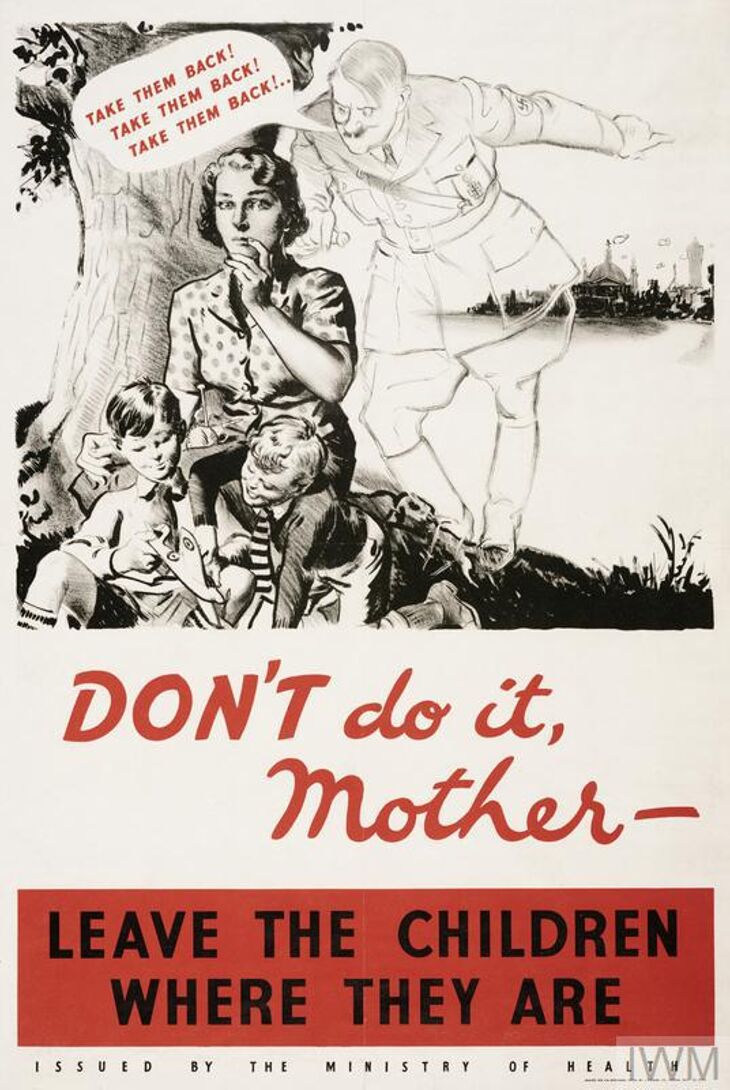

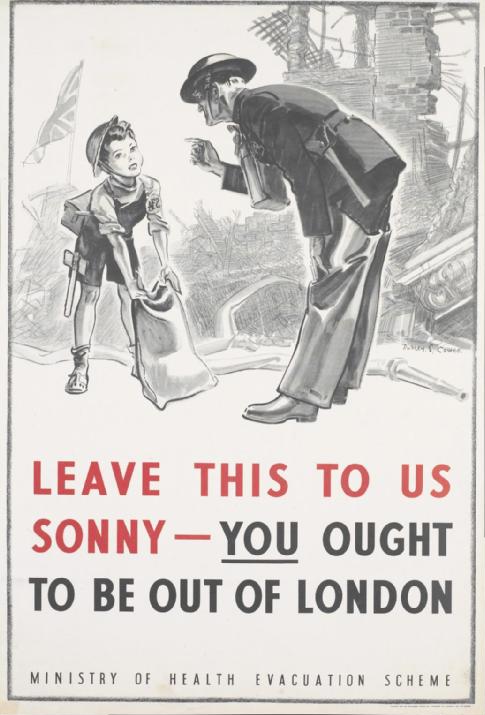
Posters from the Imperial War Museums collection. The stained glass window, by Michael Stokes, is in All Saints Church, Sudbury, Derbyshire, and was a gift from former WW2 child evacuees from inner-city Manchester to the community of Sudbury who looked after them. The quotation on the window is from Matthew 25:35 (New King James Version):
For I was hungry and you gave me food; I was thirsty and you gave me drink; I was a stranger and you took me in.
Arnold BINGHAM – Billeting Officer
Arnold Bingham was a local Baptist minister and community activist, who was appointed as evacuation billeting officer for the Hebden Royd area in late 1940 or early 1941, shortly after resigning the pastorate of Brearley Baptist Church. The billeting officer was responsible for finding suitable accommodation for evacuees, and had the power to force people to take in evacuees and also to requisition suitable empty properties. He also had to deal with disputes between evacuees and hosts, and to try and persuade unwilling hosts to comply with his billeting notices.
Mary Jackson of 9, Oak Street, Hebden Bridge, was summoned in 1942 for failing to comply with a billeting notice issued by Arnold Bingham, who had selected her to house one of a party of unaccompanied evacuee children. Mrs Jackson claimed that she could not take the child (a boy aged 12) because she worked, although Bingham pointed out that a considerable number of evacuee children were billeted in homes in the district where women went out working.
After several unsuccessful attempts at getting Mrs Jackson to take him in, the poor boy was taken to a hostel, and was later cared for by a London evacuee, a widow who had lost her husband and two daughters in the blitz (and who went out to work earn a living). Mrs Jackson was fined £1.
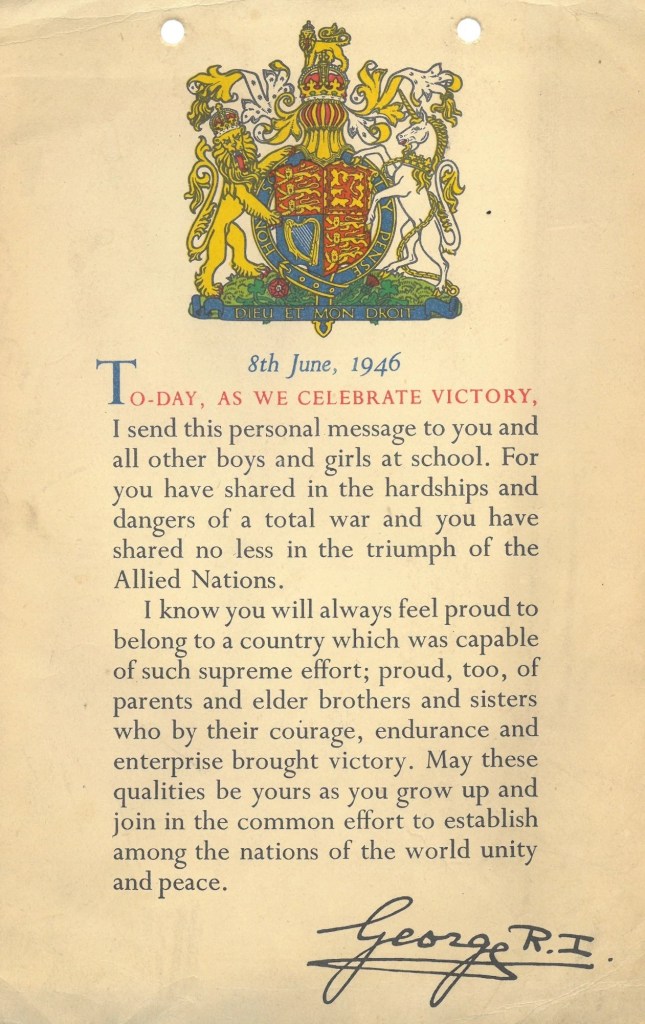
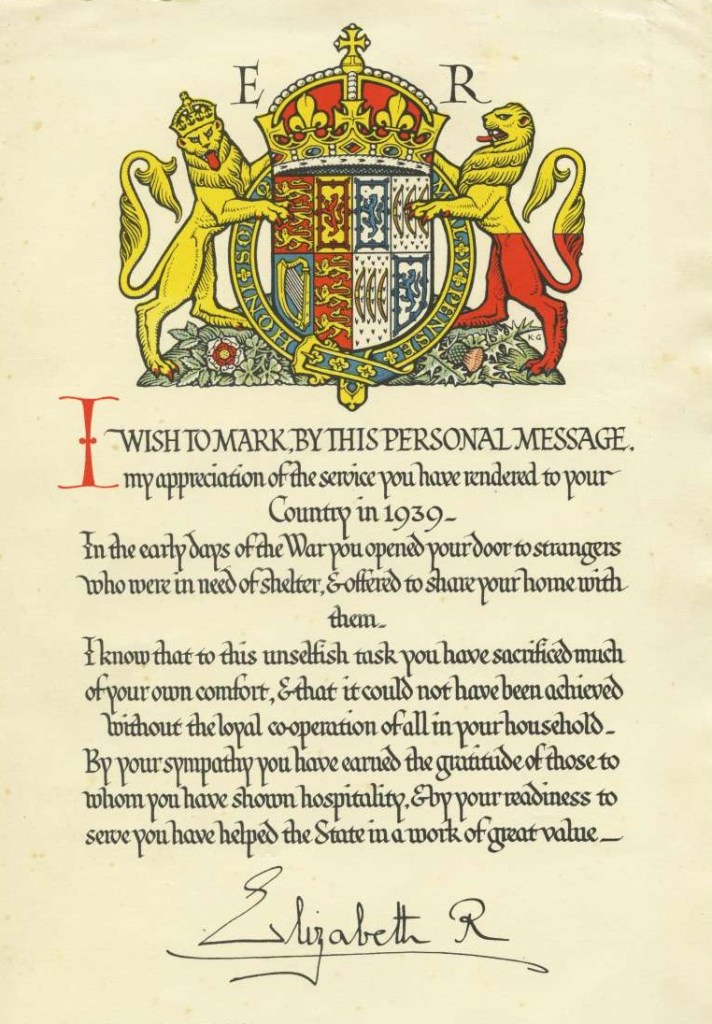
The certificate on the left was given to every school child at the end of the war, and the certificate on the right was sent to households who had hosted evacuees. It is signed by Queen Elizabeth, wife of King George VI, and mother of Queen Elizabeth II.
* * *
Be not forgetful to entertain strangers: for thereby some have entertained angels unawares.
Hebrews 13:2
 WAINSGATE GRAVEYARD PROJECT