We love the venerable house
Our fathers built to God;
In heaven are kept their grateful vows,
Their dust endears the sod.
And anxious hearts have pondered here
The mystery of life,
And prayed the Eternal Spirit clear
Their doubts and aid their strife.
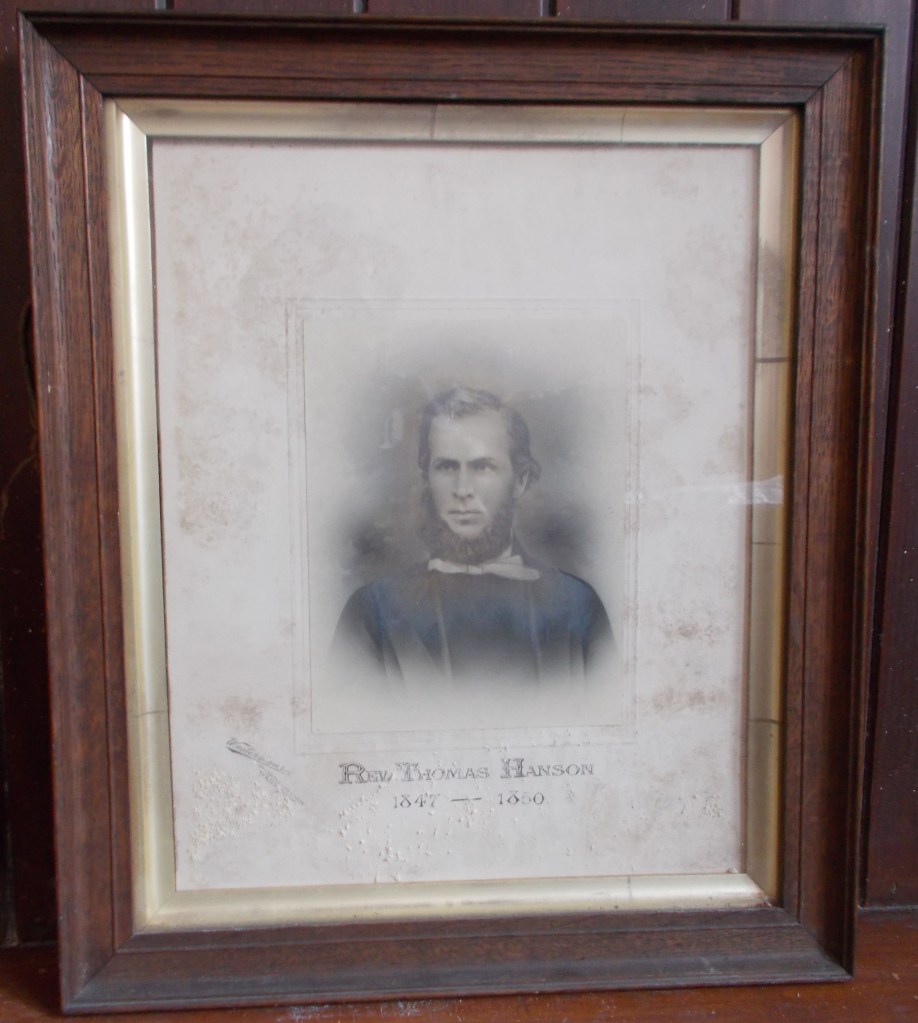
Rev. Thomas Hanson (1847-1850)
From humble tenements around
Came up the pensive train,
And in the church a blessing found,
That filled their homes again.
They live with God their homes are dust;
Yet here their children pray,
And in this fleeting lifetime trust
To find the narrow way.
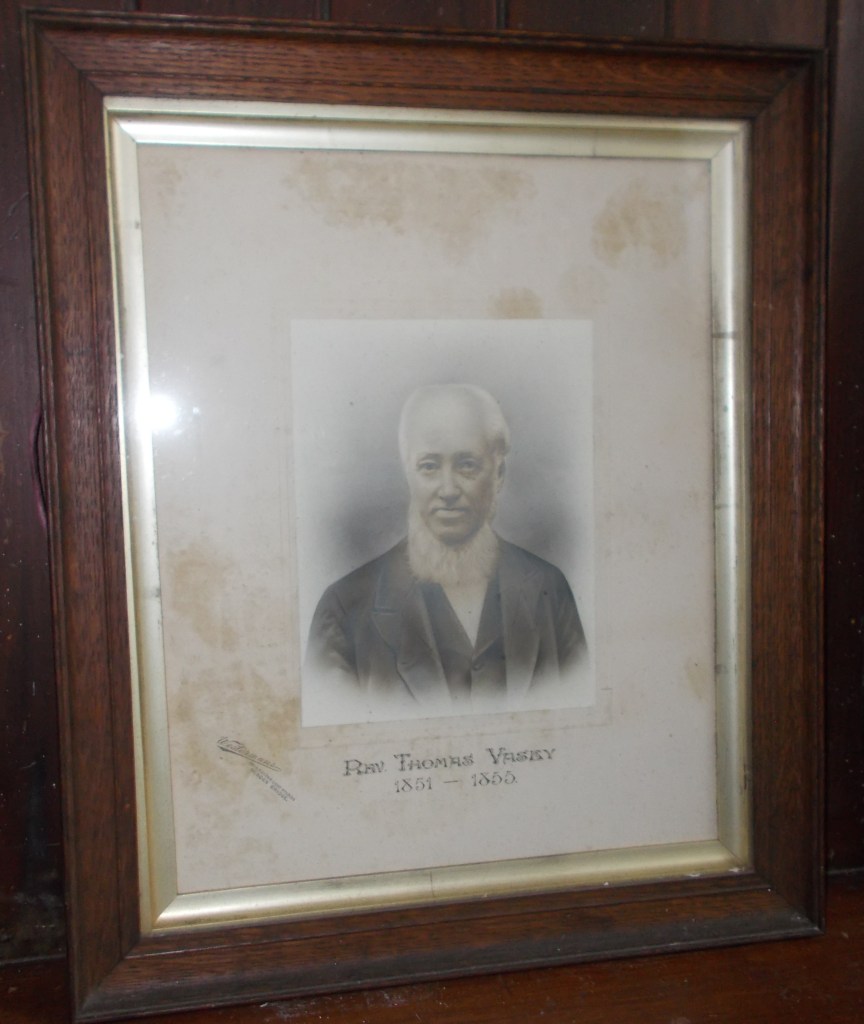
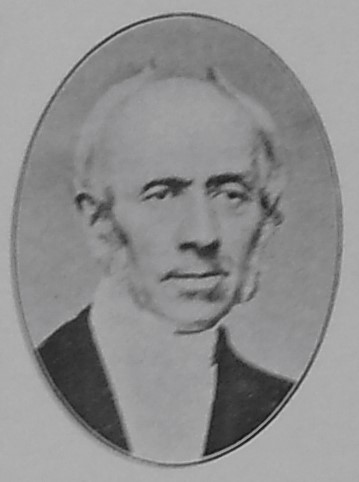
Rev. Thomas Vasey (1851-1855)
On him who by the altar stands,
On him Thy blessing fall!
Speak through his lips Thy pure commands,
Thou Heart, that lovest all!
From the hymn We love the Venerable House – words by Ralph Waldo Emerson, 1833. Emerson (1803-1882) was a Unitarian minister, philosopher, essayist and poet.
The last stanza of the hymn was traditionally used for the induction of a new minister.
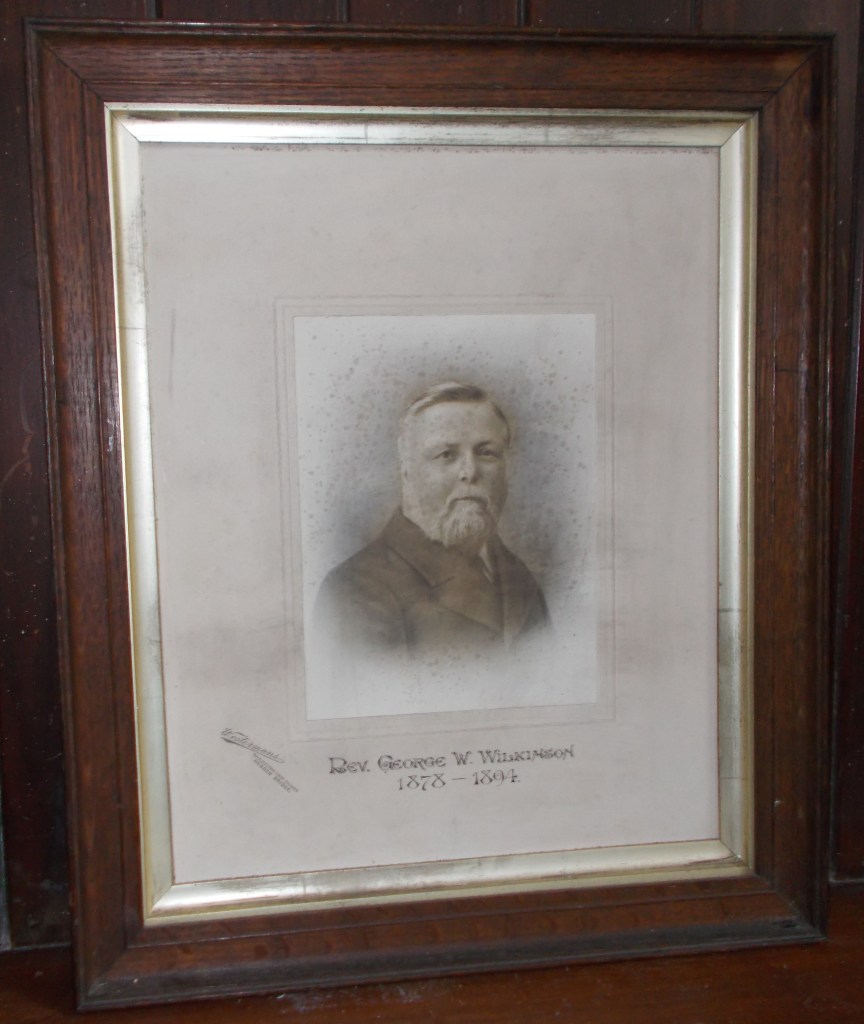
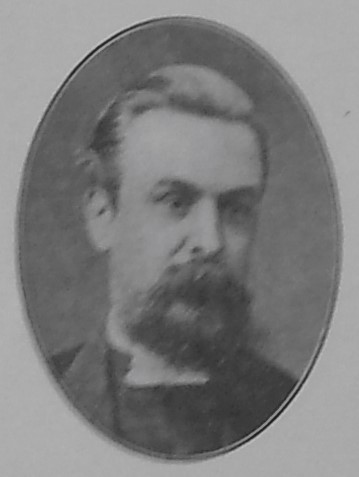
Rev. George W. Wilkinson (1878-1894)
There were 27 full-time or part-time ministers at Wainsgate between 1750 and 2001. Of these, only three are known for certain to be buried in the graveyard at Wainsgate: the first two ministers, Richard Smith (1750 to 1763) and John Fawcett (1763 to 1777), and James Jack, minister from 1901 to 1906. A fourth minister, Isaac Normington (1800 to 1810) is almost certainly buried at Wainsgate, but his name is misspelled on both the gravestone and burial register entry.
There is also a headstone commemorating John Bamber, minister at Wainsgate from 1855 to 1878, although he was buried at Inskip Baptist Chapel, Lancashire.
Three daughters of Mark Holroyd, minister from 1810 to 1835 who emigrated to America, are buried at Wainsgate, as is the first wife and three children of Jonas Smith, minister at Wainsgate from 1845 to 1847.
There are also three ministers from other nearby Baptist churches who are buried at Wainsgate: John Crook, Peter Scott and Arnold Bingham. John Fawcett jnr, son of Rev. John Fawcett and himself sometimes adopting the title Reverend, is buried in the Fawcett tomb at Wainsgate. Two of his sons, James and Stephen, both of whom were actively involved in the Baptist church, are also buried at Wainsgate.
Henry Briggs, minister at Roomfield Baptist Church, Todmorden, bought two burial plots at Wainsgate: his infant daughter is buried in one of these, but the other plot may not have been used. Caroline, the infant daughter of William Henry Ibberson, pastor at Hope Chapel, Hebden Bridge, is also buried at Wainsgate.
* * *
Click on the LINKS to find out more…..
Richard SMITH
‘This man’s words fall on us like mill-stones‘.
Came from Barnoldswick as Wainsgate’s first pastor from 1750 until his death in 1763. Buried at Wainsgate with his wife Judith.
John FAWCETT
‘It may truly said of him that he was a burning and shining light’
Theologian, author, teacher, composer of the hymn ‘Blest be the Tie that Binds’ and Wainsgate’s second pastor, from 1763 until 1777. Buried at Wainsgate with other members of his family.
John FAWCETT jnr
Son of John Fawcett, dissenting minister, teacher at his father’s academies at Brearley Hall and Ewood Hall and author of the definitive account of his father’s life and works. Buried in the family tomb at Wainsgate.
James, Stephen & William FAWCETT
John Fawcett jnr’s sons James and Stephen were both involved with the Baptist church and are buried at Wainsgate. His son William became a Baptist minister and is buried in Florence.
William WRATHALL
Fifth minister at Wainsgate, from 1788 to 1790. Burial place unknown.
John PARKER
‘It was a feast divine to sit under the sound of his voice….. a torrent of sacred eloquence, issuing from the fervour of his mind, seemed to carry away the hearts of his hearers before it’.
Minister at Wainsgate from 1790 to 1792: like Richard Smith he came to Wainsgate from Barnoldswick. He died at Wainsgate and is buried at Barnoldswick.
Isaac NORMINGTON
Minister at Wainsgate from 1800 to 1810. Almost certainly buried at Wainsgate.
Mark HOLROYD
Minister at Wainsgate from 1810 to 1835, when he emigrated to America. Three of his daughters, Hannah, Susannah and Sarah are buried at Wainsgate. Mark Holroyd is buried at Forest Hill Cemetery, Wyanet, Illinois.
Peter SCOTT
‘In the pulpit he preached with fervour and passion.’
Born in Scotland, minister at Brearley Baptist Church from 1853 to 1865. Buried at Wainsgate.
John CROOK
Minister at Ebenezer and Hope Baptist chapels, Hebden Bridge from 1841 to 1859. Buried at Wainsgate with his wife Mary.
Jonas SMITH
Minister at Wainsgate from 1845 to 1847. His first wife Hannah and three children (Joseph, Ellen and Edwin) are buried at Wainsgate. Jonas Smith’s burial place is unknown.
John BAMBER
Minister at Wainsgate for 23 years, from 1855 to 1878. Oversaw the rebuilding of the chapel and Sunday School in 1859. He and his wife Margaret are buried at Inskip, Lancashire but commemorated in the graveyard at Wainsgate.
Henry BRIGGS
Minister at Millwood chapel and Roomfield Baptist Church, Todmorden from 1871 to 1909. Bought two burial plots at Wainsgate and buried his infant daughter Flora there.
George William WILKINSON
Minister at Wainsgate from 1878 to 1894. Buried at Heptonstall Slack Baptist cemetery.
James JACK
Minister at Wainsgate from 1901 to 1906. Named his daughter Jeannie Munro Wainsgate Jack. Buried at Wainsgate with Jeannie and his wife Margaret.
Joseph FIELDING
Minister at Wainsgate from 1921 to 1930, coming there from Oldham. Once referred to as ‘the Bishop of Wadsworth’.
Arnold BINGHAM
‘He went about doing good’
Minister at Brearley Baptist Church, evangelist, missionary, social worker. Buried at Wainsgate with his wife Ellen.
Henry MEADOWS
Minister at Wainsgate from 1944 to 1946, later emigrating to Australia.
David Finlay NEIL
Came to Wainsgate from Glasgow, minister from 1955 to 1958. Assured by his new congregation that he would be ‘settling in a gradely country, among gradely folk’.
WAINSGATE MINISTERS 1750 – 2001
The twenty-seven full-time or part-time ministers who led the congregation at Wainsgate from its inception to its closure as a place of worship 251 years later.
LAY PREACHERS & DEACONS
LAY PREACHERS
‘Those who are called to serve the church through a ministry of preaching while living out their primary Christian vocation in the wider world beyond the church’.
DEACONS
‘Responsible for the leadership of the church, the fulfilment of its purpose, the pastoral care of its members and its day-to-day management and administration’.
CONGREGATIONS
From Wainsgate’s founding in 1750 to its closure in 2001 – how many people worshipped at Wainsgate, and who were they?
* * *
Richard SMITH (c1713-1763)
Richard Smith became the first pastor at Wainsgate in 1750. His conversion came as a result of the preaching of William Grimshaw (1708-1763), the evangelical Anglican incumbent of Haworth, and after his conversion he joined Barnoldswick Baptist Church and became a preacher himself.
‘For some time his mind was in a gloomy desponding state, and he was harassed with many disquieting fears respecting his own personal interest in God’s salvation; but he was earnest in prayer, and other means of grace, till at length it pleased God to calm his troubled breast, and to fill his heart with “joy and peace in believing”. Being possessed of strong natural parts, and diligent in his application to study, it was the general opinion of his religious friends that he was designed for public usefulness in the Church of God.’
The first meeting house at Wainsgate was erected around 1750, paid for by private subscriptions: the land for the meeting house, burial ground and minister’s house was donated by a local farmer. At that time there was no place of worship in the township of Wadsworth, and few people had enough schooling to read the Bible themselves. The area was neglected by the Church of England – before the arrival of the mills, the people of the upper Calder valley were no doubt considered too poor to provide a living for a minister. The nearest parish church was at Halifax, with chapels-of-ease at Luddenden, Sowerby Bridge, Sowerby, Heptonstall and Cross Stone: less than a tenth of the population of Wadsworth were communicants of the Church of England. There was a small Methodist meeting house at Heptonstall, and even smaller Baptist meeting houses at Slack and Rodhill End (also known as Rodwell End) – evangelists like Smith preached in the private houses and barns of those wanting to hear him. Wadsworth was later described as:
‘a wild and inhospitable part of the country, where civilization was in low state, and where there is little of the fear and knowledge of God…..among the inhabitants in general, ignorance and vice prevailed in a deplorable degree; there was little appearance of religion; their tempers, dispositions, and habits, partook much of the wildness of the country…..’
John Wesley preached at Stoneshey Gate, Heptonstall in 1747, his first visit to the area, and described the upper Calder valley as:
‘The most beautiful valley in England…..with the most barbarous people’.
As soon as their small meeting house was completed, the people of Wainsgate sent:
‘a humble request to the Church at Barnoldswick for RICHARD SMITH as Teacher’.
Smith was a conscientious pastor, and worked with zeal and fervour to establish a church at Wainsgate, which became the mother church to others in neighbouring towns and villages. Two other converts of Grimshaw – William Crabtree and James Hartley – were signatories with Richard Smith in 1750 of the Solemn Covenant of Church Communion. Both went on to be distinguished Baptist pastors themselves – William Crabtree at Westgate, Bradford and James Hartley at Haworth. Another convert of Grimshaw’s was John Parker, who late became the sixth pastor at Wainsgate, from 1790 to 1792.
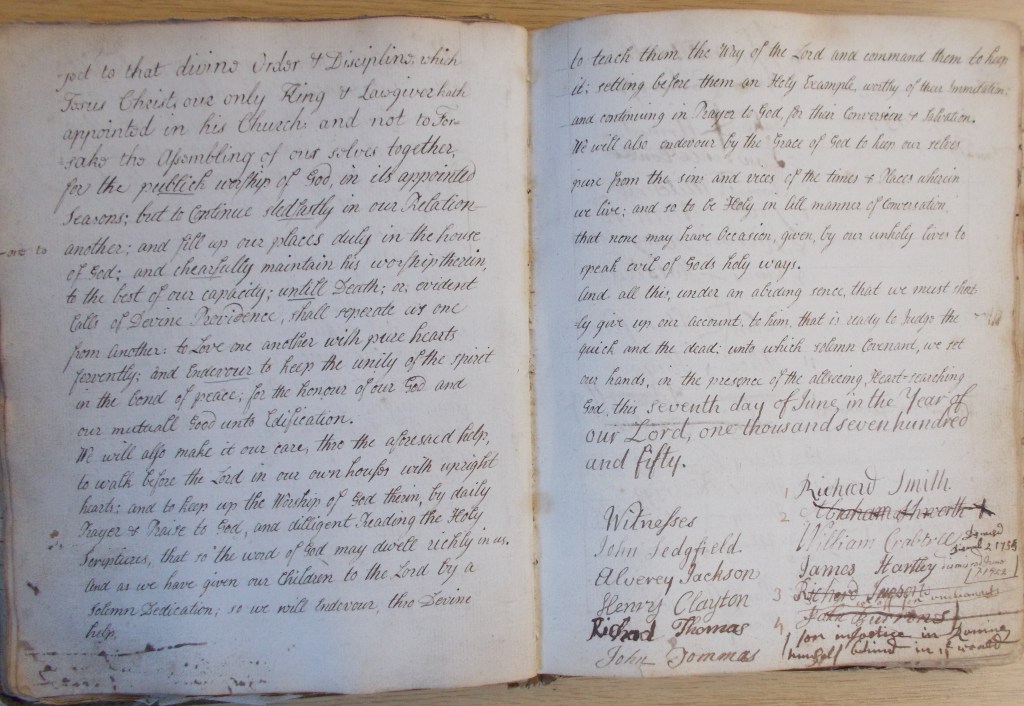
The Solemn Covenant of Church Communion, signed by Richard Smith, William Crabtree and James Hartley, 7th June 1750.
‘In his ministry he had a manner peculiar to himself, of coming home to the conscience, and touching the springs and movements of the soul. His address was full of gravity, and his words as weighty as words could be. A stranger who occasionally heard him once said:
“This man’s words fall on us like mill-stones“
‘In his own deportment he was eminently conscientious, avoiding conformity to the world, and bearing his testimony against the prevailing vices and irregularities of the times in which he lived. In some respects he carried his scruples respecting matters of conscience to a length which few would think it necessary to imitate. It is related of him, that when he felt risings of fretfulness and discontent, he generally visited the poorest of his neighbours, which, next to the truths of Christianity, his experience taught him was the best antidote to these painful sensations’.
(Quotations from An Account of the Life, Ministry and Writings of the late Rev. John Fawcett D.D, by his son John Fawcett jnr, 1818).
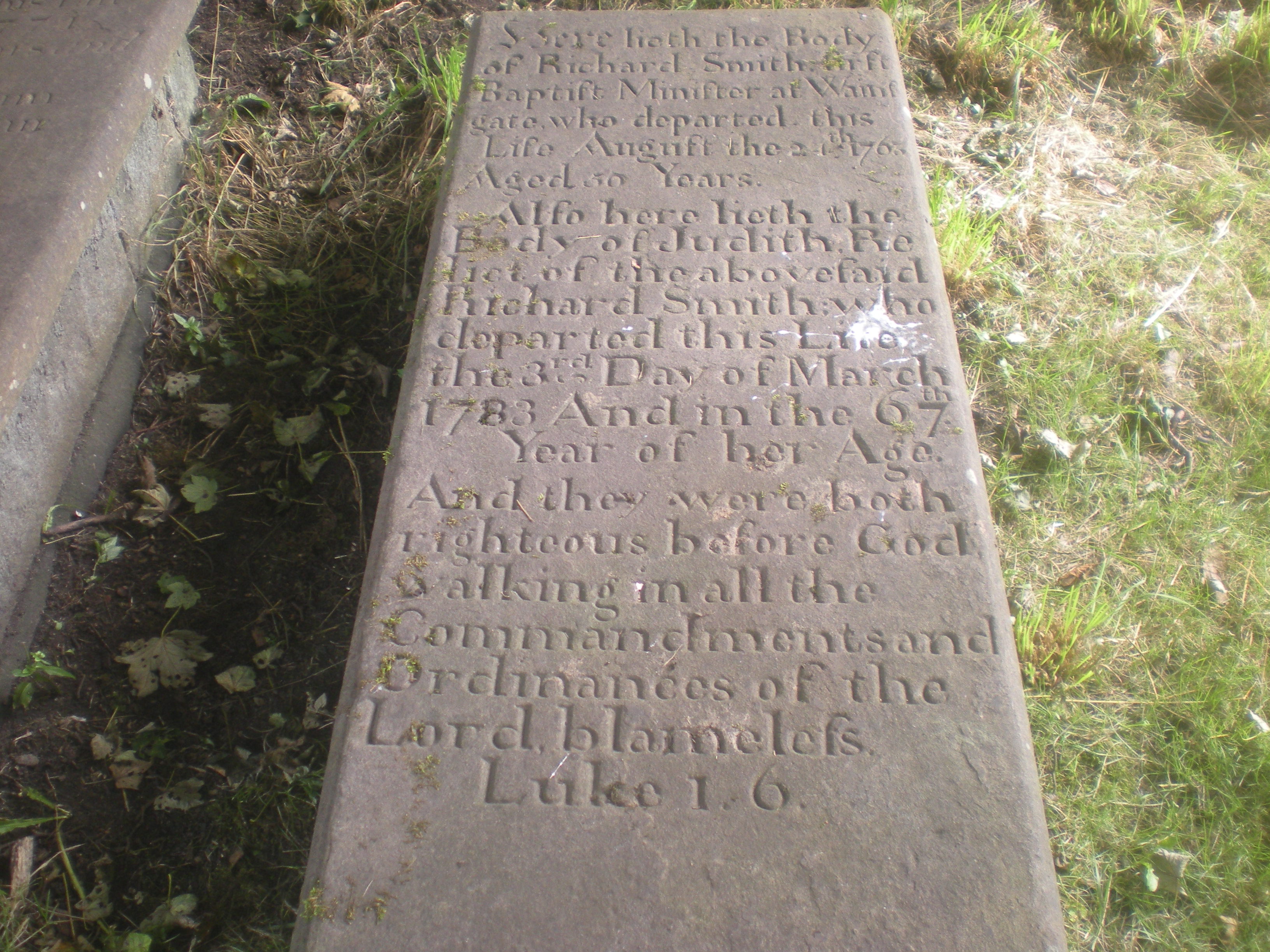
Richard Smith suffered from ill health for much of his life: his final illness was ‘long and tedious, and his pain for the most part very severe’. He died (or as Fawcett put it ‘His soul was dismissed from this tenement of clay’) on 24th August 1763 and was buried on the 27th, seemingly the fourth person to be buried at Wainsgate.

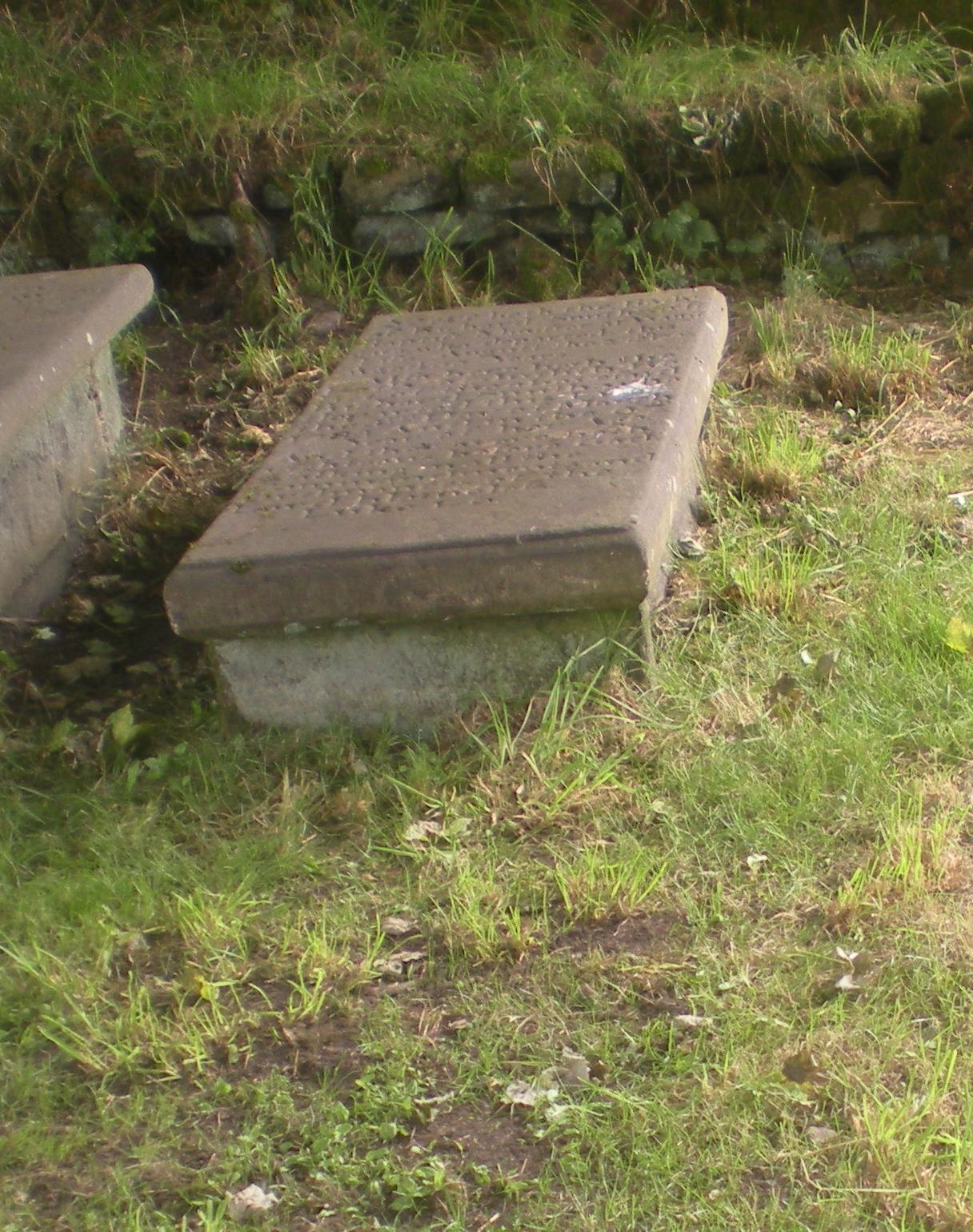
His gravestone gives his age as 50, although Fawcett’s biography says he was 52. His wife Judith died on 3rd March 1783, aged 66. Their grave (OY125) is marked by a simple table tomb, with an epitaph from Luke 1:6:
‘And they were both righteous before God, walking in all the commandments and ordinances of the Lord, blameless’.
A pastoral letter, from which the following passages are selected, was found among Richard Smith’s manuscripts. It is undated, but was probably written near the end of his life.
“To the Church of Christ, at Wainsgate, grace, peace, and love be multiplied through Christ our exalted head.
I am standing at the threshold of your door, with my heart towards you in the bowels of Jesus Christ. I must shortly give account to him that is ready to ‘judge the quick and the dead,’ as to what I have preached, how I have preached, and whether I have held fast Christ’s name and the form of sound words which he has committed to my trust. If I have let them slip, with a view to gain to myself, to acquire honour or friendship from men, or from any other worldly motive ‑ how can I hope to give up my account with joy ? how shall I be able to say, ‘I have fought a good fight, I have, kept the faith?’ I am pained to hear that you discover so much indifference to the Gospel, and that you can tamely admit of innovations of a dangerous tendency. You are anxiously concerned when your temporal interest is at stake. Ah! my brethren, does not your conduct in more important matters betray, if not want of knowledge and discernment, what is much worse, want of zeal and love?
Are not you seeking your own more than the things of Jesus Christ? Is not that night of which Dr. Gill speaks coming fast upon us? Does not he who ‘walks in the midst of the golden candlesticks,’ see your Laodicean temper of mind, and has he not something against you, because ‘you have left your first love?’ Let us search and see. Is there that love to Christ, his ministers, his word, his truths, and company, that there once was? Is there that zeal for his cause, his honour, his interest, which was evidenced at your first conversion? Is there that fervency of prayer in your families and closets? ‑ But I forbear; let conscience speak; and if it bear witness against you, ‘let him that hath an ear, hear what the spirit saith unto the churches:,’ ‑ ‘Remember from whence thou art fallen, and repent, and do thy first works.’
What I have written to you more at large before, I wish you to read with diligence and deliberation; and if things are not as I apprehend, be so kind as to inform me better. Having no other copy, I wish them, along with this, to be returned to me. ‘The grace of our Lord Jesus Christ be with you.’ Amen.”
None of the documents or other records (including his gravestone) which mention Richard Smith, use the title Reverend: he is always referred to as Richard Smith or Mr Smith. Most of the other ministers mentioned here used the title Reverend themselves or were referred to as such by others.
Rev. John FAWCETT D.D. (c1739-1817)
John Fawcett was born in Lidget Green, near Bradford. His father, Stephen Fawcett, died in 1751 when John was around twelve years old. Stephen had a small farm, and died leaving a widow and several children. His father, also called Stephen, survived him, but being totally blind (he was known as ‘Blind Stephen’) could not support his son’s family – the farm was given up and the family dispersed.
John Fawcett was apprenticed for six years with a tradesman in Bradford, believed to be a wool comb maker. His apprenticeship required him to work from six in the morning until eight at night, so he was unable to attend school, but he spent many hours late at night reading voraciously – the classics, the Bible, Bunyan’s ‘The Pilgrim’s Progress’ and the works of the Puritan Presbyterian minister and author John Flavel.
He was a regular worshipper at an Anglican church in Bradford, but also occasionally attended a Presbyterian chapel, although at the time he knew little about dissenting religious beliefs. Probably the greatest influence on his religious beliefs was hearing the Anglican cleric and evangelist George Whitefield, particularly hearing him preach to a large open-air congregation in Bradford in September 1755.
The impact of Whitefield’s preaching on Fawcett was said to be: ‘indescribably great, and remained unabated to the close of his life’, and he kept a portrait of Whitefield in his study. He later said of hearing Whitefield, who preached from John 3:14: ‘As long as life remains, I shall remember both the text and the sermon.’
And as Moses lifted up the serpent in the wilderness, even so must the Son of man be lifted up:
Through Whitefield, John Fawcett was introduced to the ministry of William Grimshaw, and would regularly walk from Bradford to Haworth to hear him preach. After a brief period of attending Methodist and Congregationalist churches, he was baptised as a believer by William Crabtree at the Baptist Church at Westgate, Bradford on 11th March 1758, shortly before his apprenticeship ended. In 1759, still not twenty years of age, he married Susannah Skirrow of Bingley, a few years older than John and a member of the Westgate congregation.
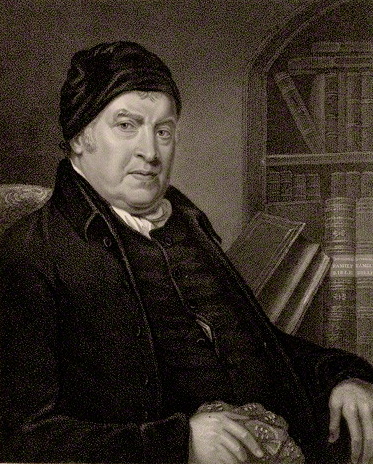
John Fawcett’s commitment to Baptist principles was partly due to his friendship with three of Grimshaw’s converts: William Crabtree of Westgate, Bradford; James Hartley, Baptist pastor from Haworth; and Richard Smith, Wainsgate’s first pastor.
All three were signatories in 1750 of Wainsgate’s Solemn Covenant of Church Communion.
He first visited Wainsgate 1n 1763, when he was invited to preach there in place of the minister Richard Smith, by then gravely ill. Following Smith’s death later in that year, he was invited to become the second minister at Wainsgate at the age of twenty-four.
His diary entry for 9th February 1764 says:
‘About a fortnight ago I recieved an invitation from the church at Liverpool, under the care of Mr. Oulton, to go and preach in conjunction with their Pastor: but I believe, if I have a call to anywhere, it will be to Wainsgate. The people there approve of my poor labours, and unweariedly press me to settle amongst them’.
When John Fawcett became pastor at Wainsgate, the church had only about thirty members (who were not entirely of one mind with respect to doctrine), and the local population was small and scattered. Fawcett’s prescence changed things drastically – before long hundreds of people were travelling from miles around to hear the new preacher at the small isolated chapel.
His stipend as minister at Wainsgate was £25 per annum, by all accounts not a great income for such a position, and he took on students, preparing several for entry to the Bristol Baptist College – the oldest Baptist college in the world and, at the time, the only one in Britain. One of his most noteable pupils, who he baptised, taught and mentored, was John Sutcliff, later to become known as John Sutcliff of Olney. He also preached at several local chapels – Heath, Cloughfold, Bingley, Gildersome, Bacup, Rochdale, Heptonstall Slack, Rodhill End and others.
Fawcett’s fame gradually spread, and in 1772 he made his first visit to London, invited to officiate for Dr. John Gill, the ailing Baptist minister and theologian at Carter Lane, Southwark. He stayed in London for several weeks and preached there more than fifty times. Gill died shortly afterwards, and Fawcett was invited to replace him on a permanent basis. A ministry in London would have been a very attractive prospect to him – his stipend at Wainsgate was still only £25 a year, his accomodation small and inconvenient for his growing family, and there were often unpleasant disagreements within his congregation. He initially accepted the offer, but changed his mind at the last moment (apparently when all of his posessions were loaded onto wagons ready for the journey to London) and decided to stay at Wainsgate.
Both the American evangelist Ira David Sankey and the author and minister Henry Sweetser Burrage described the scene (somewhat melodramatically and probably inaccurately, since neither of them were born until more than sixty years after the event) as follows :
‘The wagons were loaded with his books and furniture, and all was ready for the departure, when his parishioners gathered around him, and with tears in their eyes begged of him to stay. His wife said, “Oh, John, John, I cannot bear this.” “Neither can I,” exclaimed the good parson, “and we will not go. Unload the wagons and put everything as it was before.”
When he started to have second thoughts about leaving Wainsgate, Fawcett had suggested to his congregation that an increase of his stipend to £40 a year could make him decide to stay. They declined to agree to this (perhaps not unreasonable) request, but he stayed anyway.
It is thought by some that John Fawcett was inspired by this event to write his best known hymn ‘Blest be the Tie that Binds our Hearts in Christian Love’.
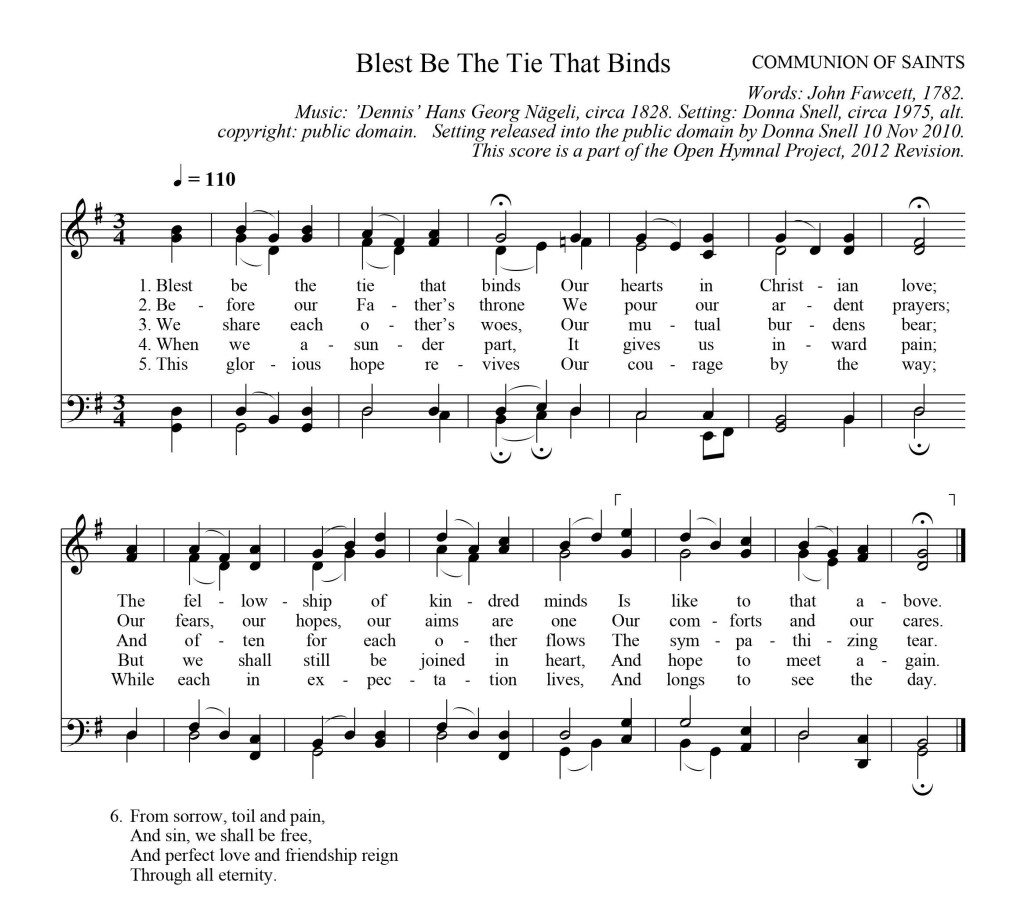
The hymn is usually sung to the tune ‘Dennis’ by Hans Georg Nägeli, but the version recorded by the Wainsgate choir in 1951 was sung to the tune ‘St. Austin’.
* * *
There is plenty more to be written about John Fawcett – the move to Ebenezer, his writing, his academies at Brearley Hall and Ewood Hall, and more will be added to this page in the near future. For further reading on Fawcett, a list of sources is included in the Bibliography.
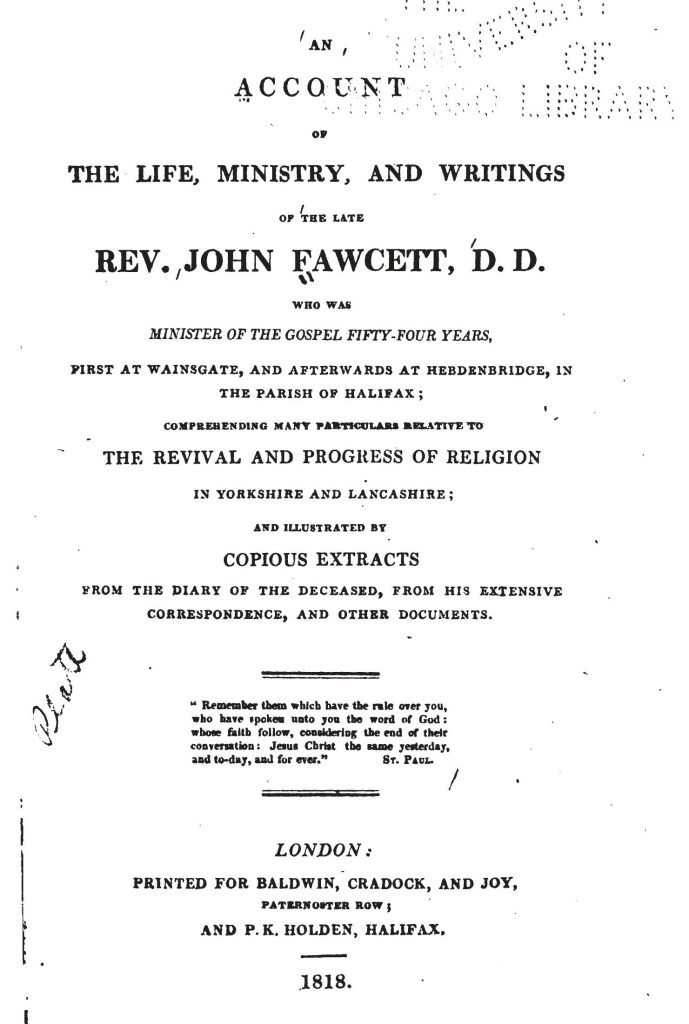
The definitive account of John Fawcett’s life is probably ‘An Account of the Life, Ministry, and Writings of the late Rev. John Fawcett D.D.’, published (anonymously) in 1818 by his son John Fawcett jnr. This is a rather long and sometimes tedious read: a shorter and more readable version is that written by Jack Uttley in 1994.
pdf copies of both books can be downloaded here:
For information about the Fawcett family tomb at Wainsgate, click here.
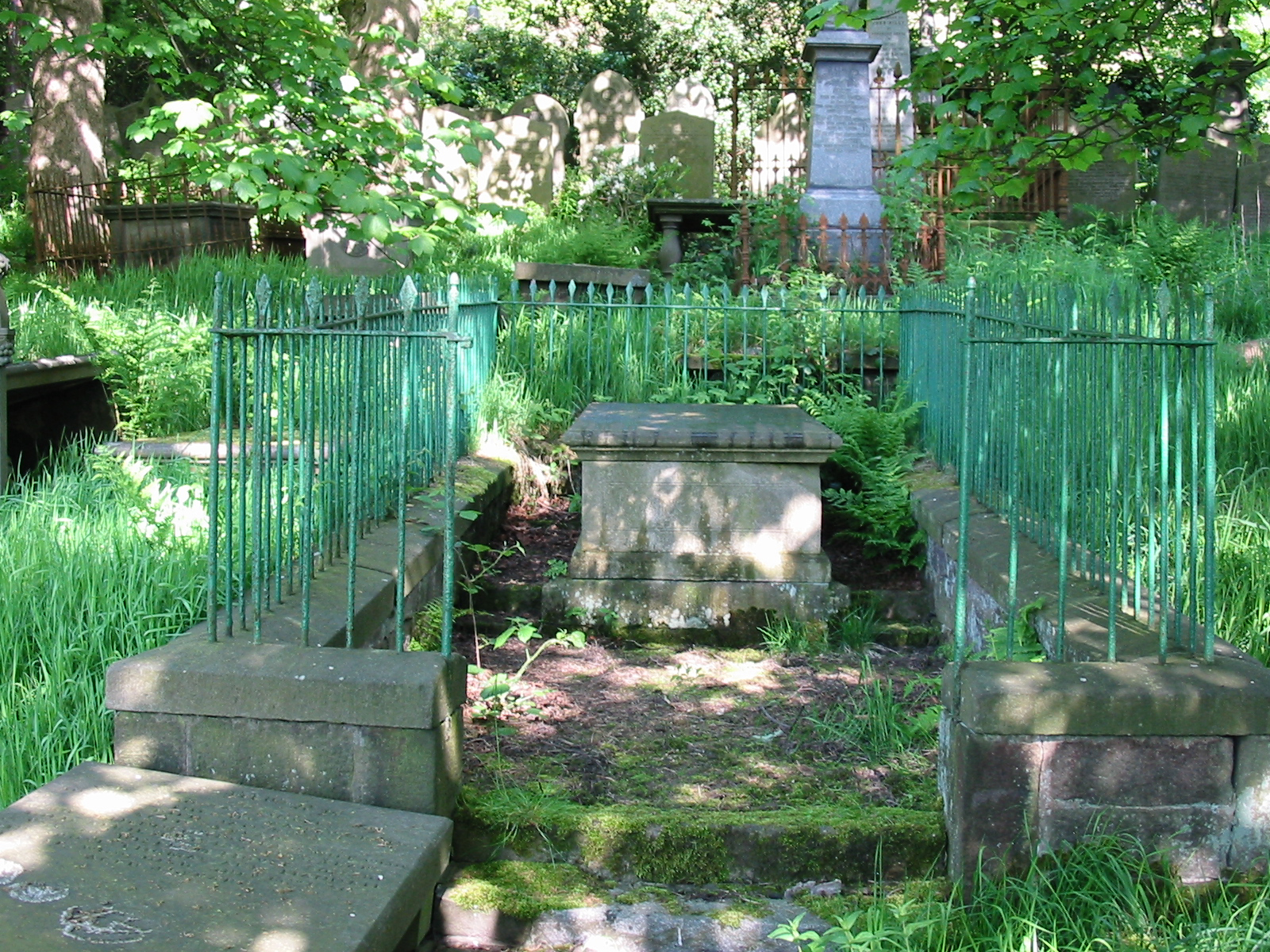
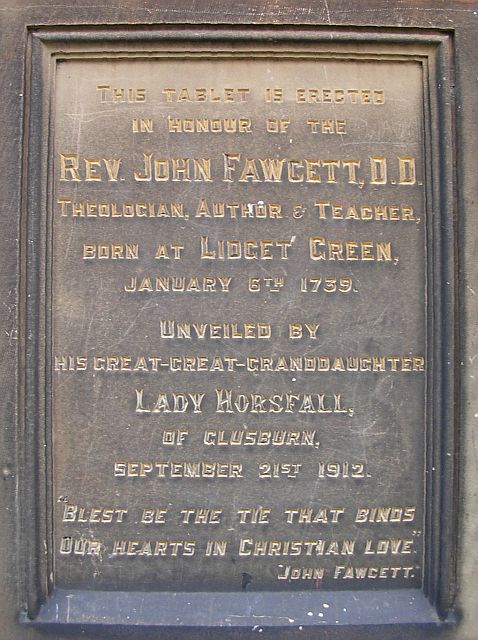
Left: The Fawcett tomb at Wainsgate. Right: Plaque commemorating John Fawcett in the New Testament Church of God, Necropolis Road, Bradford (photo by Betty Longbottom).
More coming soon…..
Rev. John FAWCETT jnr (1768-1837)
Born on 4th March 1768, John Fawcett jnr was the eldest son of Rev. John Fawcett, pastor at Wainsgate, and his wife Susannah. He married Ann Hargreaves, from Goodshaw-in-Rossendale, Lancashire at St.John the Baptist, Halifax in 1795. The Banns of Marriage record him as ‘The Reverend John Fawcett junr, of Brearley Hall in Midgeley, Dissenting Minister’. The only other record of him having the title ‘Reverend’ is in his father’s will.
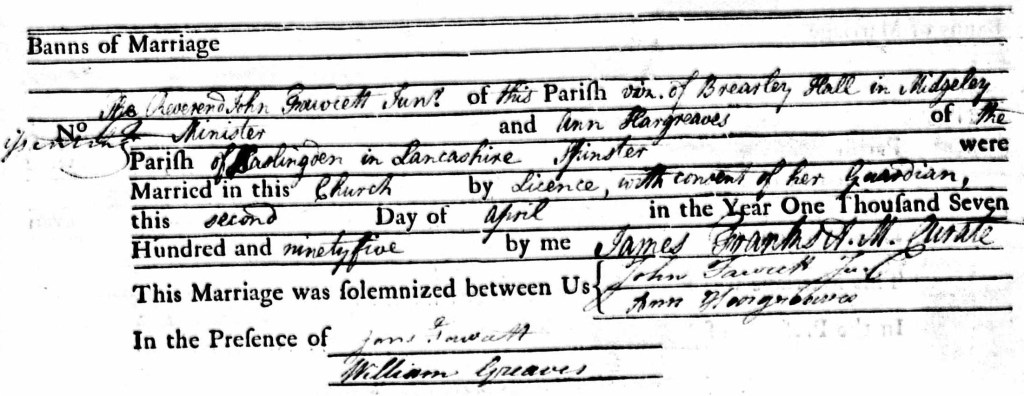
Although John Fawcett jnr used the title Reverend, there is no record of him having studied for the ministry, and he is not known to have been a minister at any of the local Baptist chapels. He is believed to have established a ‘preaching place and Sunday school’ at Mytholmroyd in 1799, and taught at his father’s acadamies at Brearley Hall and Ewood Hall. He took over running the Ewood Hall academy when his father retired in 1805.
John Fawcett jnr was the author of the definitive account of his father’s life and works ‘An Account of the Life, Ministry, and Writings of the late Rev. John Fawcett D.D.’, published in 1818, although his authorship is not credited.
John died on 13th July 1837 aged 69, and he and his wife Ann (who died in 1850 aged 76) are buried in the Fawcett tomb at Wainsgate, as are three of their eight children: Esther, who died in 1811 aged 9, John Hargreaves Fawcett who died in 1816 aged 20, and Eliza Ann who died in 1819 aged just 3 weeks.
James, Stephen & William FAWCETT
John Fawcett jnr’s three surviving sons were all involved in the Baptist church: James Fawcett and Stephen Fawcett were both involved in establishing a Baptist chapel at Brearley, and Rev. William Fawcett became a Baptist minister at Crosby Garrett in Westmoreland and died in Florence.
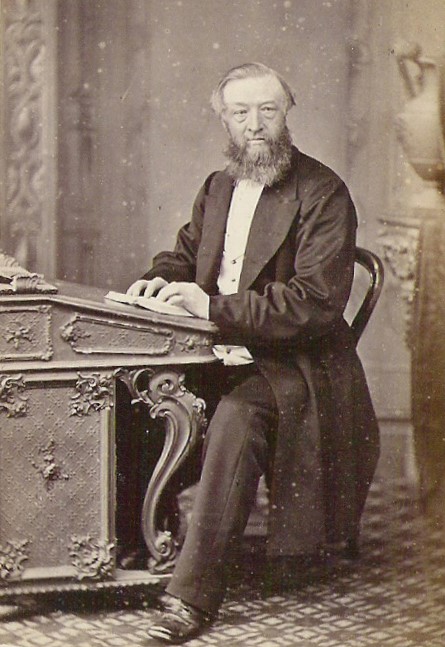
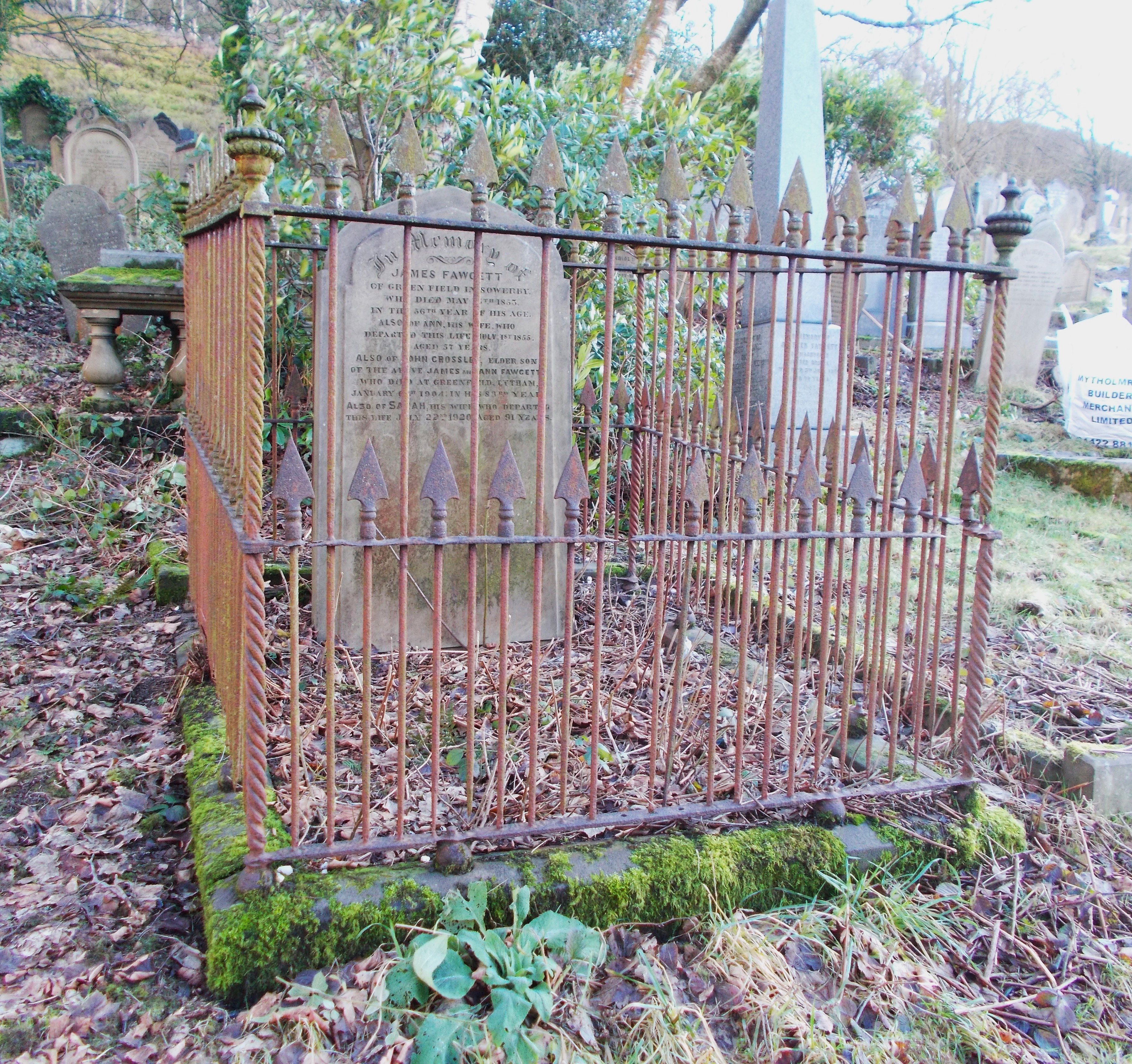
James Fawcett (1797-1853) and his grave at Wainsgate (A531-532).
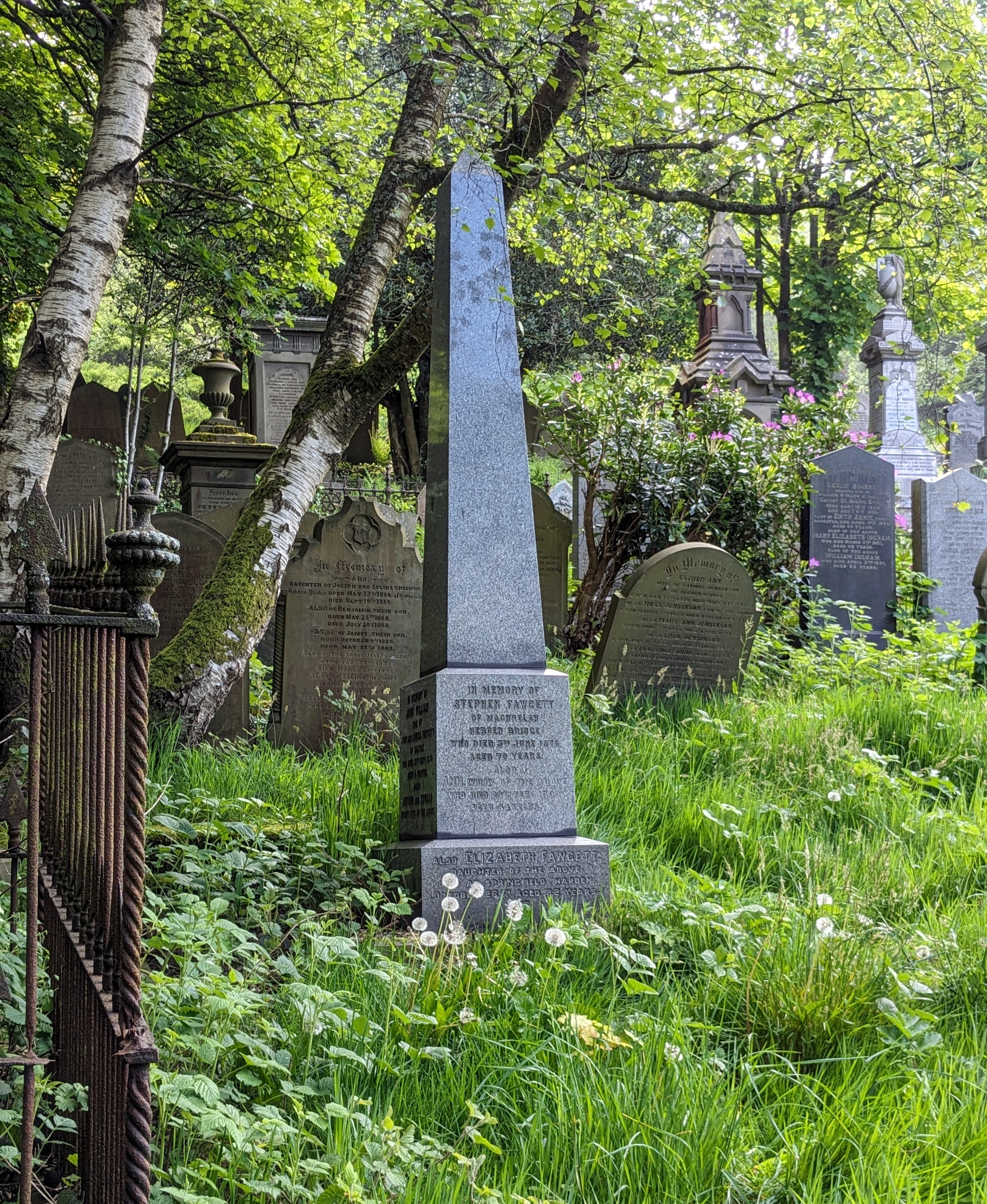
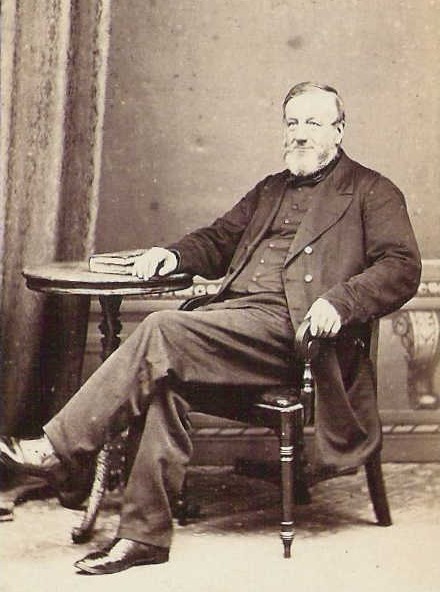
Stephen Fawcett (1806-1876) and his grave at Wainsgate (A527-536).
Rev. William FAWCETT (1799-1874)
Son of Rev. John Fawcett jnr, William was born at Ewood Hall. In 1837 he was Baptist minister at Sutton-in-Craven when he married Mary Ann Bracewell at Barnoldswick parish church. Mary Ann was living in Barnoldswick, and the marriage certificate describes her as a spinster and her profession as ‘Lady‘. The couple had two children during their brief marriage: William Mitchell Fawcett (1839-1912), later to become a successful barrister and author of A Compendium of the Law of Landlord and Tenant, and Margaret Ann Fawcett (1841-1921).
Mary died in 1841 or 1842, and in 1846 William moved to Westmoreland, where he later became a Baptist minister at Crosby Garrett, a hamlet near Kirkby Stephen.
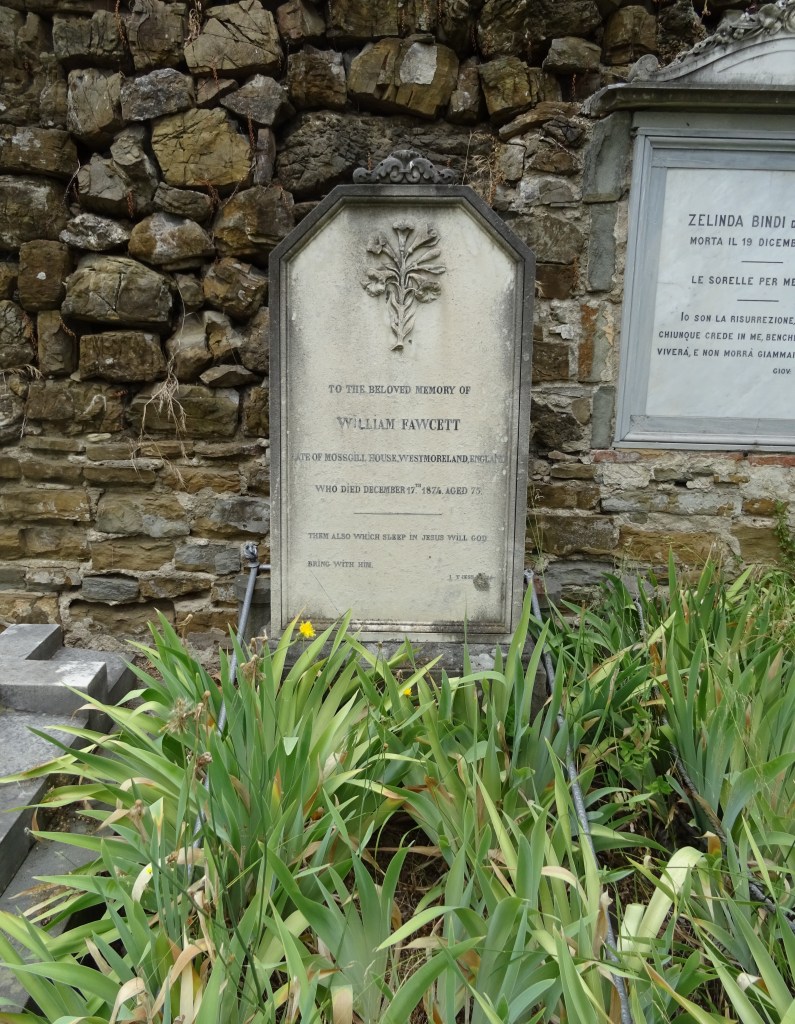
In 1851 William married Deborah Greenwood, fourteen years his junior and the daughter of George Greenwood, a Hull ship owner and merchant born in Oxenhope and himself a Baptist preacher. They were married in Bingley, and the service was conducted by Rev. Peter Scott. The 1861 census describes William, living at Mossgill House with his wife, daughter and a servant as a ‘Baptist Minister of Baptist Chapel & Landed Proprietor’.
Deborah died in 1865, aged 52, and is buried at Crosby Garrett. In 1871 William, now describing himself as ‘Minister of the Gospel’ was still living at Mossgill House with unmarried daughter Margaret (‘Gentlewoman’) and a housemaid.
William Fawcett resigned his ministry in October 1873 due to ill-health, and died in Florence on 17th December 1874. He is buried in the Cimitero Acattolico (also known as the Cimitero Degli Inglesi, English Cemetery, or Protestant Cemetery) in Florence.
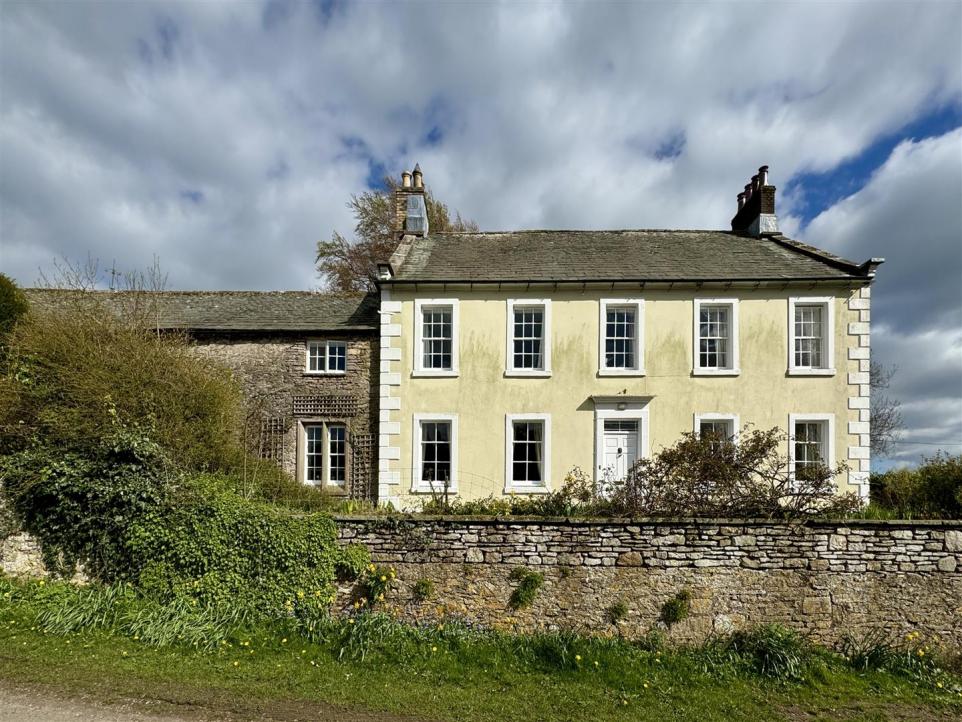
Mossgill House, built around 1747 and currently Grade II listed was reputedly designed by the same architect as Haworth parsonage (built around 1778), and is very similar in design.
William Fawcett was a friend of Patrick Brontë, and the Brontë family are believed to have been frequent visitors.
William WRATHALL
Little is known about William Wrathall, fifth minister at Wainsgate from 1788 to 1790. The Baptists of Yorkshire tells us that he was minister at Steep Lane near Sowerby, following the death of John Dracup in 1795: ‘William Wrathall of Wainsgate succeeded, but removed in 1798 to Bolton-le-Moor In Lancashire’. We don’t know his whereabouts between leaving Wainsgate and starting his ministry at Steep Lane, but it is interesting that he is referred to as ‘William Wrathall of Wainsgate’, despite seeming to have left there five years earlier.
The only evidence of his tenure at Wainsgate is an entry in an early burial register recording the burial of Mary Sutcliffe of Midgehole on 12th January 1788:
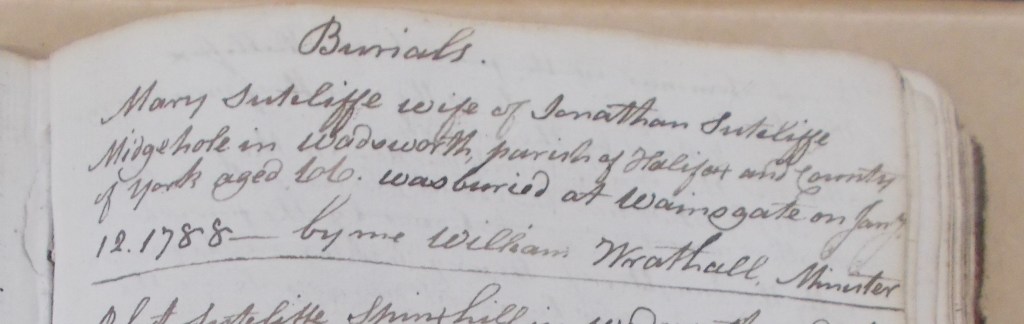
The surname Wrathall was quite common in parts of Yorkshire, particularly in the Wharfedale area, so it is possible that he came from that part of the world.
John PARKER (1725-1793)
John Parker was born at Barnoldswick on March 10th 1725: his father, Thomas Parker was from Ireland, and at the age of eleven John was sent to live with a family at Bracewell, where he stayed for several years. The description below seems to hint that he may have had cerebral palsy or a similar neurological disorder:
‘He was a boy of marked thoughtfulness, and his affectionate disposition made him beloved of those with whom he lived. He was a suffering cripple and prevented from, joining other children in their play. From childhood he suffered from a nervous disorder which affected his limbs. His confinement led him to diligent searching of the Scriptures, the reading of which directed his mind to his own condition and awakened within him a painful consciousness of his sin and at the early age of 14 he was filled with serious impressions, and passed through painful conflicts of mind’.
He was persuded to go to Haworth to hear the evangelical Anglican clergyman William Grimshaw, whose preaching made a deep and lasting impression on him:
‘He accepted Christ and went on his way rejoicing and continued with joy to meditate on the question of the sinner’s justification by Jesus Christ’.
Not being able to travel to Haworth on a regular basis, John Parker attended various local Anglican churches, but was disappointed with the teaching and preaching of the clergy: he was in great need of guidance and consolation from the church, but they provided neither. He was persuded to visit the Baptist chapel at Barnoldswick, where he heard Alvery Jackson preach, and was impressed by what he heard. He reluctantly chose to leave the established church and join the Baptists, and was baptised by Jackson in 1750. Alvery Jackson took a close interest in the young man, and worked to educate and prepare him for the Baptist ministry, a calling for which John Parker seemed to show exceptional aptitude.
‘In 1753, the Church unanimously and repeatedly invited him to preach. John Parker’s retiring nature, timidity and sense of inability induced him to withdraw from such a task, but importunity ultimately prevailed and he tried. The trial in his mind was a failure, and he, resolved never to try again. To this resolve the church turned a deaf ear, and John Parker was compelled to continue preaching’.
Following Alvery Jackson’s death on the last day of 1763, Barnoldswick Baptist church elected John Parker as his successor, a role he fulfilled for many years until ill-health forced him to step down. He was by all accounts very humble and unprepossessing in appearance, but impressed those who heard him preach:
‘He was diligent, peaceable, affectionate and faithful. He was a man mighty in prayer, his weak but penetrating voice was resonant with a holy fervour, and his soul sent forth its petitions in flashes of devout eloquence.’
‘When he was under a favourable gale and his subject peculiarly interesting . . . It was a feast divine to sit under the sound of his voice, a torrent of sacred eloquence issuing from the fervour of his mind seemed to carry away the hearts of the hearers before it.’
After ill-health forced him to stop preaching, he retired to his small farm to rest and recover, and after two or three years he was well enough to accept an invitation from Wainsgate to become their sixth minister. He accepted the offer somewhat reluctantly: it was hard for him to move from his friends and from the town he had lived in all his life, particularly late in his life, but as he wrote to friends at the time:
‘I am now wandering among the hills seeking strayed sheep and lost souls. There are multitudes of these in this corner of the wilderness. My soul pities them. I earnestly long to be instrumental in saving some of them.’
The burial registers record fourteen burials conducted by him between 1790 and 1792: in several of the entries he describes himself as a ‘Dissenting Minister’:
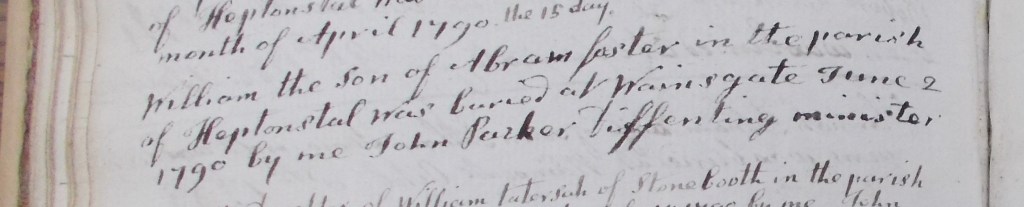
In September 1791 John Parker suffered a ‘severe attack of fever’ which left him virtually blind:
‘It was a most affecting sight to behold this venerable servant of God enfeebled with disease, decrepitude, and blindness; struggling to declare to the last, the story of the Cross to the people whom he loved but could not see. His preaching at this period, is described as a “picture of dignity in ruins.” A few days before his death he preached from the words, “For to me to live is Christ, and to die is gain” (Philippians 1:21)’
He died peacefully in his sleep at Wainsgate on 29th May 1793, aged 68. He was buried at Barnoldswick, ‘in the presence of an immense concourse of people’, and the funeral sermon was delivered by his old friend John Fawcett, who preached from Acts 20:25 –
‘And now, behold, I know that ye all, among whom I have gone preaching the kingdom of God, shall see my face no more’
John Parker was ‘interred at Barnoldswick in the ground adjoining the Old Chapel’. The old chapel was replaced by a larger chapel in 1797, the new chapel being built in the adjoining garden. Nonconformist Chapels and Meeting-houses in the North of England (Christopher Stell, 1994) notes that there were two memorials externally on the front wall (only one still remains) as well as ‘a small walled burial-ground in front of the chapel’ containing ‘several table-tombs of the late 18th and early 19th century’. One of the tombs was that of John Parker and his wife Alice, who died in 1804, and another was that of Nathan Smith, who succeded Parker as pastor at Barnoldswick and died in 1831.
The chapel, with the gallery and all internal fittings removed, was later used as a furniture store and auction room, and was listed Grade II in 1950. When the current owners bought the property in 2007, the graveyard had been vandalised and only two of the memorials remained, neither of them John Parker’s.
The Old Chapel House is now a luxurious 4-bedroom holiday rental. One of the remaining memorials is on the wall next to the entrance, and the other one has been incorporated in the external landscaping adjacent to the parking area.
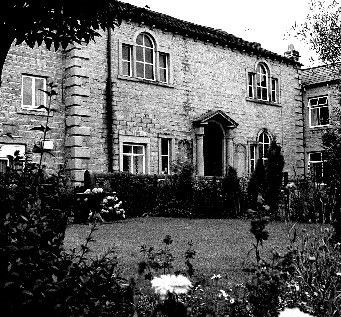
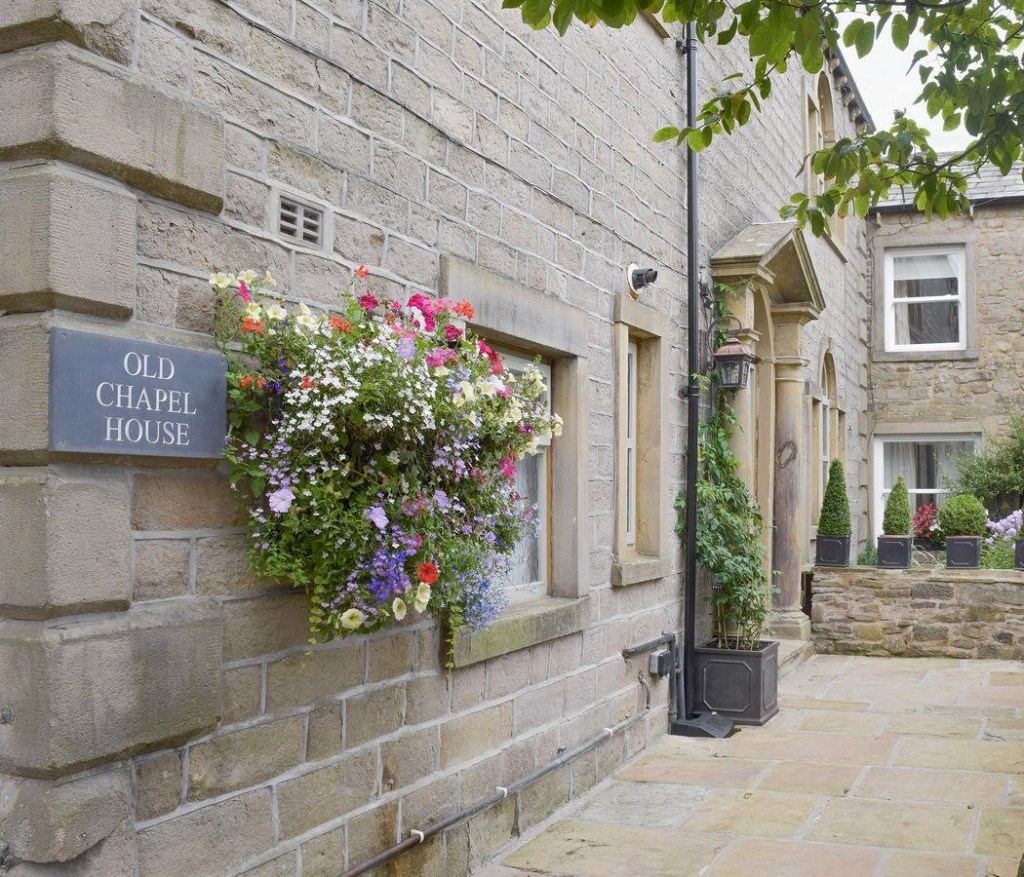
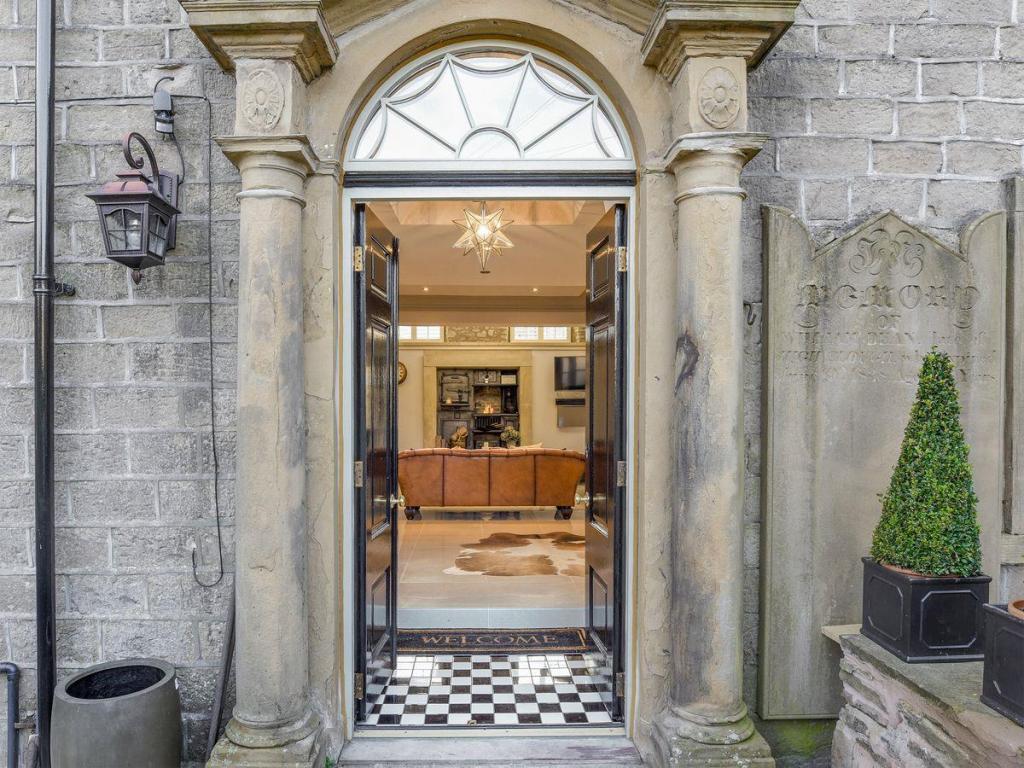
Left: undated photograph of the 1797 chapel. Centre & right: as it is now.
With thanks to Stanley Challenger Graham for transcribing History of the Baptists in Barnoldswick by Rev. Evan R. Lewis (1893), from which much of the information and the quotes above are taken. The transcription can be found on the website oneguyfrombarlick.co.uk.
Isaac NORMINGTON (c1754-1826)
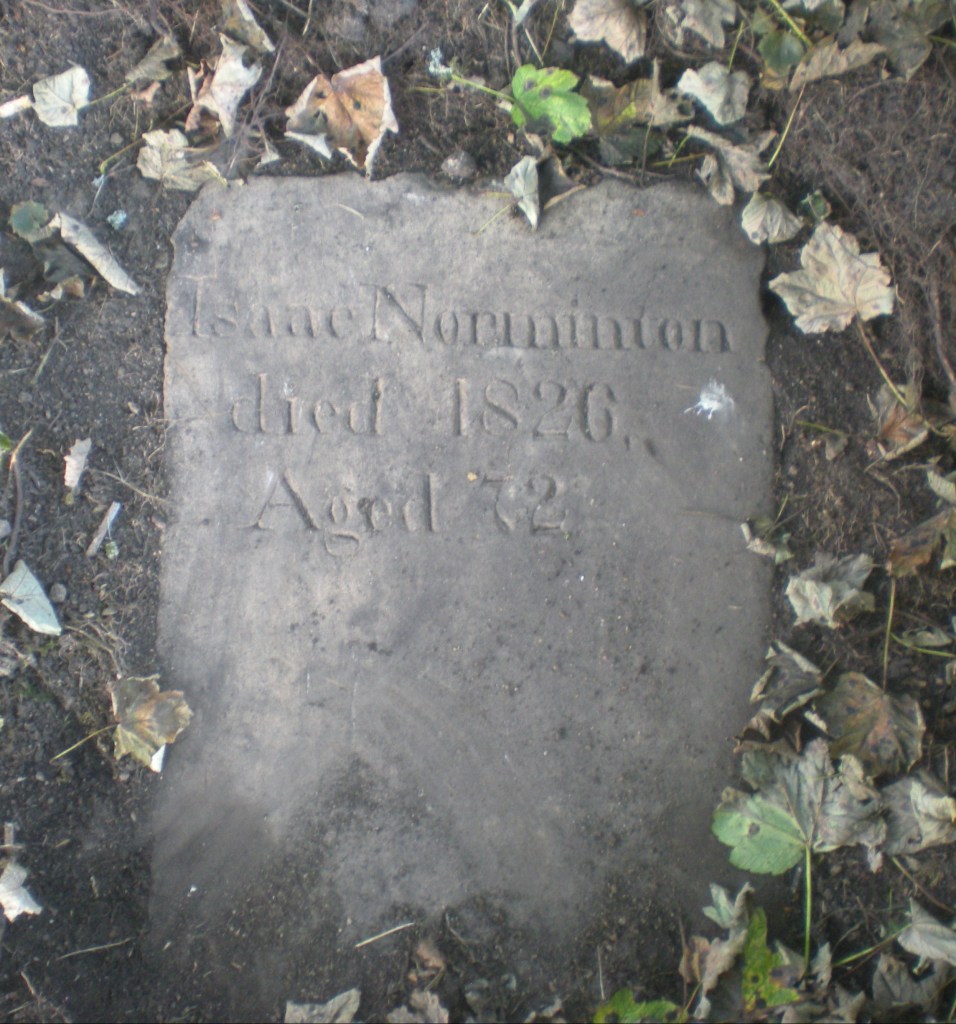
Little is known about Isaac Normington, eighth minister at Wainsgate from 1800 to 1810. A buried marker stone was unearthed in the Fawcett Yard, close to Fawcett’s tomb. The inscription reads ‘Isaac Norminton, died 1826, aged 72’.
The burial register has an entry for April 6th 1826 for Isaac Normanton, plot 176 (which is where the stone was found), aged 72.
Despite the different spellings of his name on the gravestone and in the burial register, this is almost certainly the grave of Isaac Normington.

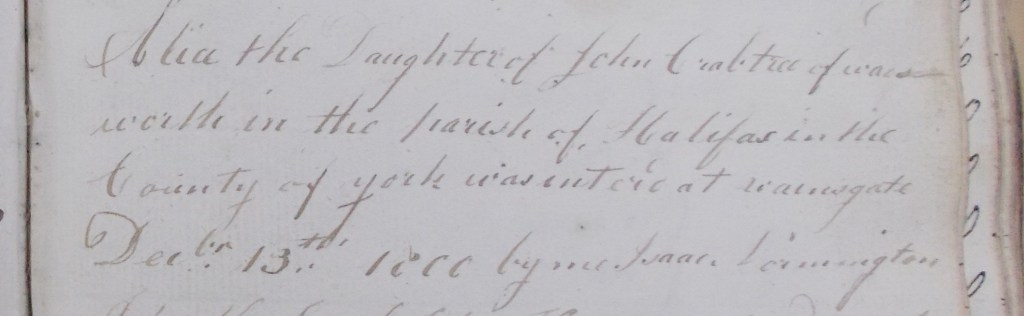
The only evidence of Isaac Normington’s time at Wainsgate is an entry in an early burial register, recording the burial of Alice Crabtree on 13th December 1800:
Mark HOLROYD (c1766-1854)
Mark Holroyd was born at Merrybent Farm near Ripponden, son of Jeremiah and Mary Holroyd. After becoming a Particular (or Calvinistic) Baptist he was an itinerant preacher before becoming pastor at Cloughfold in Rossendale (probably between 1804 and 1808) and then pastor at Wainsgate in 1810. He remained at Wainsgate for 25 years, and was responsible for the rebuilding of the chapel in 1815 and the Sunday school in 1834.
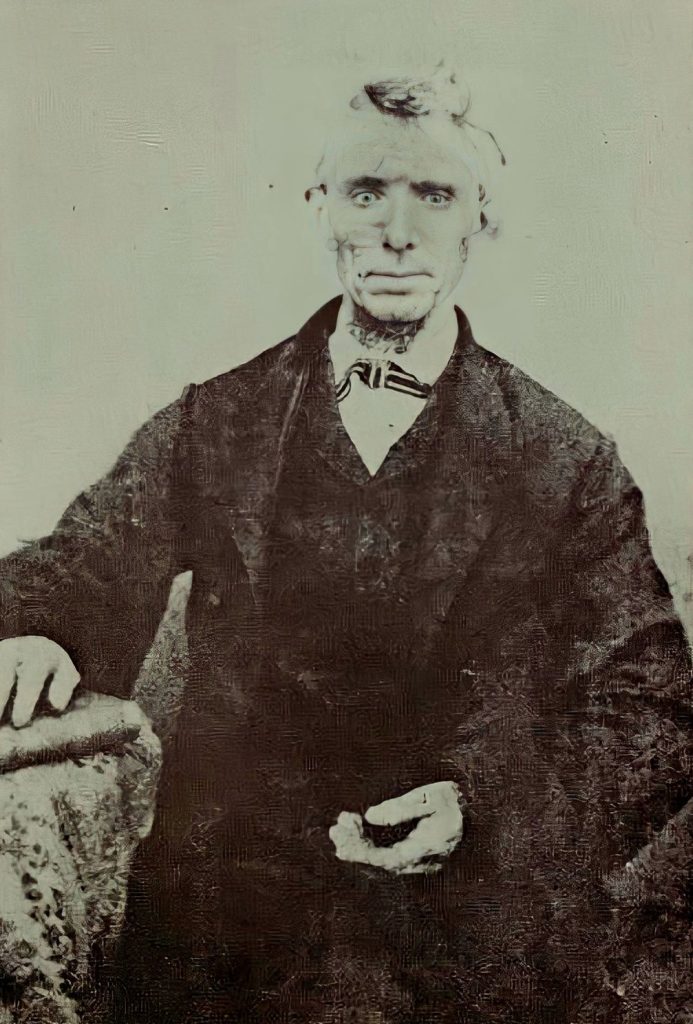
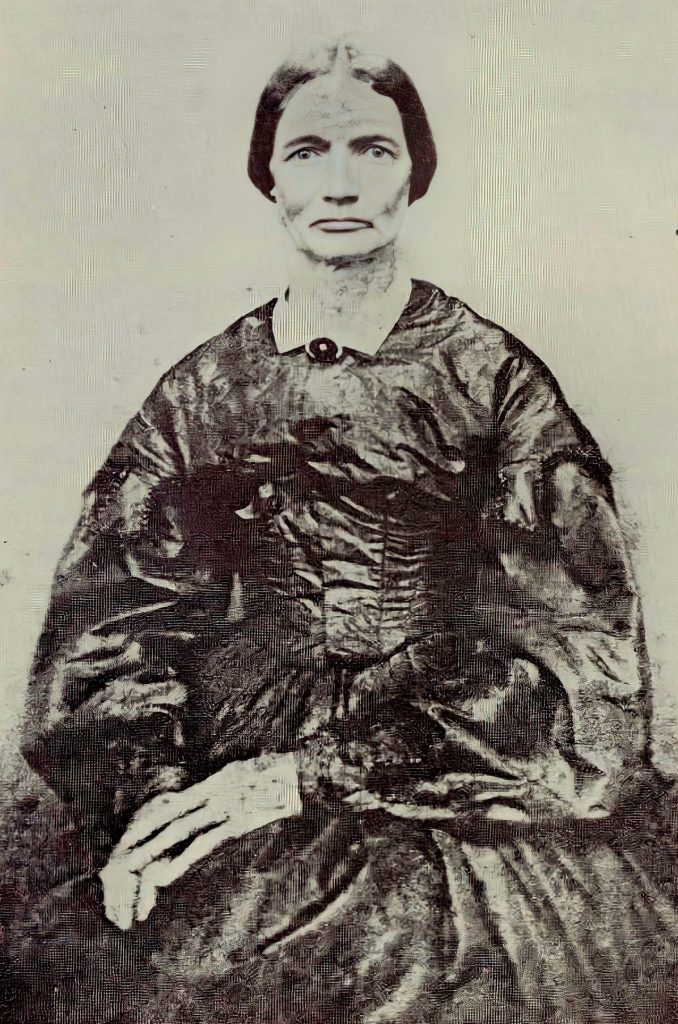
Mark and Sally Holroyd
In 1786 Mark married Hannah Mackerill, with whom he is believed to have had ten children, several of whom died in infancy. Hannah died from consumption around 1805, probably aged about 40. In 1808 or 1809 he married Sally Ashworth from Heptonstall, and they had six children – Mary Ann, William, Susannah, Mark, Stephen and Ebenezer. As well as teaching his children to read and write, Mark put his sons to work as soon as they were old enough – he had four hand looms which were used to weave cotton and worsted cloth. Three of Mark’s sons – William, Stephen and Ebenezer became Baptist ministers after emigrating to America.
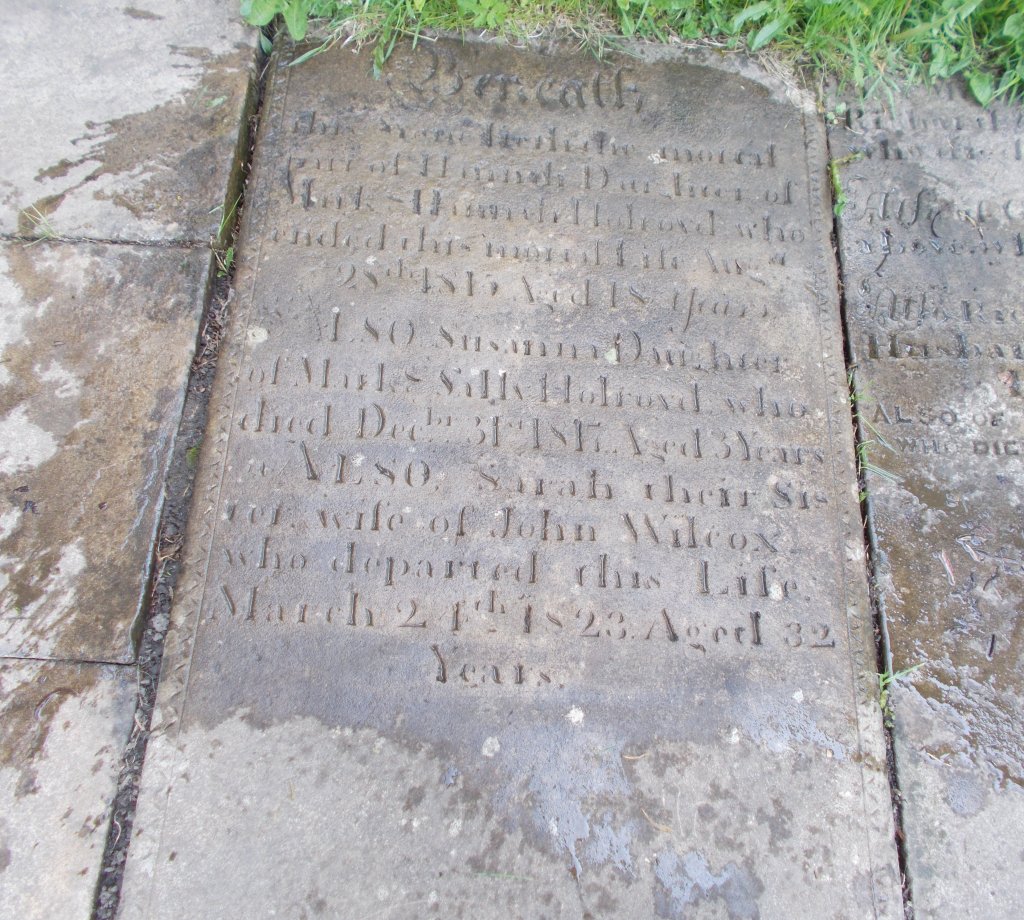
Susannah died from smallpox on 1st January1818, aged 3, and is buried at Wainsgate, in plot OY110. Also buried in this plot are two of his daughters from his first marriage – Hannah, who died in 1815 aged 18, and Sarah, wife of John Wilcox (or Wilcock), who died in 1823 aged 32.
Their grave in the Old Yard is marked by a flat slab, located just to the south of the chapel. Since all of these burials predate the building of the present chapel in 1860, we cannot be absolutely sure that this stone marks the exact location of their grave.
Mark and Sally’s eldest son William emigrated to America , aged 18 in 1830, settling in Pitcher, Chenango County, New York, and in 1835 his parents and four remaining siblings followed him, settling in South Otselic, about ten miles from Pitcher, where Mark became pastor at Baptist churches in South Otselic and nearby Lincklaen. Sally Holroyd died on 30th April 1848 aged 69, and is buried at Rhode Island Cemetery, Chenango County. In 1852-3 Mark, along with his sons William and Mark and their families moved to Wyanet, Bureau County, Illinois, where he died on 5th July 1854 aged 87. He is buried at Forest Hill Cemetery, Wyanet.
Mark Holroyd’s son Mark Holroyd II (1815-1902), who was born at Wainsgate and emigrated to America with his family in 1835, wrote a memoir in 1901 when he was aged 85 and near the end of his life. It was written in longhand in a leather bound book, and ran to over 125 pages of autobiography, as well as philosophical and theological essays. Extracts from his memoir which focus on his memories of Wainsgate can be found here. He also produced a pen and ink sketch in 1895 of how he remembered Wainsgate when he left there 60 years earlier – it can be seen here.
Mark Holroyd’s descendants seem to have taken a great interest in their family history (as do many Americans with British ancestry). Amongst various documents found in a cupboard at Wainsgate was a photocopy (incomplete?) of a booklet titled A Holroyd Genealogy: 1766-1972 – a two-hundred year history of The Descendants of (Elder) Mark Holroyd and Sally Ashworth, written by Flora E. Holroyd of Pittsburg, Kansas in 1972.
Several of Mark’s descendants have travelled to Wainsgate from America to visit the place where he lived and worked: George and Mildred Gaskill from Corwith, Iowa and their children and grandchildren; Harriet and Charles Hecklinger from Colrain, Massachusetts who visited in 1982, and most recently Tracy Holroyd Weltha (4th great-granddaughter of Mark Holroyd) and her husband Eric from Kansas who visited Wainsgate in 2024.
Rev. Peter SCOTT (c1793-1866)
Born in the Western Isles of Scotland, he spent his early years working as a woodcutter, before studying for four years at Horton Baptist College, Bradford, followed by pastorates at Colne, Shipley and Sutton-in-Craven (from 1847 to 1853):
‘Starting from home early on Monday mornings, carrying with him his week’s supply of oatmeal, he spent whole weeks in the heart of the great fir forests. Hard work, homely fare and lonely days were his lot.’
Following the death of James Fawcett he was appointed as minister at Brearley Baptist Church in 1853 and remained there until June 1865. He was well known to the congregation at Brearley, having preached there on several occasions, including at the inaugural service when the church opened in 1846.
‘In the pulpit he preached with fervour and passion: out of it, he was a brilliant conversationalist, and he had a capacity for making strong and lasting friendships’.
‘Wherever he had been, he had won golden opinions for himself, and left behind fragrant memories.’
He is also remembered for teaching the members of the church to be ‘self-reliant and helpful’. Rev. Scott never married, and after his retirement lived at the home of his friend Rev. William Haigh at Steep Lane, near Sowerby, where he died on 11th October 1866 aged 73.
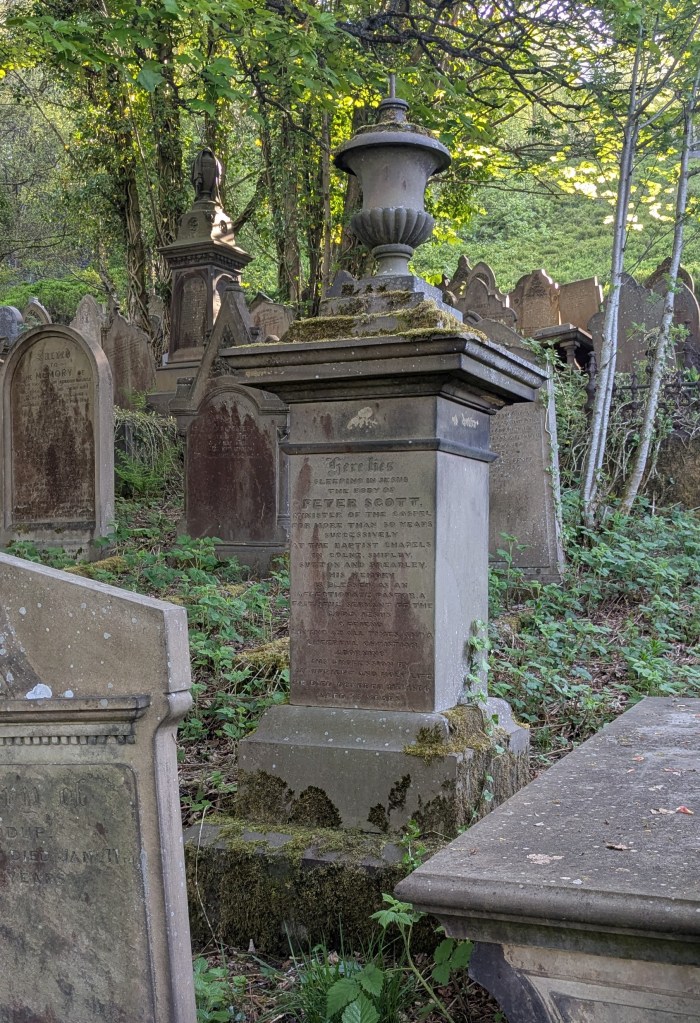
His grave (plot A511) is marked by a substantial but elegant memorial, with an epitaph eloquently praising his life and work.
The memorial also mentions Caroline, infant daughter of William Henry and Ruth Ibberson of Hope House, Hebden Bridge, who died on 2nd May 1880, aged 13 months and is buried in this plot, which was bought by the Trustees of Hope Chapel. William Ibberson was pastor at Hope Chapel, Hebden Bridge from 1877 to 1881.
Rev. W.H.Ibberson
Here lies Sleeping in Jesus
the Body of PETER SCOTT,
Minister of the Gospel for more than 50 Years Successively at the Baptist Chapels in Colne, Shipley, Sutton and Brearley.
His Memory is Blessed as an Affectionate Pastor, a Faithful Servant of the Lord Jesus, a Friend Loving at All Times, and a Cheerful Christian, Adorning His Profession by an Upright and Holy Life.
He Died October 11th 1866 Aged 73 Years.
Rev. John CROOK (c1797 – 1861)
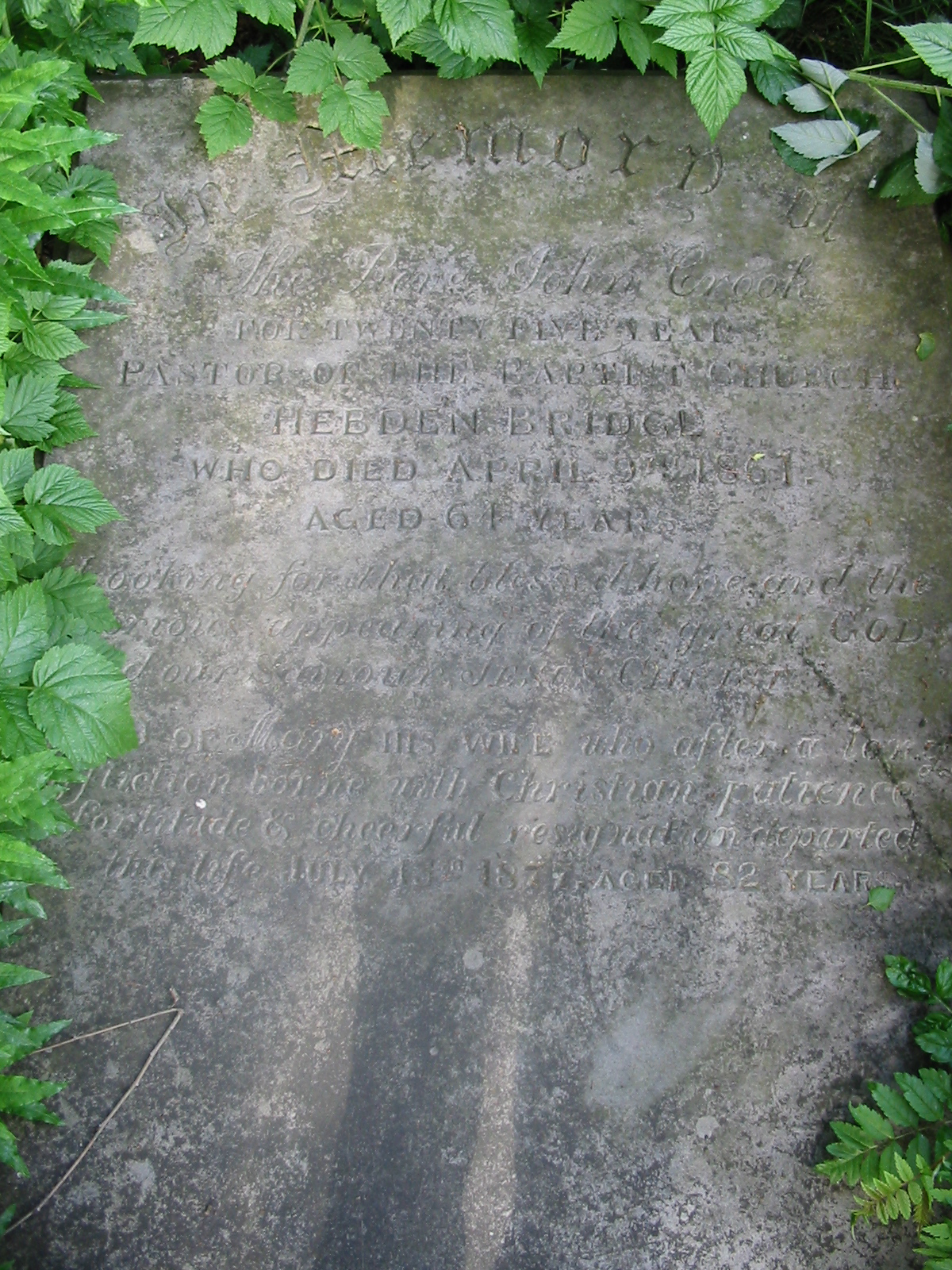
Born in Inskip, Lancashire. Minister at Ebenezer Baptist Chapel, Hebden Bridge from 1841, he oversaw its move to the newly built Hope Baptist Chapel in 1858. He retired due to ill-health in 1859, and died on 9th April 1861 aged 64. His wife Mary, born in Leicester, died ‘after a long affliction borne with Christian patience, fortitude & cheerful resignation’ in 1877 aged 82.
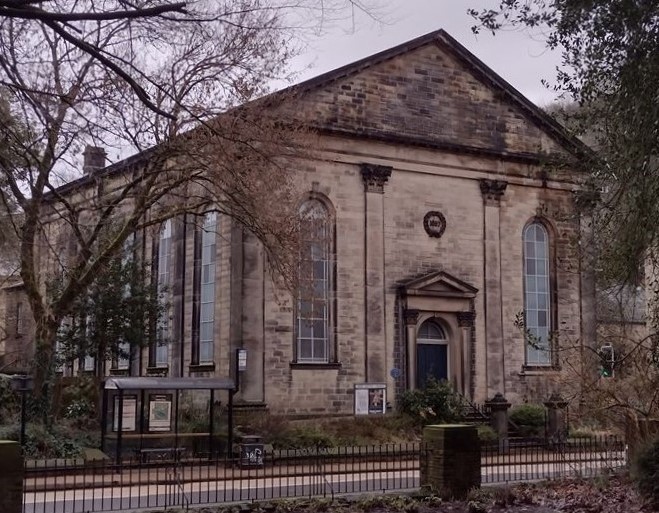
Hope Baptist Chapel, Hebden Bridge.
The burial plot (A512 ) was bought by the Trustees of Hope Chapel, and the epitaph on his gravestone (Titus 2:13) reads:
‘Looking for that blessed hope, and the glorious appearing of the great God and our Saviour, Jesus Christ.’
Rev. Jonas SMITH (c1812-1880)
Jonas Smith, born in Kildwick (between Keighley and Skipton) was minister at Wainsgate from 1845 to 1847, and although he is not buried there, his first wife Hannah and three of their children are buried in plot A515. Their son Joseph died in 1846, aged 14 months, but his wife and another son and daughter died after they had left Wainsgate: Hannah died in Bacup in 1862 aged 49, Ellen died in Bacup in 1864 aged 11, and Edwin died in 1870 aged 15, also in Bacup.
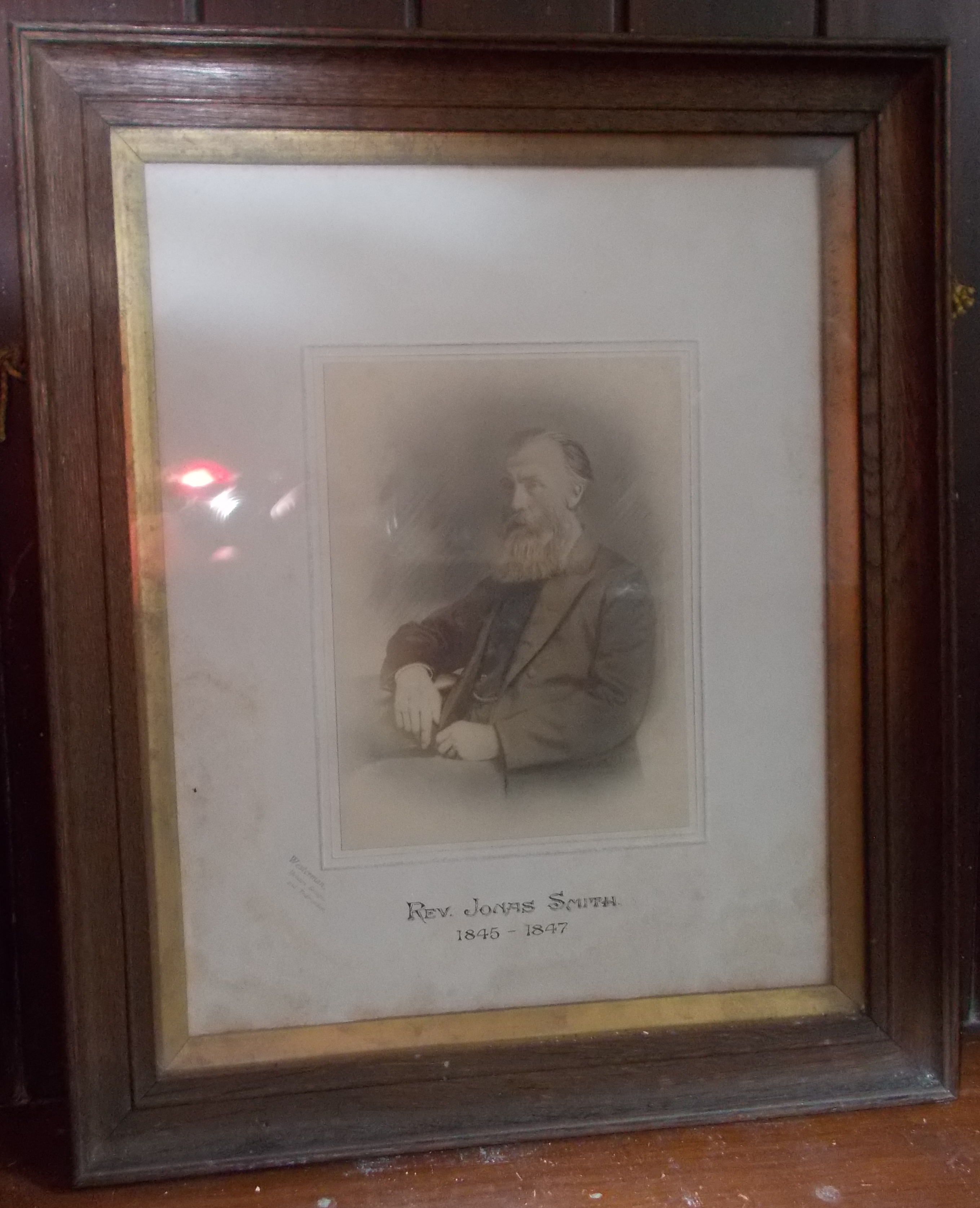
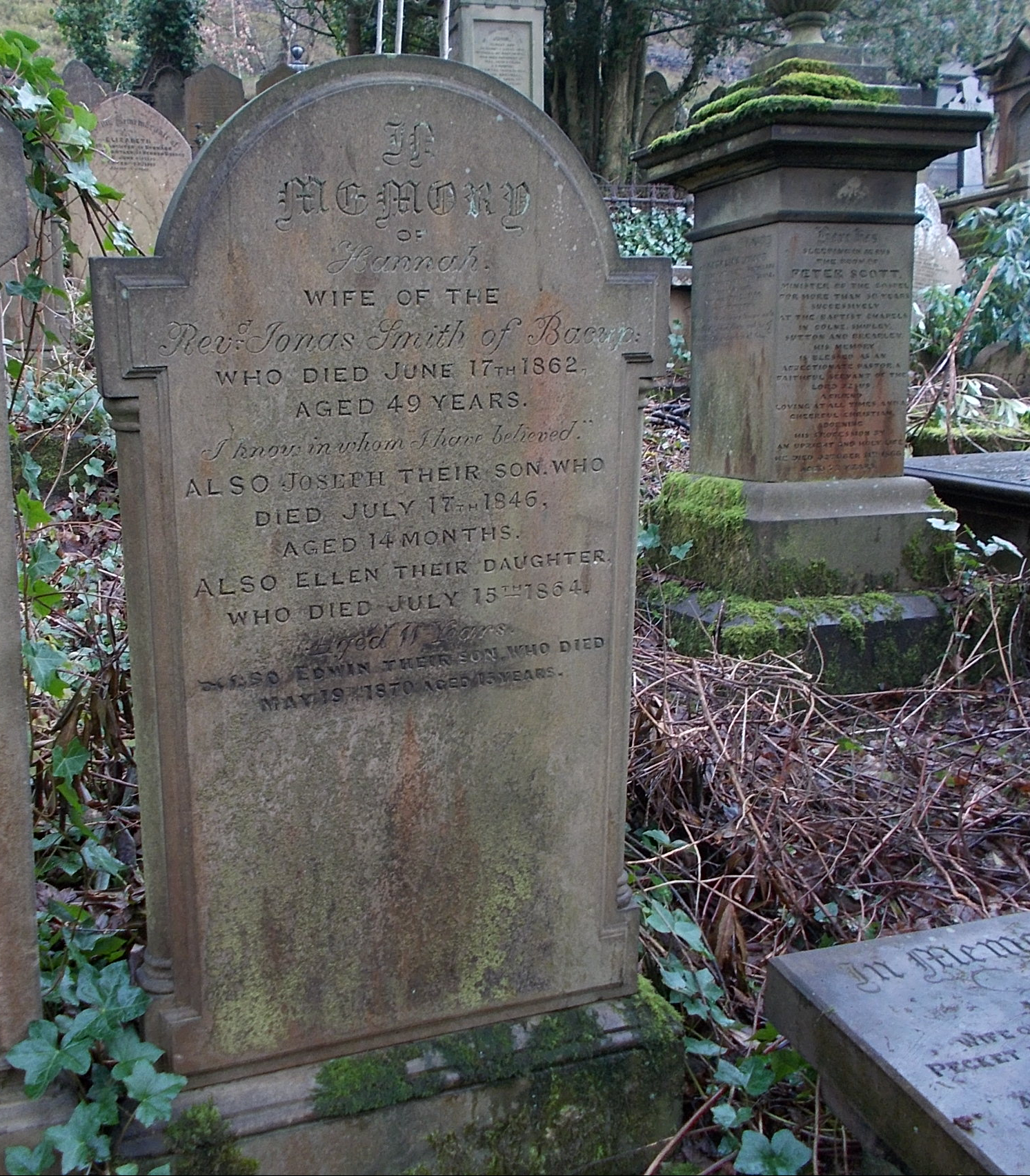
After leaving Wainsgate in 1847, Jonas Smith became minister at Ebenezer Baptist Church, Bacup and stayed there until 1874, when he and some members of his congregation split from Ebenezer, eventually forming Mount Olivet Baptist Church, where he remained until his death on 26th September 1880. The burial place of Jonas and his second wife, Mary, has not been established.
Rev. John BAMBER (c1813-1882)
John Bamber was pastor at Wainsgate for 23 years, from 1855 to 1878, and it was during this time that the chapel and Sunday school were rebuilt, the new Sunday school opening in 1859 and the chapel in 1860.
He was born at Crossmoor, Lancashire, the son of Henry and Ellen Bamber. The 1841 census describes him as a shoemaker, living with his wife Margaret at Inskip, Lancashire and in 1851 they were living in Hunslet, Leeds, and he was a ‘Baptist Minister of the Baptist Tabernacle’. The 1861 census shows them living at Wainsgate: no children are recorded (and none are recorded in the 1841 or 1851 census), but they have a boarder, Alfred Fish aged 12, born in Lancashire and described as a scholar.
Alfred Fish died on 26th August 1869 aged 20, and is buried in a double plot (A543/544) which was bought by John Bamber. Little is known about him – possibly the son of Mary and John Fish, a ‘cotton spinner & manufacturer’ from Oswaldtwistle. Why was he boarding with John and Margaret Bamber – perhaps training to become a Baptist minister?
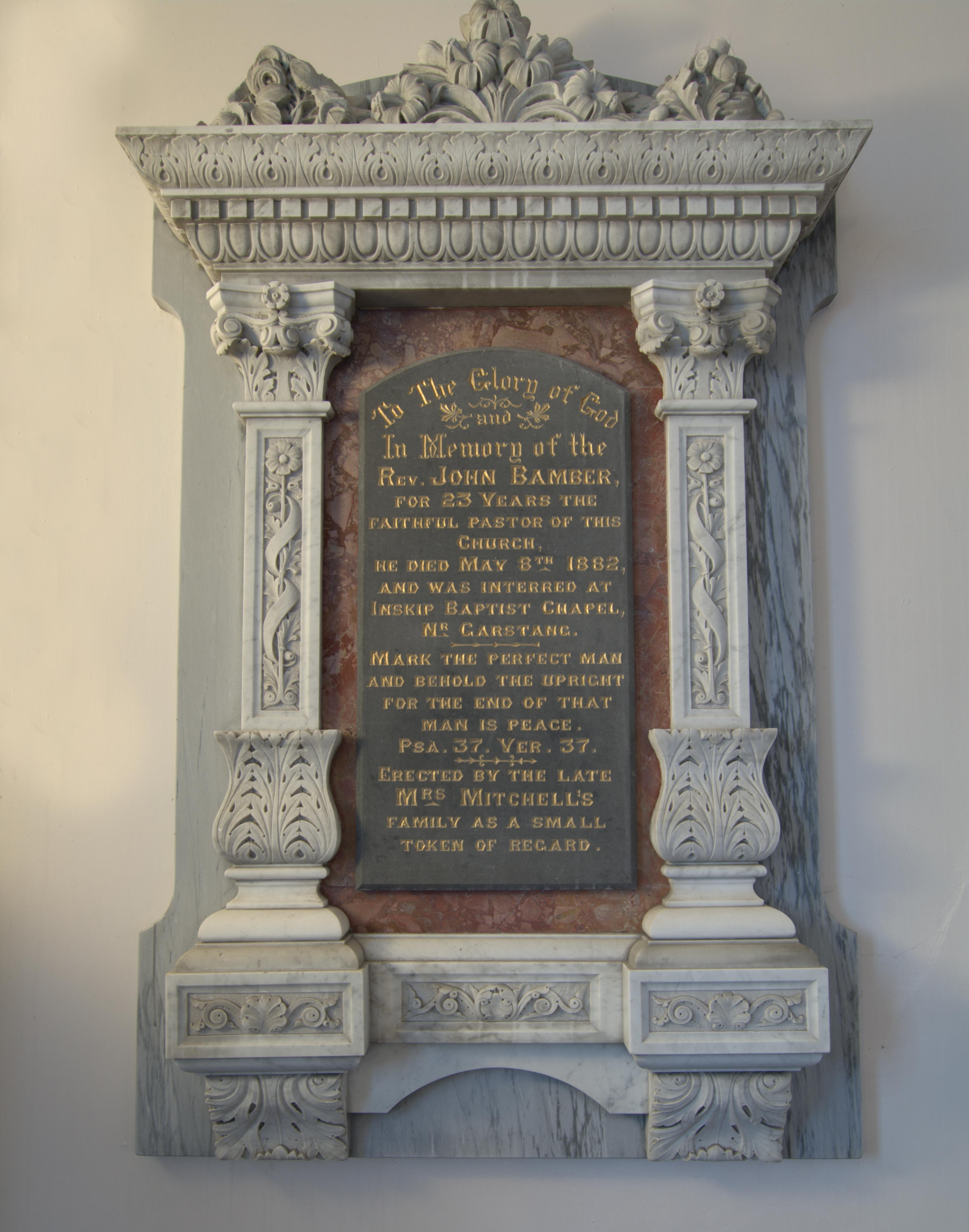
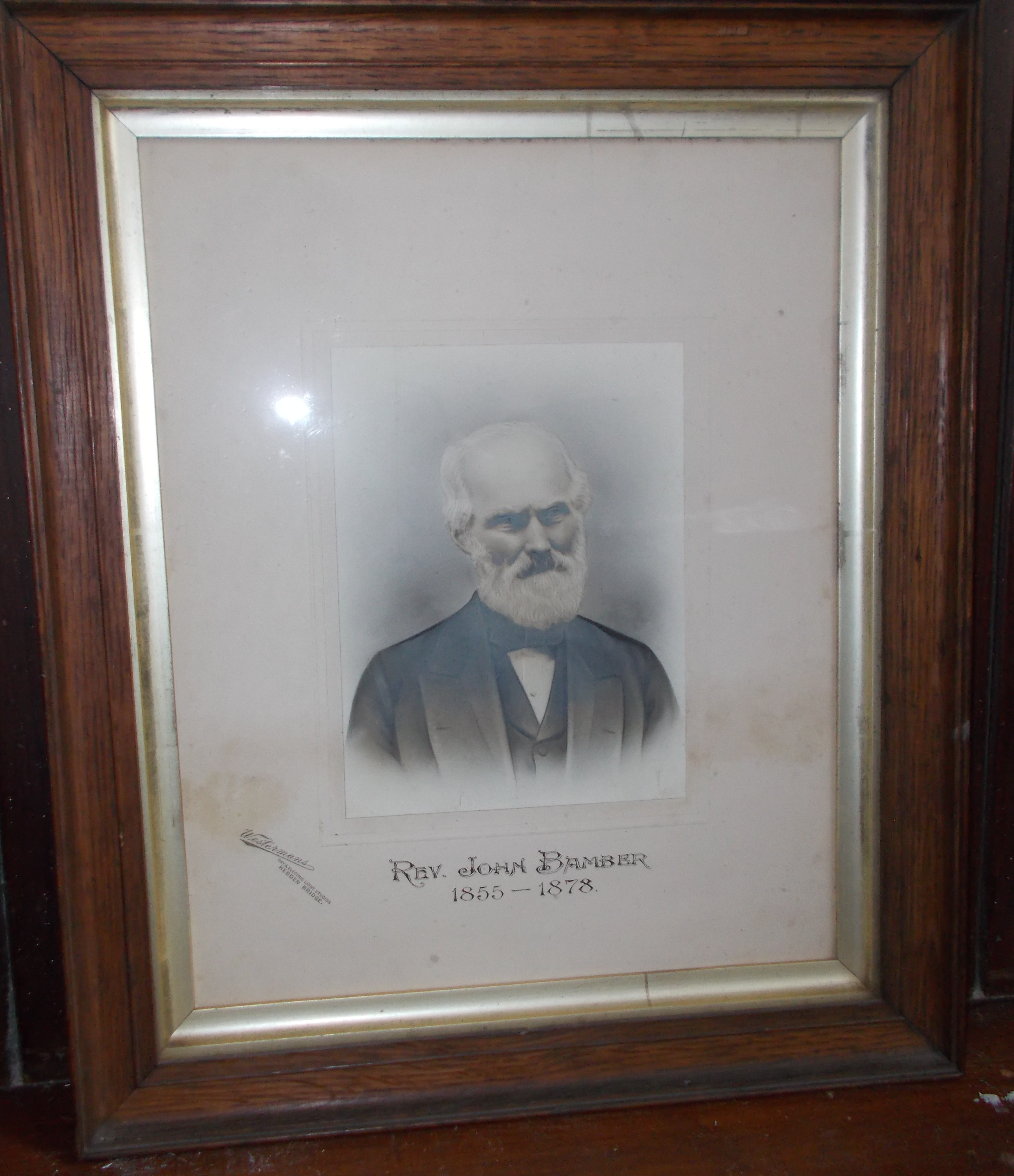
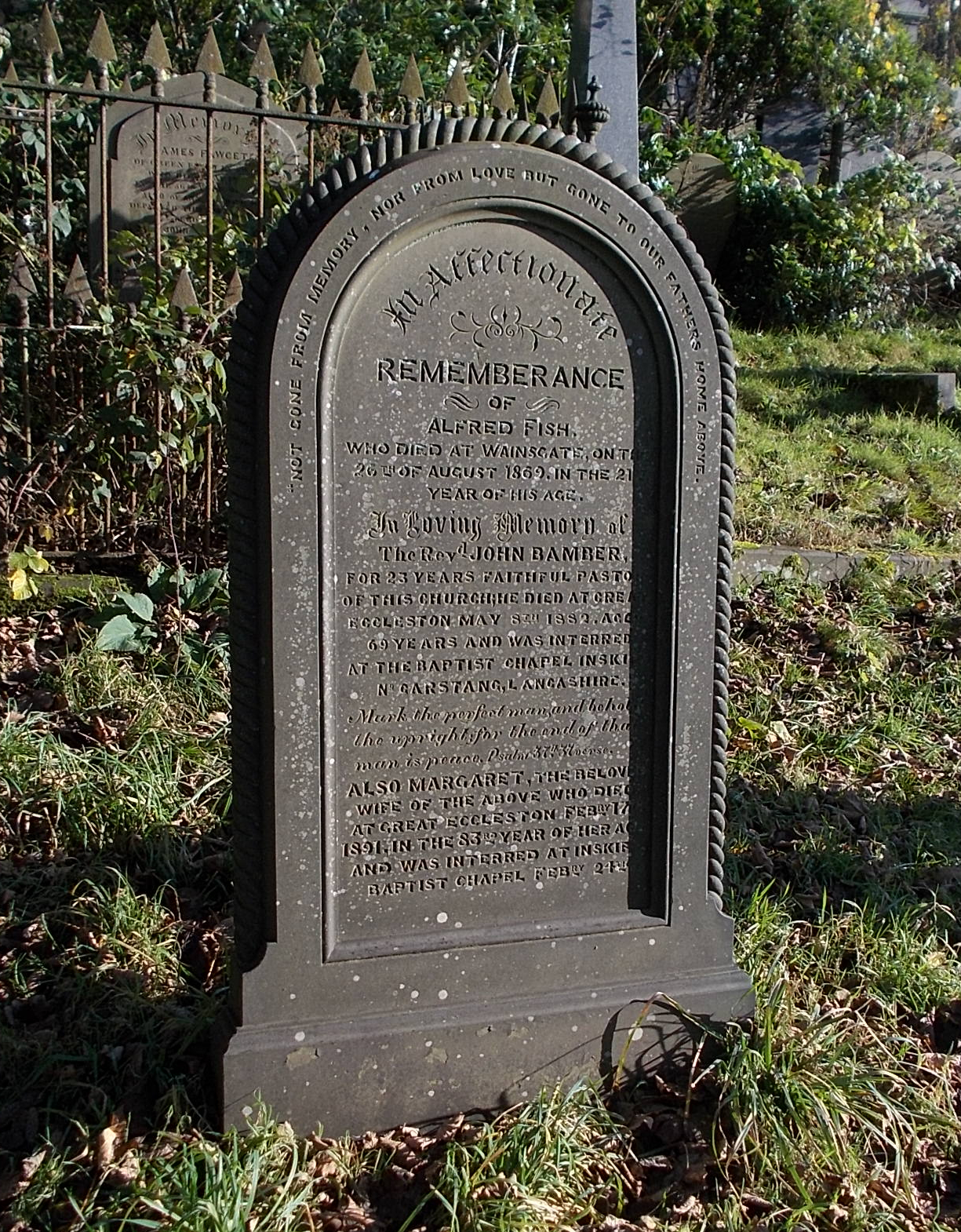
In 1881 John Bamber, a ‘retired Baptist Minister’ was living with Margaret at Great Eccleston, Lancashire, where he died on 8th May 1882 aged 69. Margaret died at Great Eccleston in 1891, aged 82. Both were buried at Inskip Baptist Chapel and are also commemorated on the headstone marking Alfred Fish’s grave.
There is also an elaborate marble memorial tablet in the gallery of the chapel, believed to have been installed in 1904, ‘Erected by the late Mrs Mitchell’s family as a small token of regard’. (presumably Sarah Ann Mitchell of Boston Hill, who died in 1900). The headstone and memorial tablet both have an epitaph from Psalms 37:37:
‘Mark the perfect man and behold the upright: for the end of that man is peace’.
Rev. Henry BRIGGS (c1846-1920)
Henry Briggs became minister at Millwood Baptist chapel in Todmorden in 1871, and oversaw its move to a new home at Roomfield, where he remained as minister until 1909. He is recorded in the receipt books as buying two burial plots at Wainsgate: plot B185a on 31st December 1876, and plot B324a on 18th September 1903.
The burial register has an entry for 30th December 1876 – ‘Child of Rev. H. Briggs, Todmorden, 10 months’. Birth and death records tell us that the child was named Flora, the first child of Henry and his wife Mary Ellen (born Hall), and was presumably buried in plot 185a. The grave is unmarked, and no other burials are known to have taken place in that plot.

Plot B324a is also unmarked, and no burials are thought to have taken place in it. The reasons for Henry Briggs buying the plot are unknown: neither he, his wife nor their three surviving children are thought to be buried at Wainsgate.
Rev. George W. WILKINSON (1849-1924)
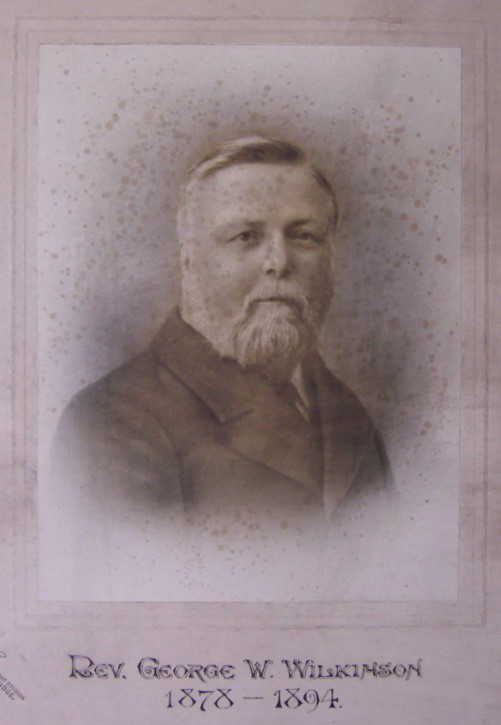
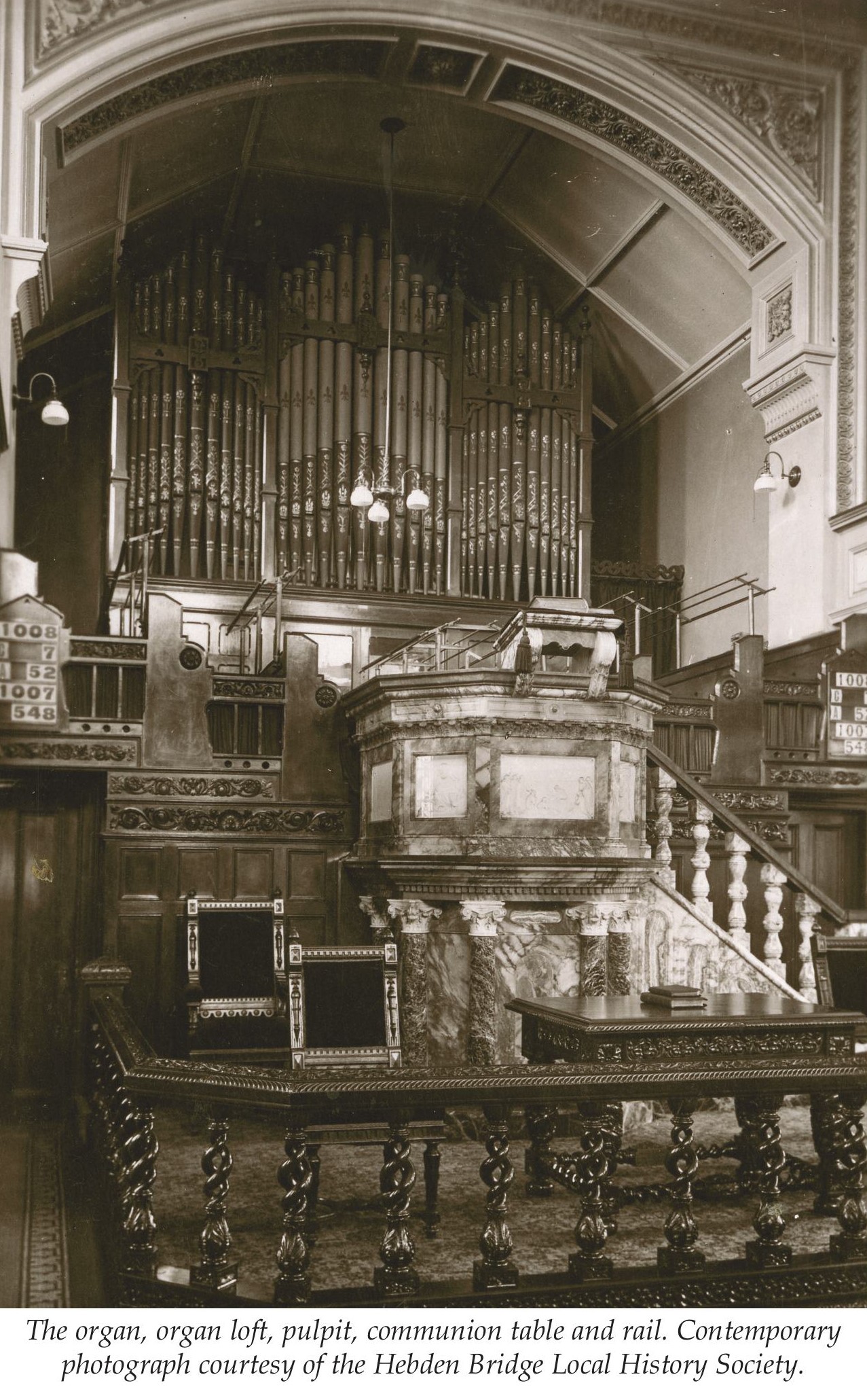
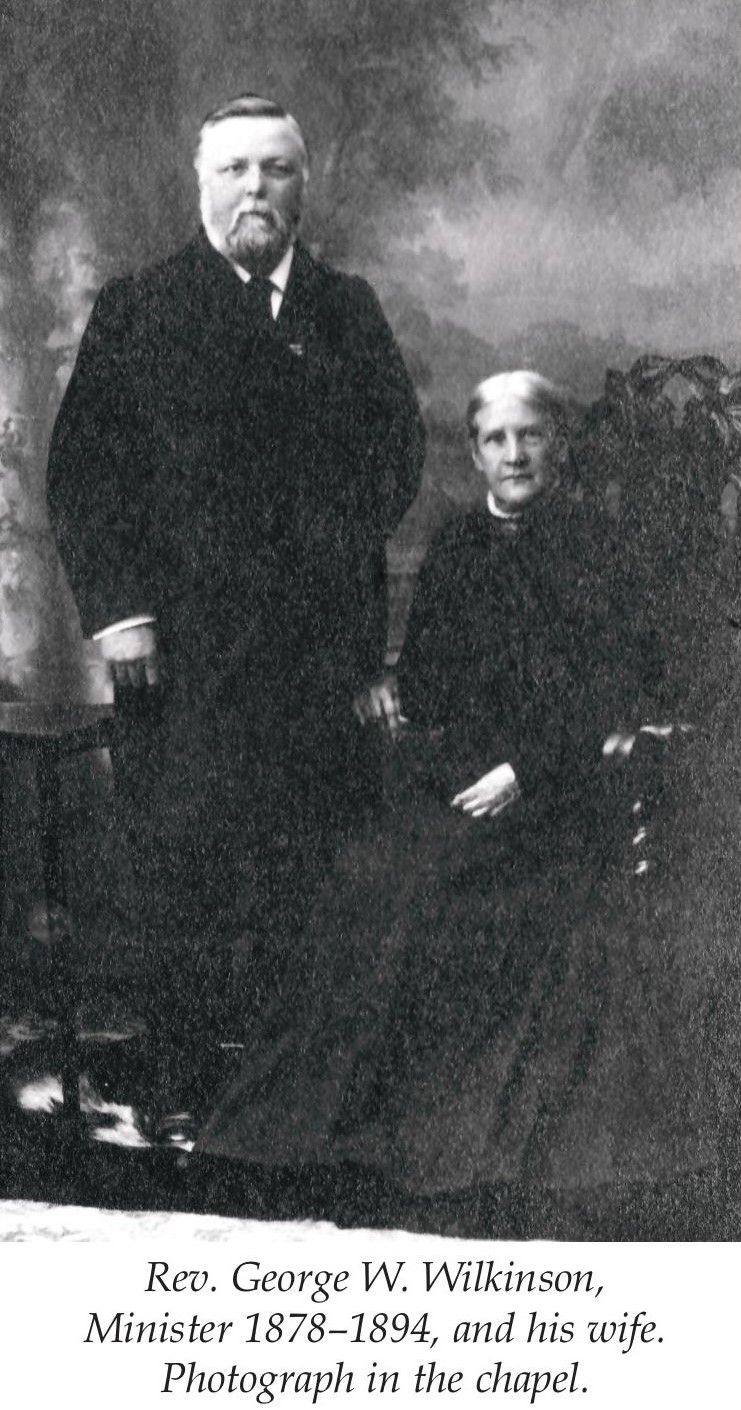
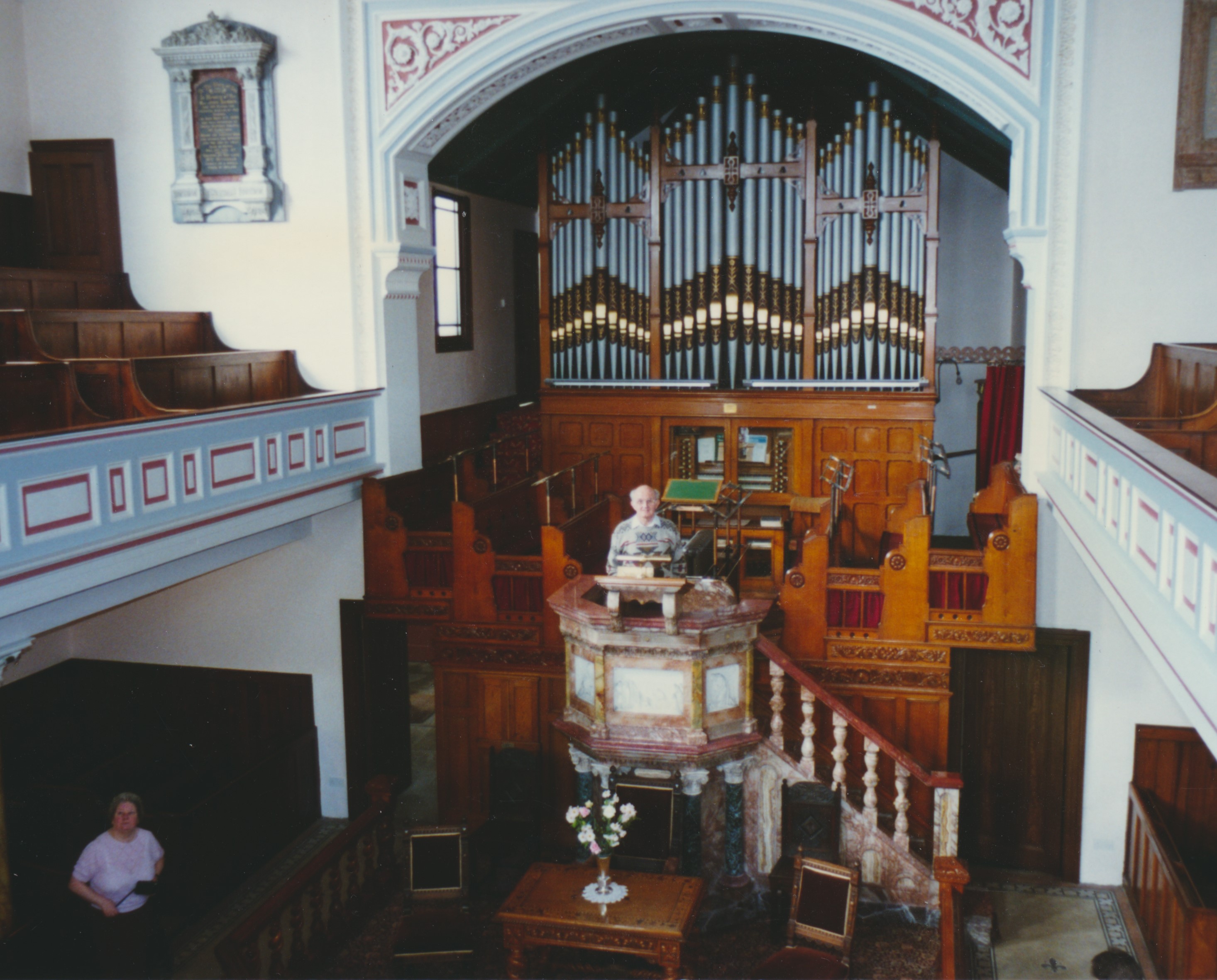
George William Wilkinson was born in Stalybridge, Cheshire in 1849. He trained for the ministry at Brighton Grove College, Manchester and on leaving the college became pastor at Linthorpe Baptist Church, Middlesborough in 1875. He moved to Wainsgate in 1878, staying there for 16 years and overseeing major improvements to the chapel, including the installation of the organ, the new pulpit and the construction of the new manse, ‘Cousinville’.
He married Betty Atherton in 1875, and the couple had three children, Herbert, Edgar and Christabel: after his retirement he joined his sons in their wholesale fustian clothing business. He continued to serve various churches as a ‘supply’ preacher after his retirement, and was actively involved with Birchcliffe Baptist Church and School and took a prominent role in the YMCA movement.
George Wilkinson was living at Bethel Terrace, Hebden Bridge when he died ‘following upon a lengthy illness’ on 18th January 1924, aged 74, and was buried at Heptonstall Slack Baptist Cemetery.
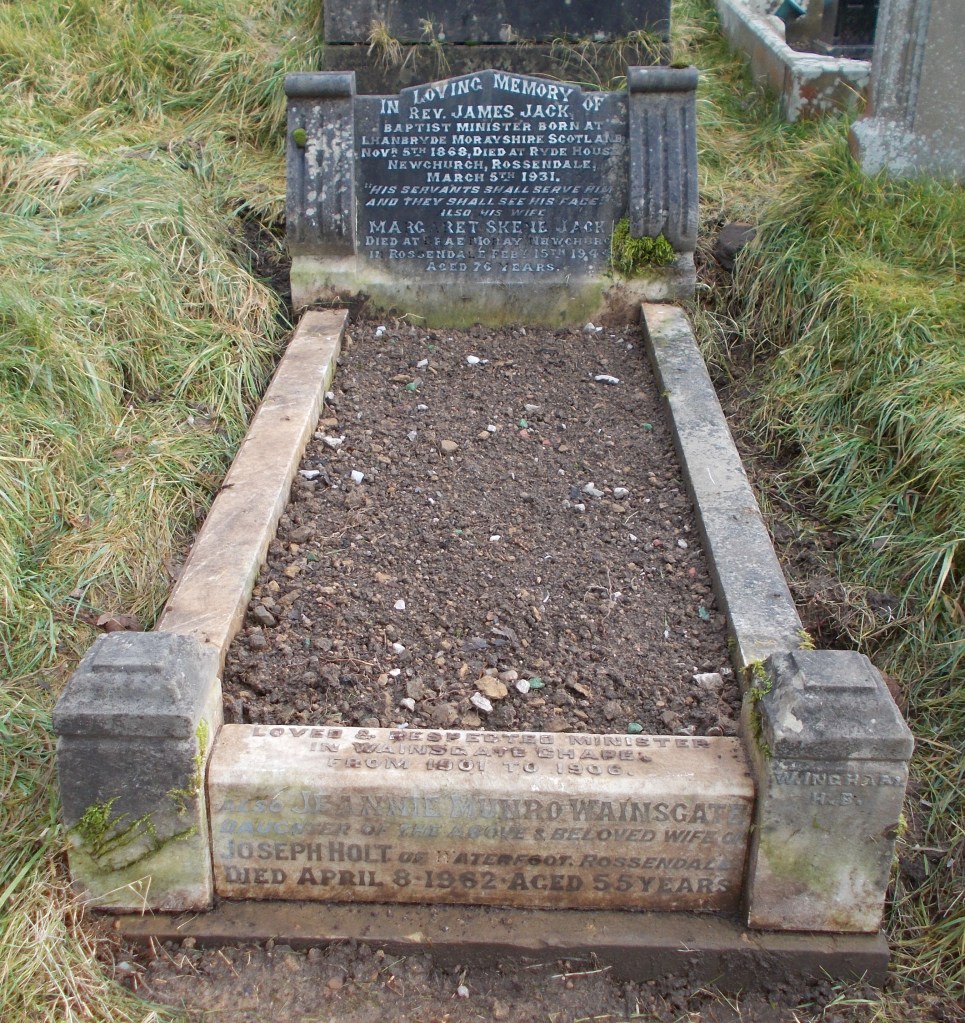
Rev. James JACK (1868-1931)
Born in 1868 at Lhanbryde near Elgin, Morayshire, he was minister at Hull Baptist Church when he married Margaret Skene Smith, born in Inverness-shire, in 1899. Minister at Wainsgate from November 1901 to August 1906, he then moved to Bingley, where he was minister at Bingley Baptist Church. Although his pastorate at Wainsgate was relatively brief, the period saw some important events at Wainsgate, including the construction of the new road from Akroyd Lane, the widening of Wainsgate Lane and the installation of the stained glass windows donated by the Mitchell and Appleyard families. Rev. Jack was highly respected and deeply loved by his congregation, and it is said that his decision to leave Wainsgate was greatly regretted.
He was living at Newchurch, Rossendale when he died in 1931, aged 62. The epitaph on his headstone (plot F848) is from Revelation 22: 3-4:
‘His servants shall serve him and they shall see his face.’
His wife Margaret died in 1944, aged 76. The second of their two daughters, born in Bingley in September 1906 (but presumably conceived while her parents were living at Wainsgate) was named Jeannie Munro Wainsgate Jack. She married Joseph Holt in 1931 and was living in Clitheroe when she died in 1962 aged 55. She was buried with her parents at Wainsgate.
Rev. Joseph FIELDING
Minister at Wainsgate from January 1921 to September 1930, he oversaw a considerable amount of repair work and the long overdue internal redecoration of the chapel.
‘A very happy and useful ministry, but it brought many changes………Throughout this ministry, pastor and people worked harmoniously together and it was with greatr regret that Mr. Fielding’s resignation was received’.
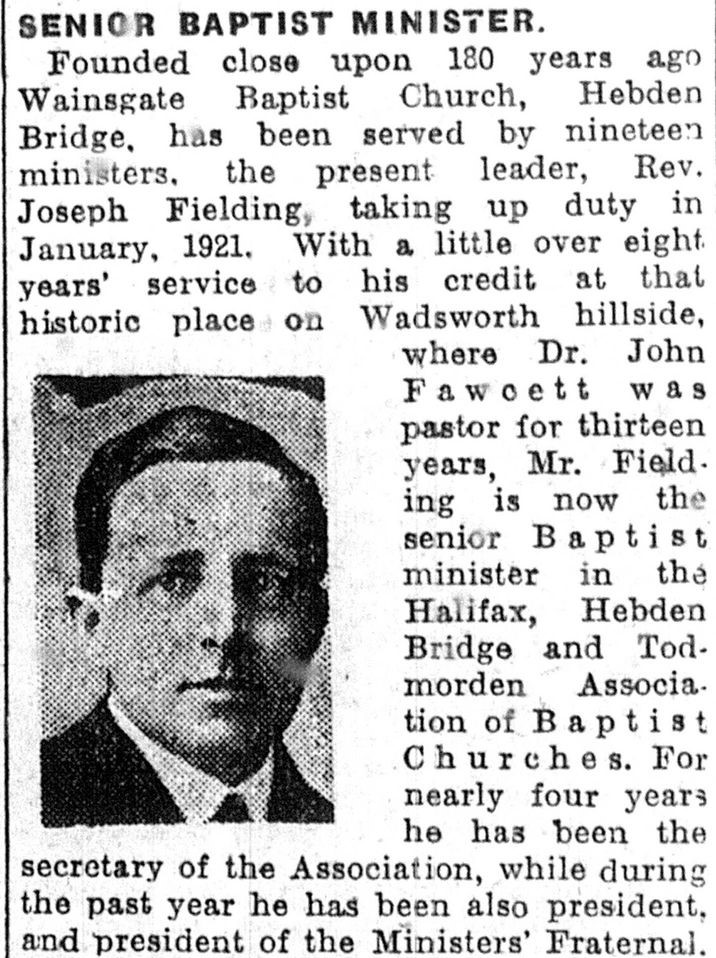
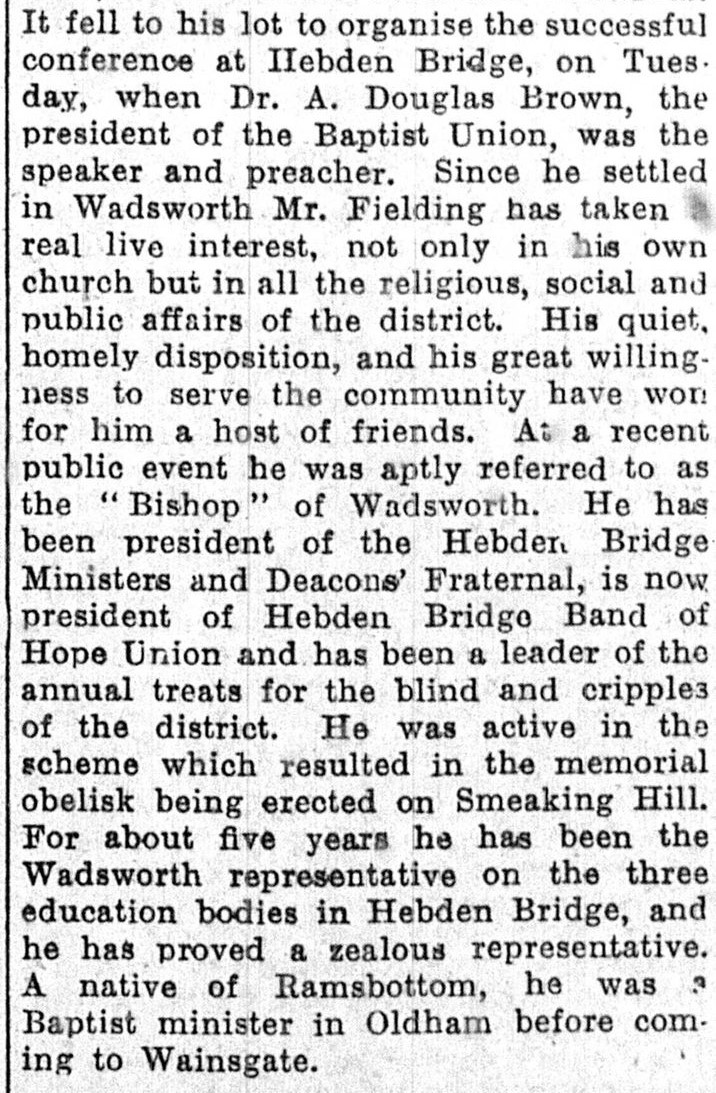
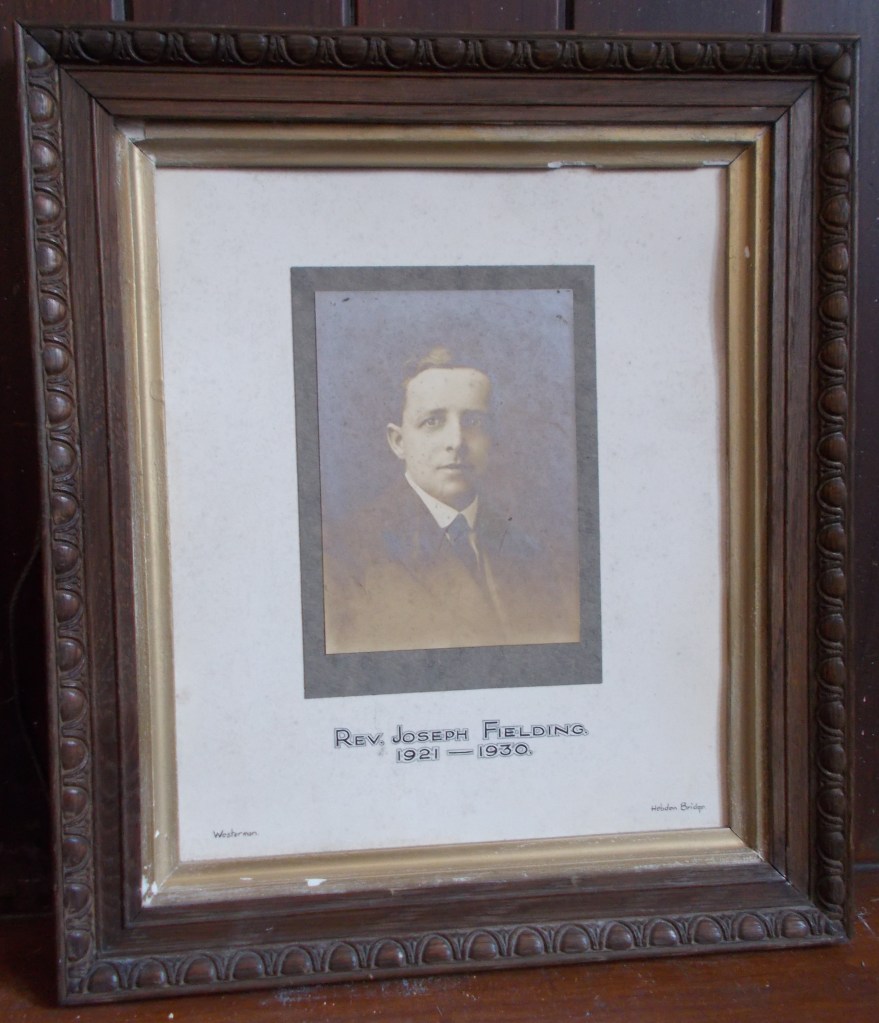
Joseph Fielding, minister at Wainsgate 1921-1930.
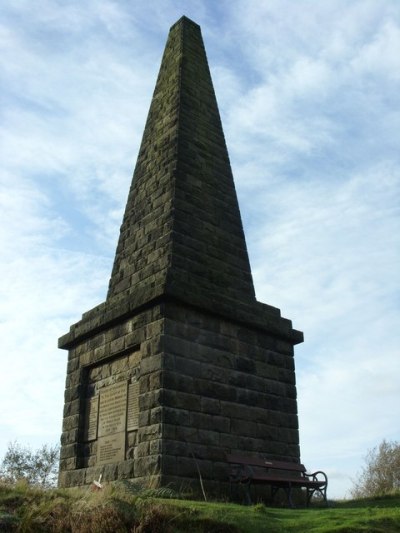
Joseph Fielding was chairman of the Memorial Committee which commissioned the Wadsworth war memorial at Smeakin Hill, and presided over the service of dedication when it was unveiled on 23rd September 1923.
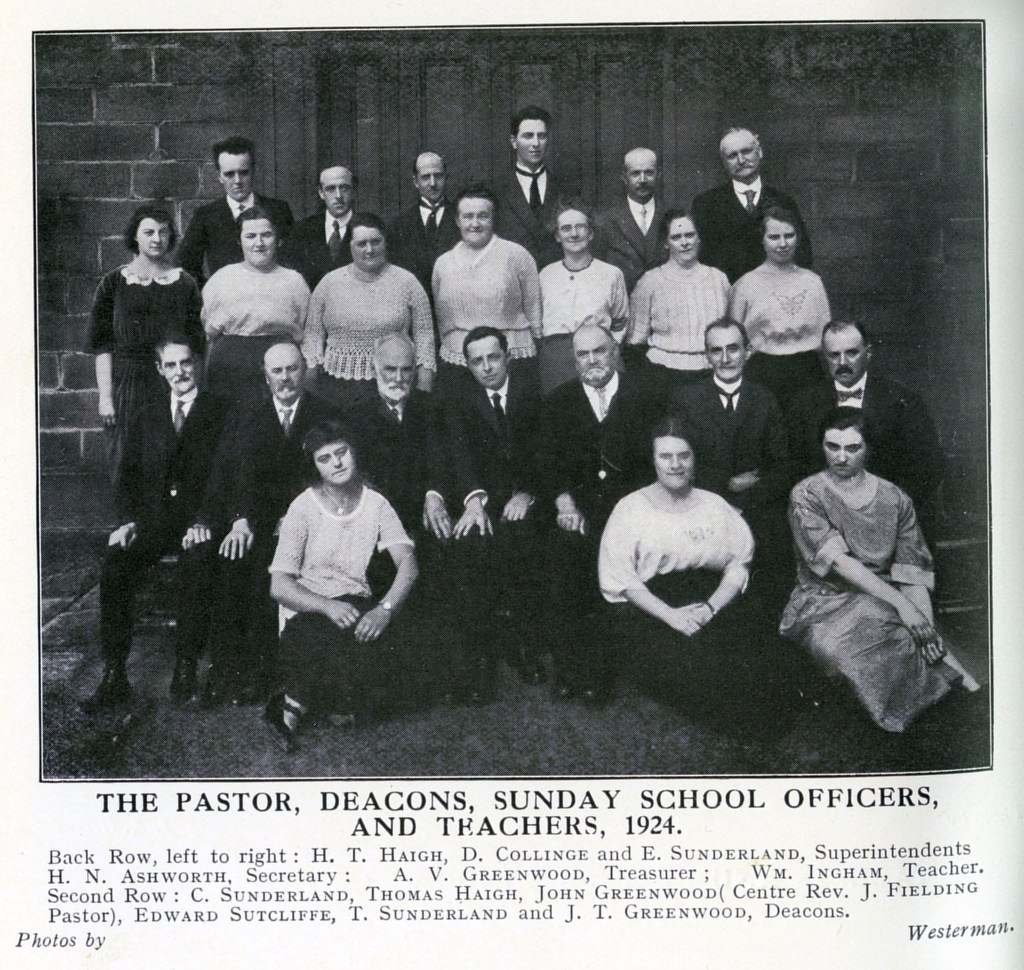
Rev. Joseph Fielding with Wainsgate deacons, Sunday school officers and teachers, 1924.
Rev. Arnold BINGHAM (1886-1962)
Born in Sheffield, Arnold Bingham was brought up in the Church of England, and in 1909 he went to America and worked for two years as a fruit rancher and in the timber trade in Oregon. Returning to England in 1911, he entered the Church Army Training College in London, was nominated as an evangelist and travelled around Devon in a ‘Gospel caravan’.
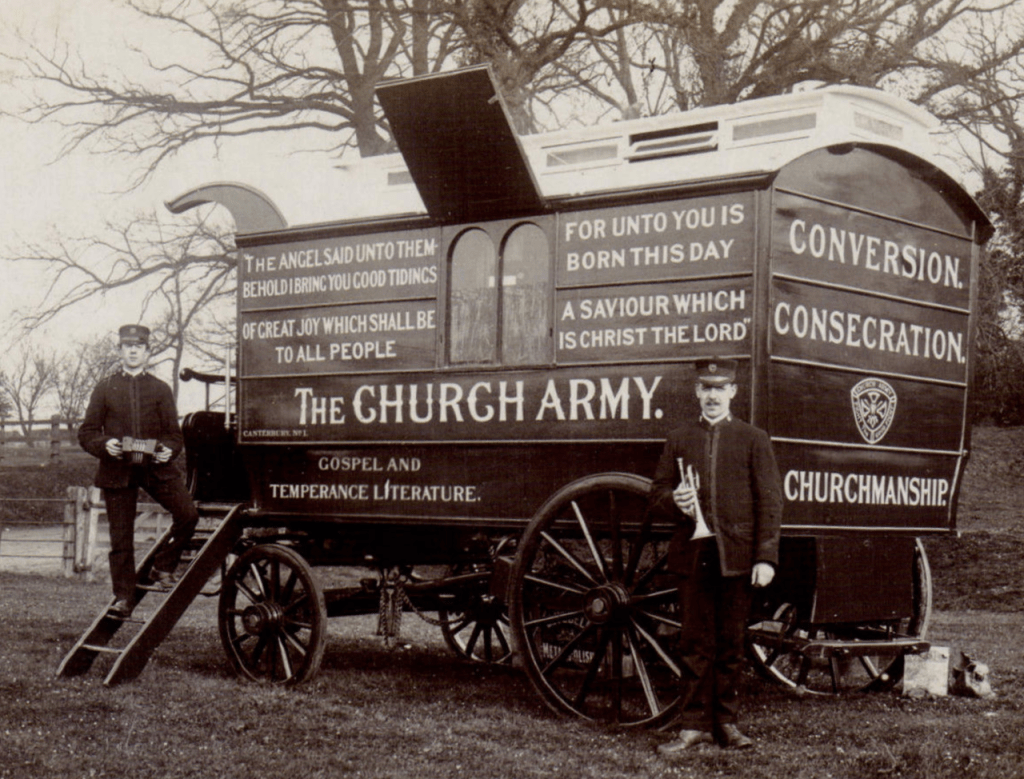
Church Army gospel caravan – undated photograph, but possibly c1910.
In 1914 he volunteered for military service, and served with the Army in India and Mesopotamia (now Iraq). After returning to England in November 1918 to take charge of a Mission Church in Newcastle. In 1919 he married Ellen Heath (from Endon, Staffordshire), and for the next few years they travelled around Northumberland, where he did missionary work with miners, and later in Durham and Yorkshire, holding missions at Washington, Darlington, Dewsbury, Norland, Krumlin and Brearley.
The 1921 census records Arnold and Ellen living in Newcastle, where he described himself as a ‘Church Army Evangelist’ based at St. Silas church, Byker.
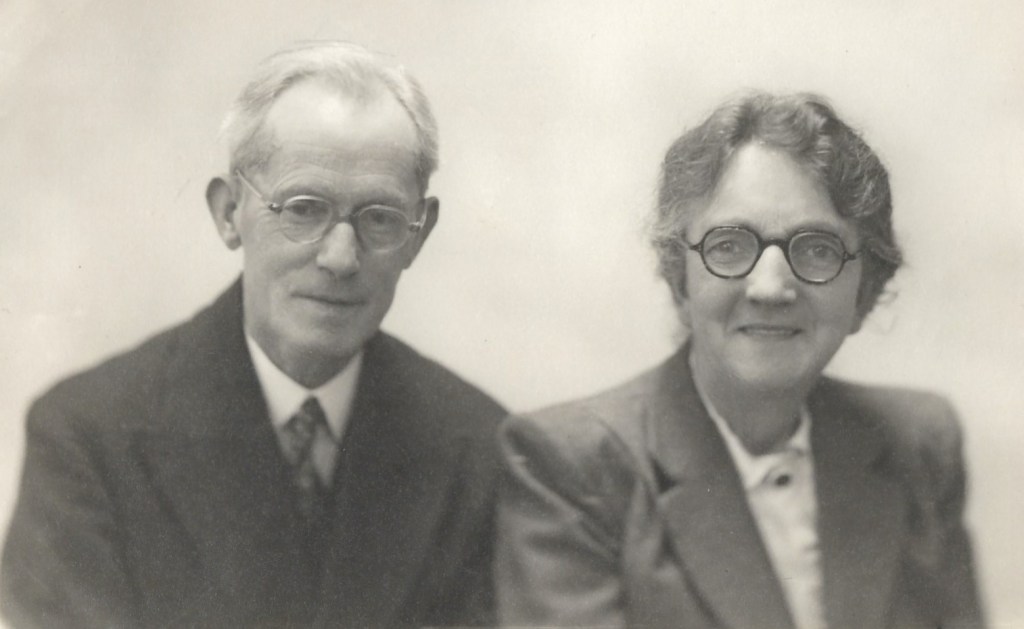
Arnold and Ellen Bingham
Arnold Bingham was installed as pastor of Brearley Baptist Church in 1924, after the pastorate had been vacant for thirteen years. He soon doubled the membership of the church and started many organisations there, before resigning in 1940. After leaving Brearley he continued to preach at other chapels in the area, including Wainsgate, where he officiated at several burials, the last one just four months before his death in 1962.
While he was at Brearley, he opened a ‘Health Stores’ in Todmorden indoor market and later opened a shop at 32, Market Street, Hebden Bridge, which he ran until about a year before his death. It seems that his shop may have been a forerunner of such local institutions as Aurora Wholefoods, Bear Wholefoods in Todmorden and Valley Organics at 16, Market Street.
Arnold Bingham was a man who was a true community activist, involved in a large number of local voluntary organisations. He held offices in several Baptist and Free Church organisations in the Calder valley, including the Hebden Bridge Auxiliary of the Baptist Missionary Society, the Hebden Bridge Auxiliary of the British & Foreign Bible Society and the Yorkshire Association of Baptist Churches. He was a member of the County Temperance Committee, and secretary of the Hebden Bridge Blind and Cripples’ Treat Committee (later renamed as the slightly less offensive Committee for the Physically Handicapped).
He was secretary of the Hebden Bridge Citizens’ Advice Bureau (the first 200 bureaux opened on 4th September 1939, the day after war was declared) for many years, secretary to the Marriage Guidance Council (founded in 1938 and relaunched as Relate in 1988) and worked with refugees and evacuees during WW2. He was a member of the committee which brought refugees from Czechoslovakia to the district before the war, and was appointed as billeting officer for evacuees for the Hebden Royd District.
He also somehow found time to be vice-president of the Hebden Bridge Angling Society and Chairman of the Catering Sub-Committee of the Joint Coronation Celebration Committee in 1953.
Towards the end of the war, the Binghams opened a youth club (the High Street Mission) in the High Street area of Hebden Bridge, intended for poorer chidren who did not attend a Sunday School. The club was open to boys and girls of all ages, and offered activities such as table tennis, sewing classes for the girls, and a Christmas party. Up to fifty children attended, and the club lasted for around nine years. On at least one occasion Arnold Bingham was known to have spoken up for boys from his club who had been brought before the magistrates for petty crimes.
“And most feared of all was the Bridge Lanes gang, under the fearsome ‘Whippet’ Harris, ably assisted by ‘Meggy’ Eidson. Bridge Lanes and High Street, before the bulldozers did their work in the 1960s, was a crazy medley of terraces, alleys and balconies, populated by hordes of wild and seemingly fearless children. Such was the reputation of the area that Mr Bingham, a true Christian gentleman, set up a ‘mission’ there. Table tennis and other simple games could be enjoyed for the price of a hymn and a prayer.”
From From Rationing to Rock ‘n’ Roll: a 1950s view of Hebden Bridge by Peter Thomas.
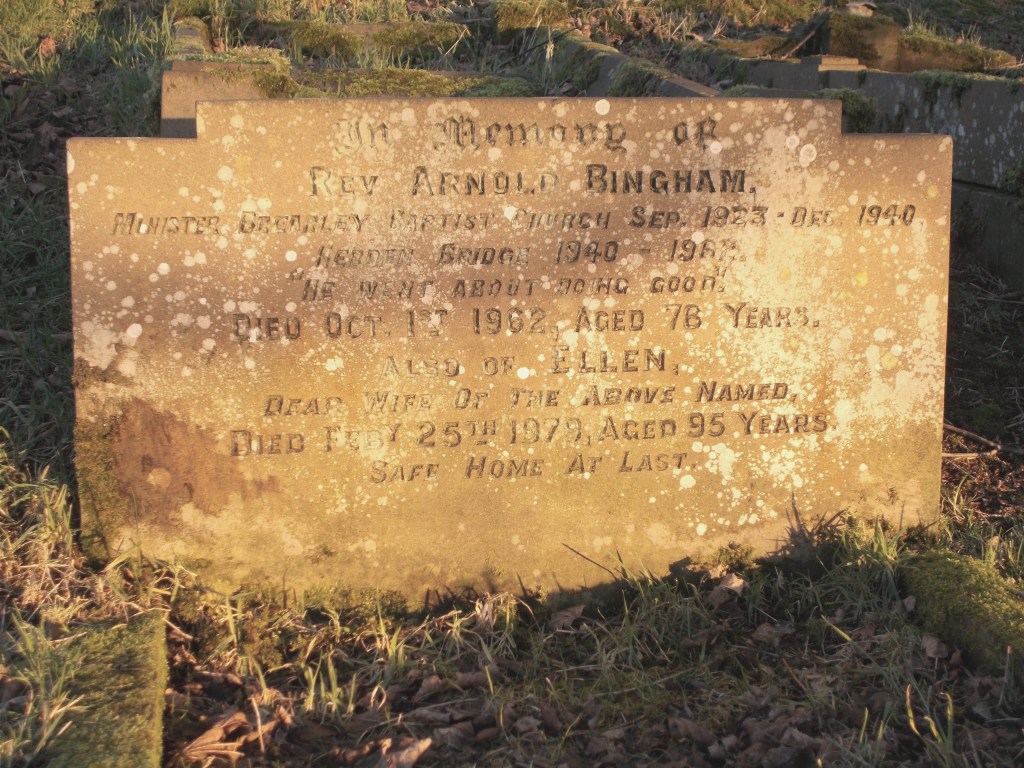
Arnold Bingham was living at 11 Boston Hill, Old Town, when he died at Halifax Royal Infirmary on 1st October 1962, aged 76. His funeral at Wainsgate was reported to have a large attendance of personal friends, social workers and church representatives.
His epitaph (plot J865) reads ‘He went about doing good’, which is from Acts 10:38.
‘How God anointed Jesus of Nazareth with the Holy Ghost and with power: who went about doing good, and healing all that were oppressed of the devil; for God was with him’.
His wife Ellen died in 1979 at Bellevue House, Shelf, aged 95. Her epitaph reads ‘Safe home at last’. There are two possible sources for this epitaph: one is the early 20th centry hymn Safe Home at Last, written by Julia E. Burnard:
‘Saviour, be Thou ever near me, May Thy holy presence cheer me, Bring thy child when life is past, Safe home at last.’
It may also be inspired by this exttract from the poem The Sexton by early 20th century Scottish poet Isaac Y. Ewan:
‘No more to fear, No more to die,
Shed every tear, Breathed every sigh!
All sorrows borne, All trials past, No more to mourn,
Safe home at last! Safe home at last!’
With thanks to Diana Monahan for researching the life of Arnold Bingham and obtaining the photograph of Arnold and Ellen.
Rev. Henry MEADOWS
Following the departure of Rev. Edwin Exall in 1942 it was two years years before the next pastor was appointed. This was a difficult time for Wainsgate: congregations had been declining in the ten years before the war (‘death having claimed many of the most faithful supporters’) and the outbreak of war meant that many young men and women were called away for military service or war work.
In April 1944 Henry Meadows was appointed as the new minister. We don’t know much about his background, but he came to Wainsgate with his fiancée, Miss Ellis, who came from South Shields, and he had trained for the ministry for five years at Rawdon College near Leeds.
The commencement of his ministry at Wainsgate was marked by tea and a concert on the Saturday and services the following day. The new minister and his fiancée were welcomed by the church secretary, Dennis Collinge, and after the tea a gift stall was opened by Miss Ellis. The concert was presided over by Raymond Ashworth, and consisted of songs performed by members of the choir, with ‘humorous interludes’ by Len Taylor, an entertainer from Halifax. There was also a song and dance routine performed by Marjorie Jackson and her friend Mary Mortimer. Rev. Meadows preached at the Sunday services, which included a ‘thankoffering service’ in the afternoon, when the Sunday school students brought gifts for their new minister. The choir was conducted by Raymond Ashworth and the organist was J.W. Parker.
A Short History of the Baptist Church at Wainsgate 1750–1950 tells us that Henry Meadows took up a position in Australia after leaving Wainsgate in 1946, and that:
‘… it is hoped that Mr. and Mrs. Meadows will both enjoy better health as a result of this change’.
The same source also mentions Edwin Exall, minister from 1934 to 1942, and his wife’s poor health while living at Wainsgate:
‘His was a very happy ministry and all were sorry that Mrs. Exall had not enjoyed good health at Wainsgate. The change was made on her account and it is very gratifying to note that her health has improved considerably since leaving this district’.
* * *
A thankoffering (sometimes thank offering or thank-offering) service is a special act of worship, expressing thanks to God for his blessings and involves the congregation giving gifts or money to support the church and its missions. Thankoffering is still practised by some Baptist churches in Britain, and is traditionally associated with women members of Protestant churches, particularly WELCA (Women of the Evangelical Lutheran Church in America).
The idea of thankoffering has its basis in the lesson of the widow’s mite, told in two of the synoptic gospels (Mark 12:41–44 and Luke 21:1–4):
‘And he looked up, and saw the rich men casting their gifts into the treasury. And he saw also a certain poor widow casting in thither two mites. And he said, of a truth I say unto you, that this poor widow hath cast in more than they all: For all these have of their abundance cast in unto the offerings of God: but she of her penury hath cast in all the living that she had’.
Rev. David F. NEIL
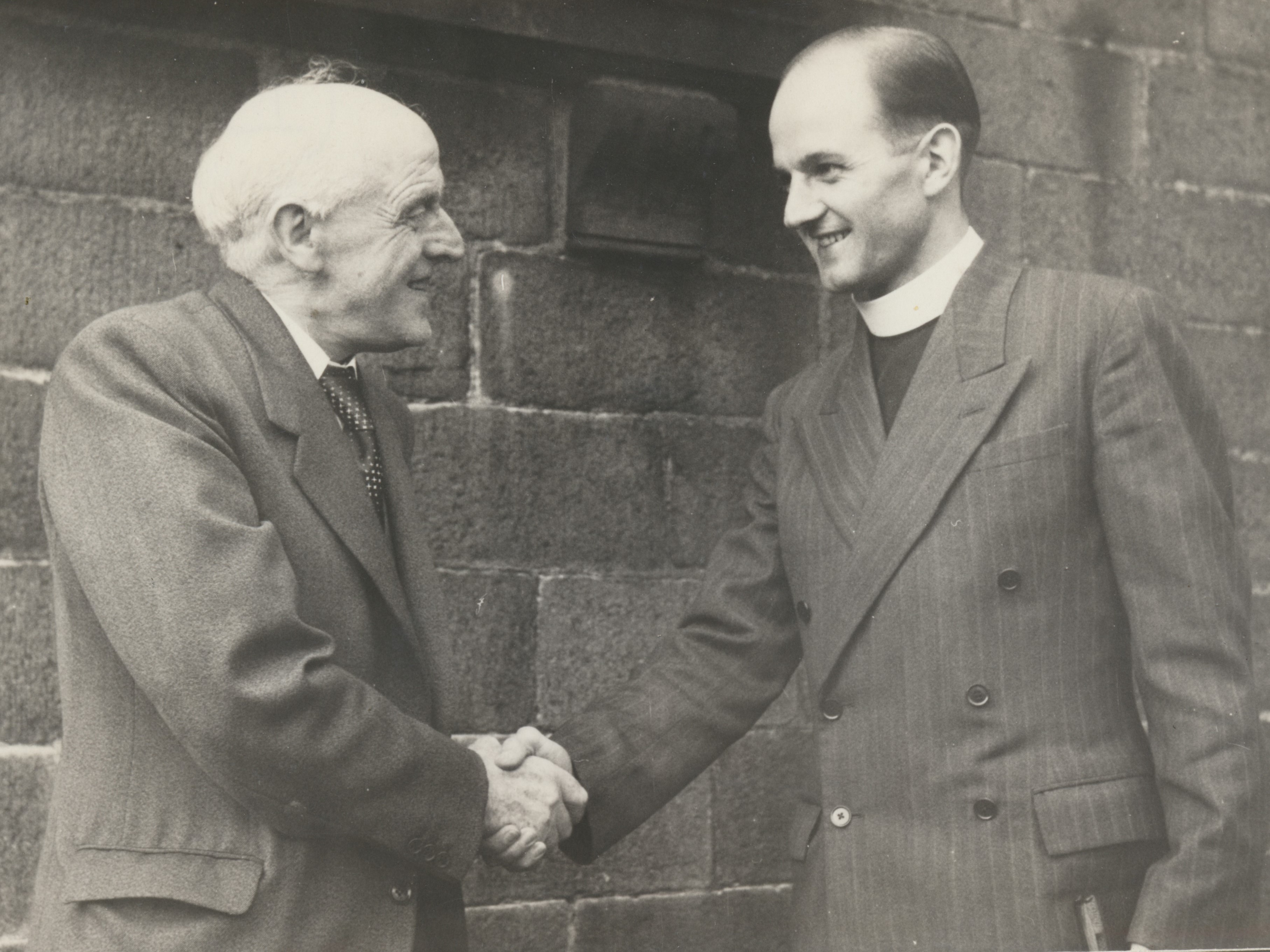
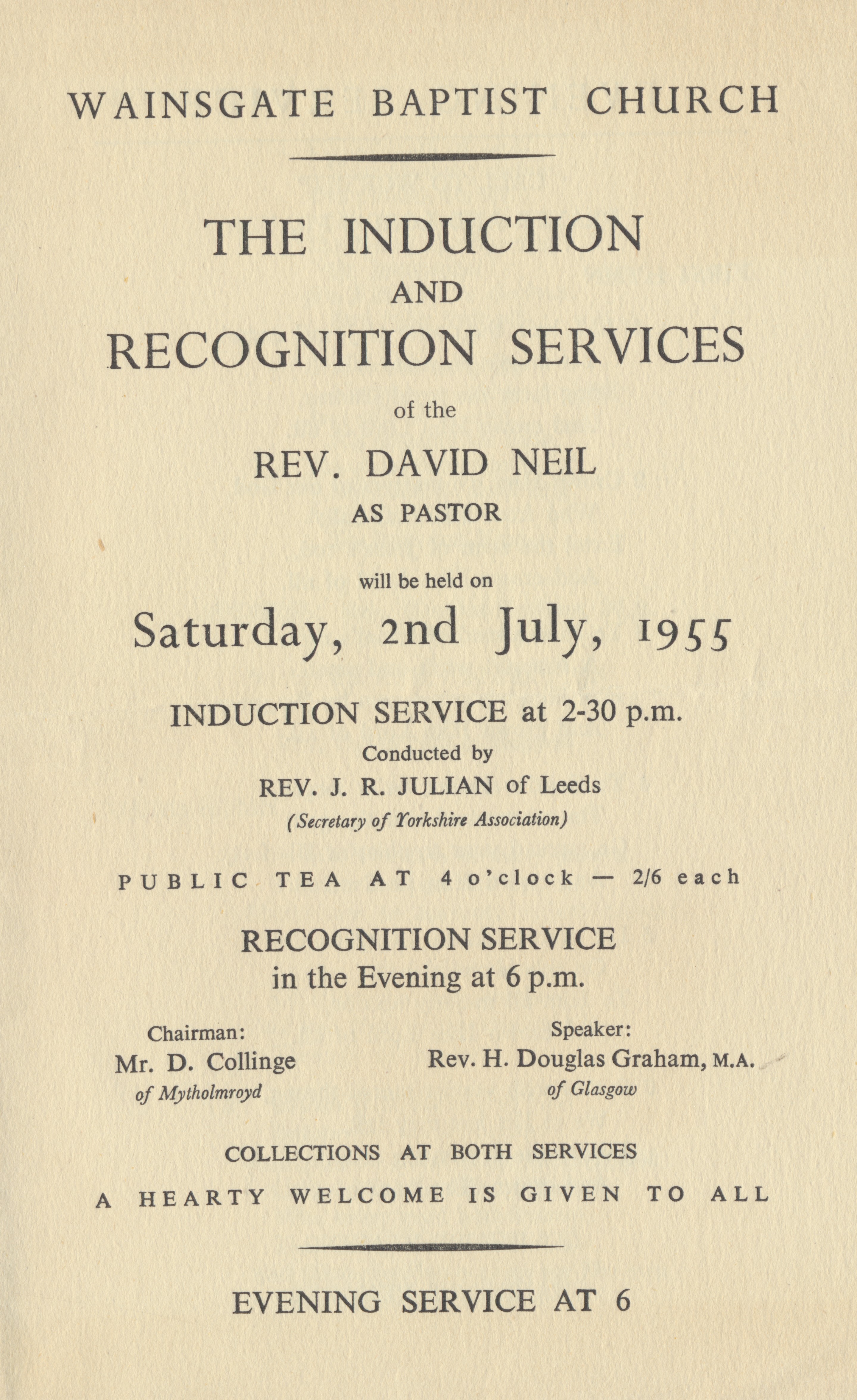
Dennis Collinge welcoming Rev. David Neil to Wainsgate, 1955.

Induction of Rev. David Neil, 1955.
Rev. David Finlay Neil came to Wainsgate from John Street Baptist Church in Glasgow, and around forty of his friends from Glasgow (shown in the photograph above) came to attend his induction, including his parents, his fiancée Miss Ruby Clark and her parents. The party left Glasgow by coach at 7 o’clock in the morning, but managed to get lost and ‘stranded in Lancashire’, and were late for the afternoon service. They arrived in time for tea, attended the evening service and were given supper before setting off back to Glasgow.
Dennis Collinge welcomed all of the visitors to Wainsgate, and assured the contingent from Glasgow that Rev. Neil would be:
‘settling in a gradely country, among gradely folk’.
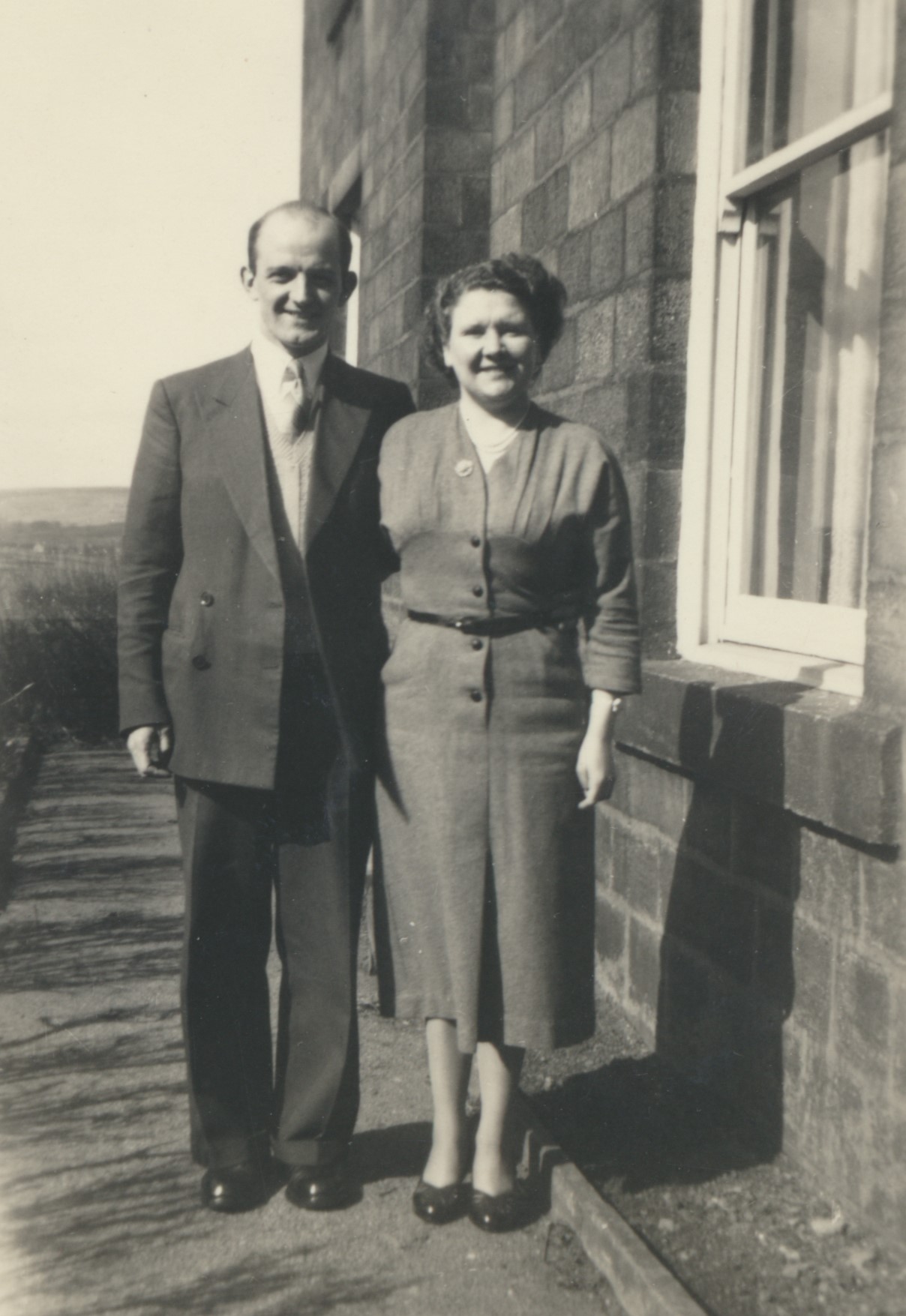
Left: David & Ruby Neil outside the manse, Cousinville (1956?). Right: David & Ruby Neil at Wainsgate, 2002.
* * *
WAINSGATE MINISTERS 1750-2001
Richard SMITH 1750-1763
John FAWCETT 1763-1777
John LAW 1779-1783
George MELLOR 1784-1786
William WRATHALL 1788-1790
John PARKER 1790-1792
John BREARLEY 1798-1799
Isaac NORMINGTON 1800-1810
Mark HOLROYD 1810-1835
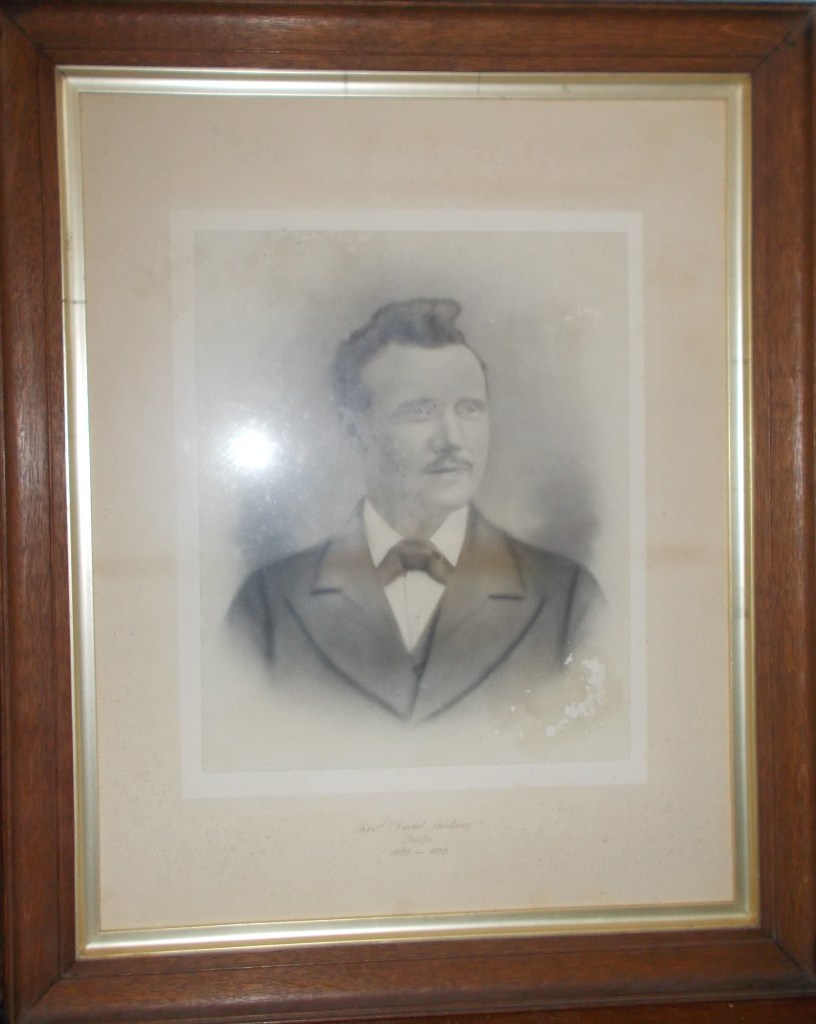
Rev. David Lindsay
Joseph GARSIDE 1837-1839
Jonas SMITH 1845-1847
Thomas HANSON 1849-1851
Thomas VASEY 1851-1855
John BAMBER 1855-1878
George W. WILKINSON 1878-1894
David LINDSAY 1896-1899
James JACK 1901-1906
Ernest HIGSON 1910-1915
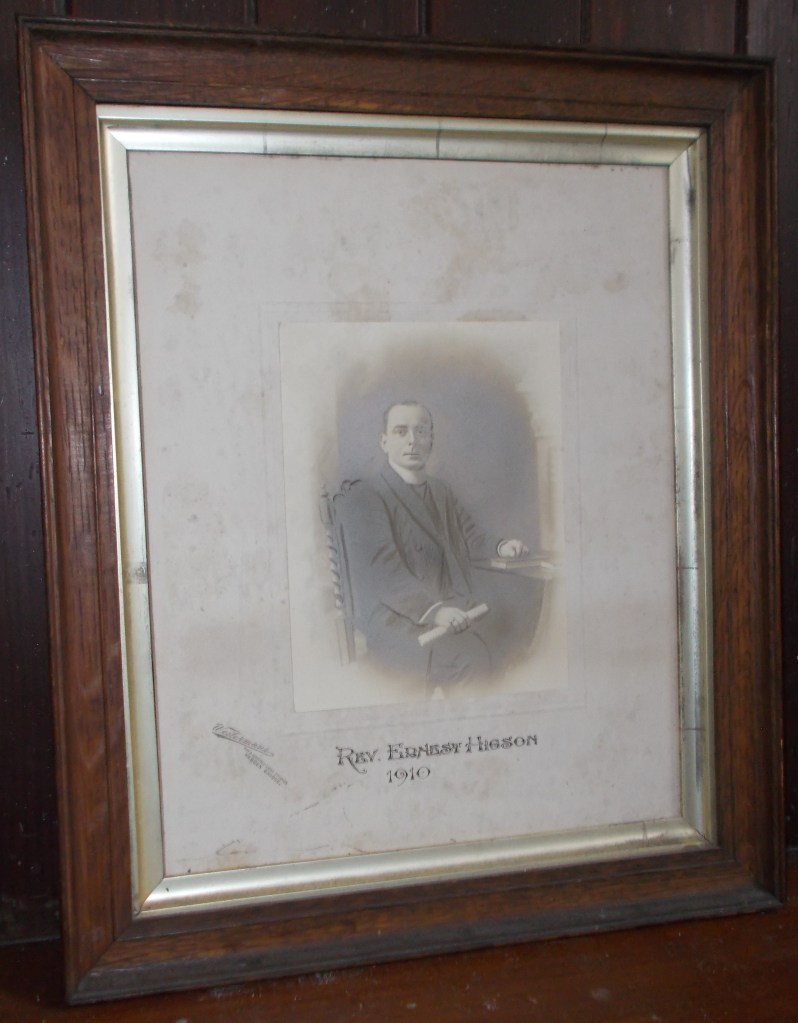
Rev. Ernest Higson
Joseph FIELDING 1921-1930
Edwin EXALL 1934-1942
Henry MEADOWS 1944-1946
A. Cyril DURRANT 1948-1953
David F. NEIL 1955-1958
Horace C. NEWMAN 1959-1961
John C. BEYER (Wainsgate’s last full-time minister) 1962-1967
H. E. HOLLANDERS (Birchcliffe Chapel) 1968-1970 (part-time)
S. J. KIRBY (Hope Chapel) 1970-2001 (part-time)
Rev. Joseph Fielding
LAY PREACHERS & DEACONS
LAY PREACHERS
Lay preachers were vitally important to Wainsgate’s congregation, particularly during the periods when there was no full-time minister. They were not ordained ministers, and are described by the Northern Baptist College as:
‘Those who are called to serve the church through a ministry of preaching while living out their primary Christian vocation in the wider world beyond the church’.
John Thomas Greenwood was a local lay preacher who is recorded as having officiated at a number of funeral services at Wainsgate, particularly in the period between 1915 and 1921 when there was no full-time minister. Probably his most important funerals were those of the five victims of the 1920 Oxenhope Charabanc Disaster, all of whom were buried at Wainsgate. One victim was buried on 3rd November, the other four on the 4th, and a memorial service was held on Sunday 7th November.
It seems that the families of the deceased specifically requested that John Greenwood should conduct the memorial service, and the chapel was ‘packed to its full capacity’.
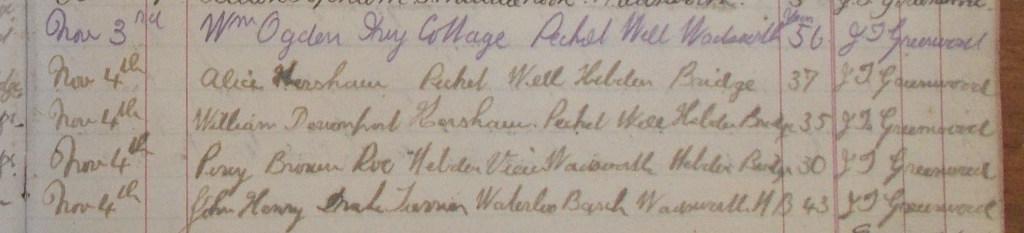
Wainsgate burial register, 1920.
All we know for sure about John Thomas Greenwood was that in 1920 he lived in Pecket Well. There is a 1924 photograph showing a deacon of Wainsgate named J.T. Greenwood, who may be John Thomas Greenwood the lay preacher. Also pictured is A.V. Greenwood (Arthur Vince Greenwood) who may be his brother and John Greenwood, who may be his father.
There is no record of anyone called John Thomas Greenwood being buried at Wainsgate, although the receipt book records plot F826 being bought by ‘Mr J.T. Greenwood’ (of Foot Kiln or Birchcliffe?) on 1st March 1922. The plot is unmarked and may be unused.
The adjacent plots F827, F828 & F829, were bought on the same day by John Greenwood, Arthur Vince Greenwood and James Albert Greenwood – the father and brothers of a John Thomas Greenwood (although we can’t be absolutely sure that this is John Thomas Greenwood the lay preacher – Greenwood was a very common name in Wadsworth at that time).
Stephen Fawcett (1806-1876), grandson of Rev. John Fawcett and son of John Fawcett jnr, is recorded in the 1871 census as being a ‘Local or occasional preacher of the Baptists Society’. He was living in Halifax with his wife Ann (daughter of John Cousin snr) and daughter Elizabeth, and his source of income is recorded as ‘Interest from Houses, Dividends and Land’.

He doesn’t seem to have been bothered too much by having to work for a living during his life: although the 1841 census records his occupation as ‘Farmer’, the 1851 and 1861 censuses describe him as being a ‘Landed Proprietor’ and ‘Land & House Proprietor’. Both his 1831 marriage certificate and the probate register of 1876 refer to him as a ‘Gentleman’.
DEACONS
The deacons at Wainsgate worked alongside the minister, focusing on the practical and administrative aspects of the church. The Baptist Union of Great Britain describe the role of a deacon quite succinctly:
‘Deacons shall, with the Minister(s) (if any), be responsible for the leadership of the church, the fulfilment of its purpose, the pastoral care of its members and its day-to-day management and administration’.
The 1924 photograph of Wainsgate’s pastor, deacons, Sunday school officers and teachers shows six people named as deacons: C. Sunderland, Thomas Haigh, John Greenwood, Edward Sutcliffe, T. Sunderland and J.T. Greenwood.
C. Sunderland is almost certainly Crossley Sunderland (1861-1948), a Fustian weaver born in Heptonstall. He is buried at Wainsgate (plot F772/773), and his wife, three sons and a daughter are all interred or commemorated there:

His wife Ada (born Ingham) died in 1921 aged 56.
Their eldest son Wallace Lindsey Sunderland (1889-1959) married Modesta Bergliot Brynjelsen, a young Norwegian woman who had moved to Old Town.
Percy Oswald Sunderland (1891-1961), like his older brother Wallace, became a poultry farmer.
Elsie Millicent Sunderland (1893-1980) married William Pickles, who died in 1951, and then married James Edward Fisher in 1962.
Their youngest son, Clarence Ingham Sunderland, a printer and talented artist, was killed in Flanders in June 1916, aged 20.
Thomas Haigh (1858-1925) was Church Secretary for 21 years and Sunday School teacher and Superintendent for almost 50 years. His wife Sarah (born Bancroft, 1866-1934) was a Sunday School teacher for many years, and their son Harry (1903-1956) was associated with the Sunday School throughout his life, as scholar, teacher and Superintendent.
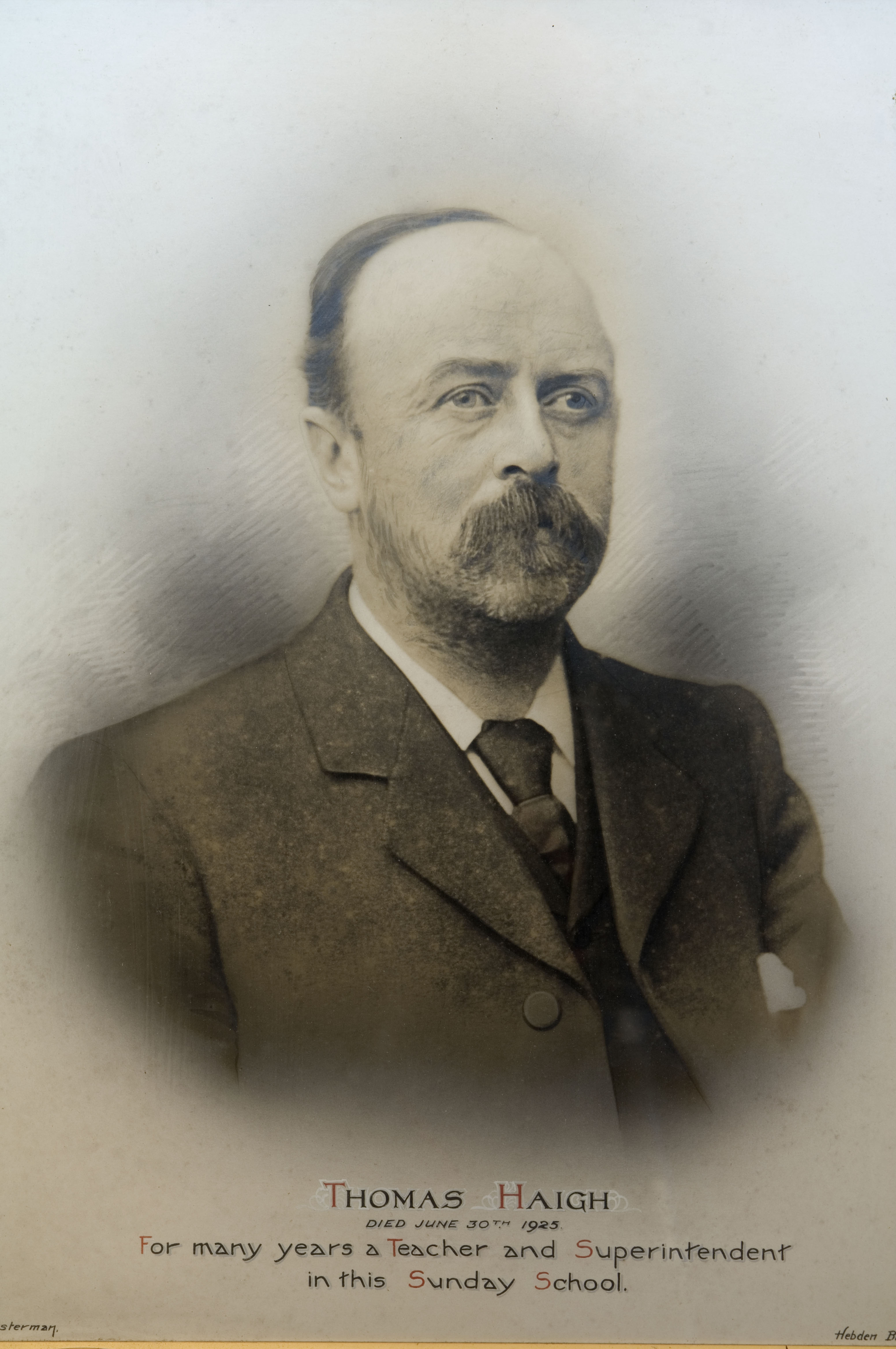
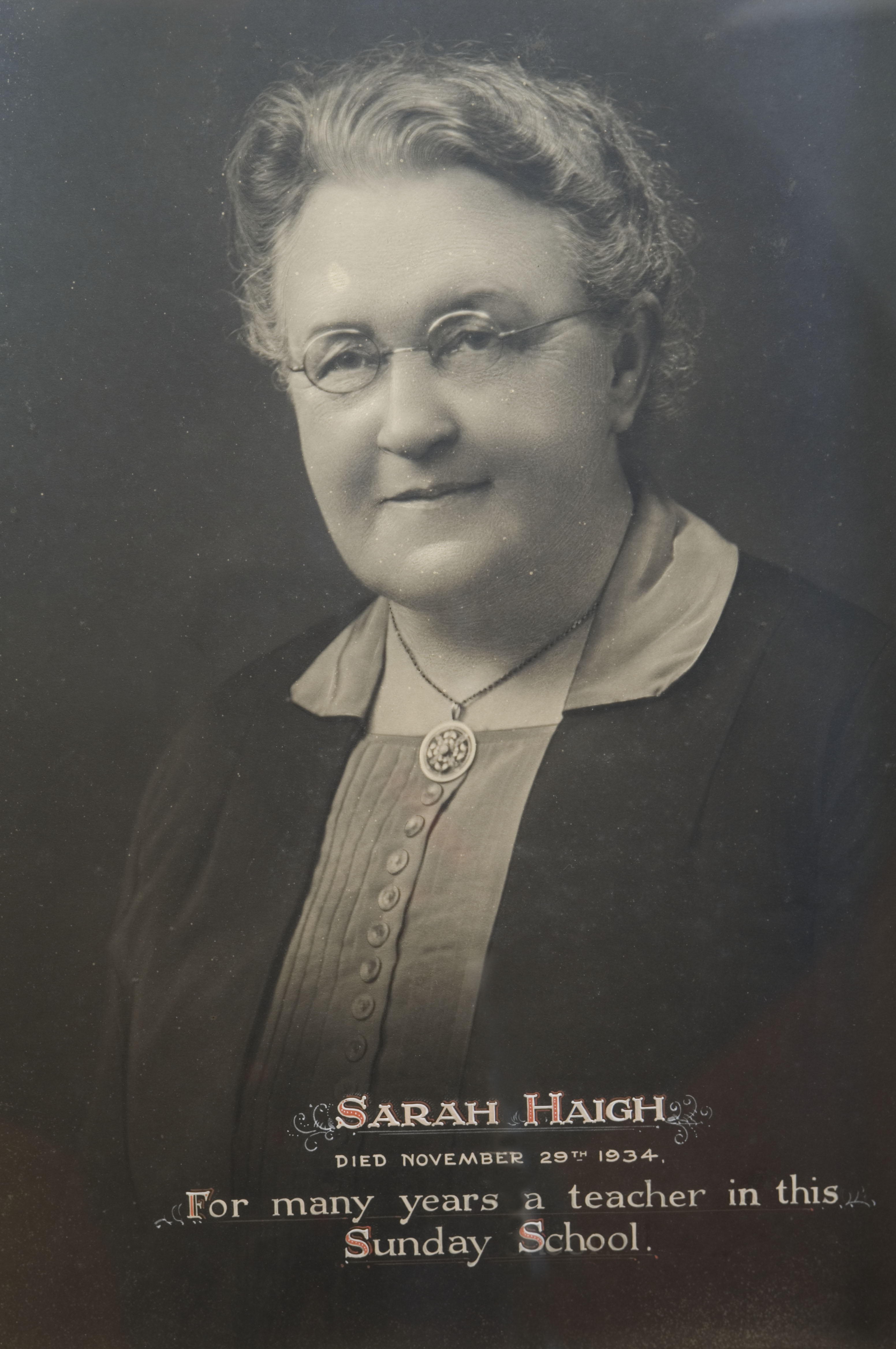
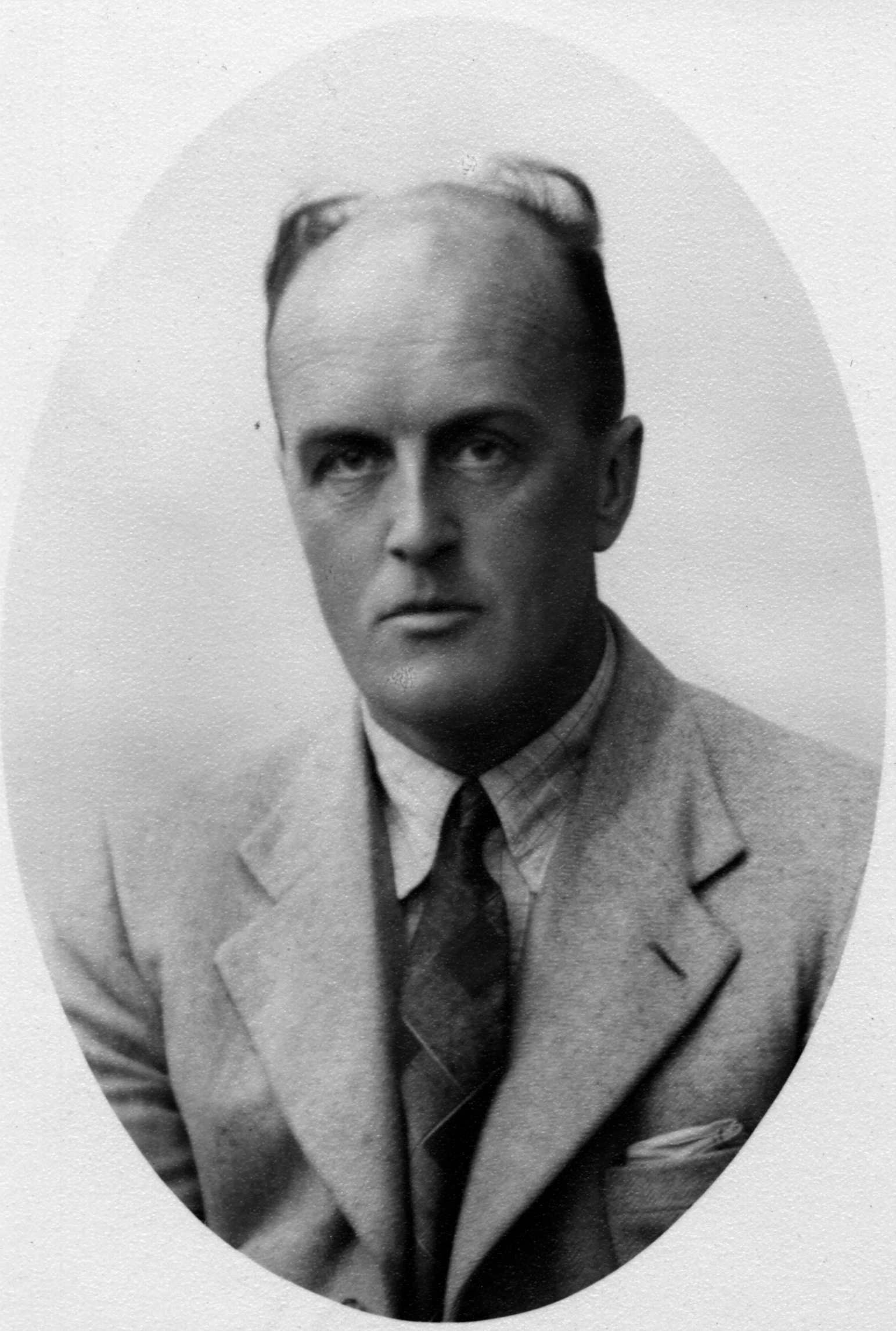
Harry Haigh appears in the photo (although wrongly captioned as H.T. Haigh) and Sarah is almost certainly in the photograph, although like all the other women (presumably all Sunday school teachers) she is not named. She is probably the woman standing behind Thomas and in front of Harry Haigh.
All three are buried at Wainsgate in plot B264a, together with an infant son, Richard Henry Haigh who died in 1899.
John Greenwood is possibly the father of two other people in the photograph: Arthur Vince Greenwood, Treasurer (1886-1956) and J.T. Greenwood (another deacon). He lived at Ayre View, and died in 1926 aged 78. He is buried with his wife Elizabeth in plot F827 at Wainsgate.
Edward Sutcliffe was almost certainly a cotton weaver / manufacturer who died in 1927 aged 66. He lived in Unity Lane, Hebden Bridge with his wife Mary Jane, who was the daughter of Richard Ashworth and sister of Albert Richard Ashworth.
T. Sunderland is almost certainly Thomas Sunderland, who died in 1953 aged 89.
He is buried at Wainsgate in plot F800/801 with his wife Sarah (born Sutcliffe) and their only child, Eddison Sunderland.
Eddison Sunderland was a Sunday school teacher, and died in 1925 aged 32. He appears on the 1924 photograph (captioned as a Superintendent of the Sunday school) and is also commemorated with a brass plaque in the chapel and a framed photograph displayed at Wainsgate.
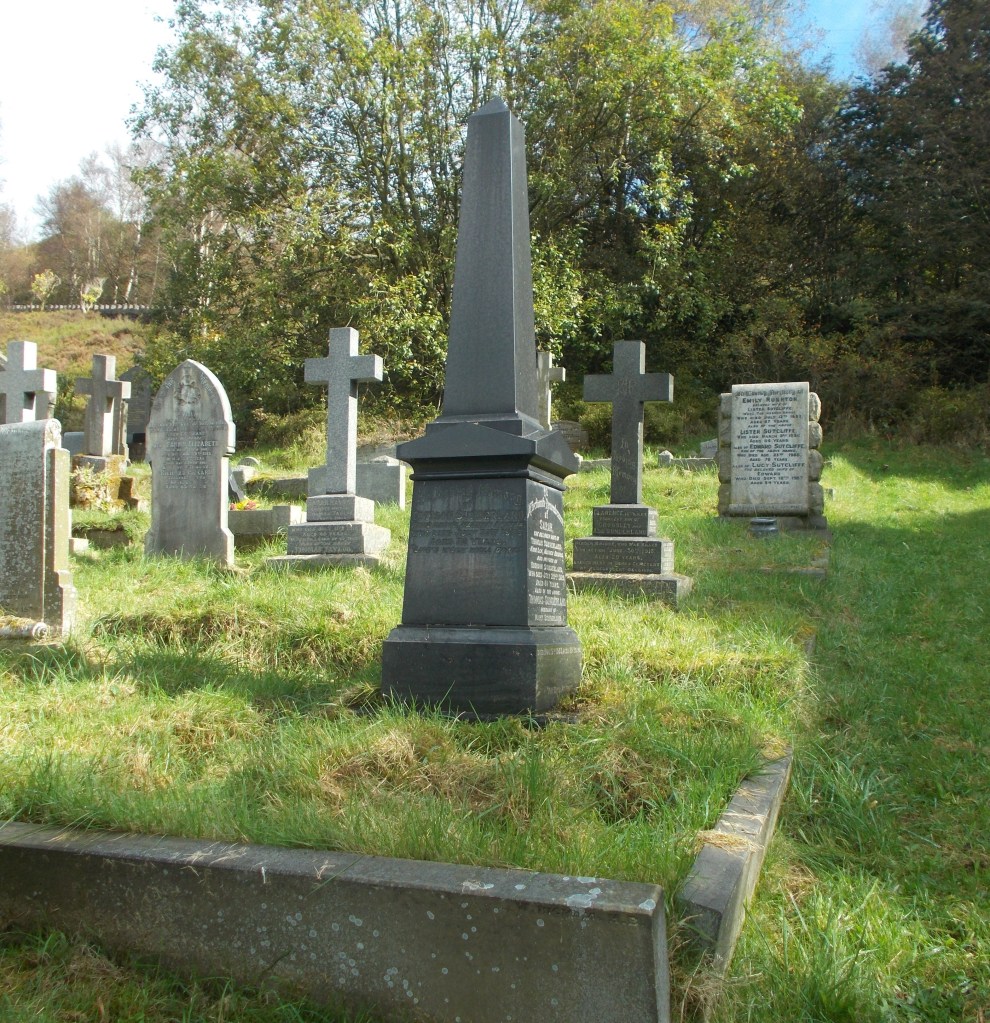
J.T. Greenwood is probably John Thomas Greenwood, son of fellow deacon John Greenwood and brother of Arthur Vince Greenwood. He may also be the lay precher John Thomas Greenwood, but we can’t be absolutely sure. He may be buried in plot F826, which was bought by ‘Mr J.T. Greenwood’ on 1st March 1922. The plot is unmarked and may be unused, and their is no record of his burial in the burial registers.
CONGREGATIONS
We know virtually nothing about the first meeting house built at Wainsgate in 1750, apart from the fact it was cold, uncomfortable, damp and prone to flooding, a consequence of the floor having been lowered shortly after it was first built. The land for the meeting house had been donated by a local farmer, and the building, which was paid for by voluntary subscriptions from people who were mostly not well off, was built as cheaply as possible. It could accommodate around a hundred people, although we don’t know how many people actually attended the first services held by Wainsgate’s first pastor, Richard Smith.
We do know that Wadsworth at that time was:
‘a wild and inhospitable part of the country, where civilization was in low state, and where there is little of the fear and knowledge of God…..among the inhabitants in general, ignorance and vice prevailed in a deplorable degree; there was little appearance of religion‘.
We also know that in the Solemn Covenant of Church Communion, signed by Richard Smith, William Crabtree, James Hartley and others on 7th June 1750, described the church members as:
‘a small handfull of the unworthy Dust of Zion, usually assembling for the Worship of God at Wainsgate’.
* * *
By the time of Wainsgate’s 250th anniversary, which was celebrated on 4th June 2000 with two special services, the membership had declined drastically, and the worshippers were few in number and increasingly elderly and frail. Services were held in the ground floor Sunday school room, which was easier to heat and more appropriate and comfortable than the 400 seat chapel for such small congregations.
In 2001 the Yorkshire Baptist Association, who had been trustees of Wainsgate since 1988, agreed to close the chapel, and the transfer to the Historic Chapels Trust (who eventually took over ownership in June 2005) was set in motion. A thanksgiving service, the last public service at Wainsgate, was held on 19th August 2001.
But what happened in the 250 years between the birth of Wainsgate in 1750 and its closure in 2001? How many people worshipped at Wainsgate, and who were they?
More coming soon…..
* * *
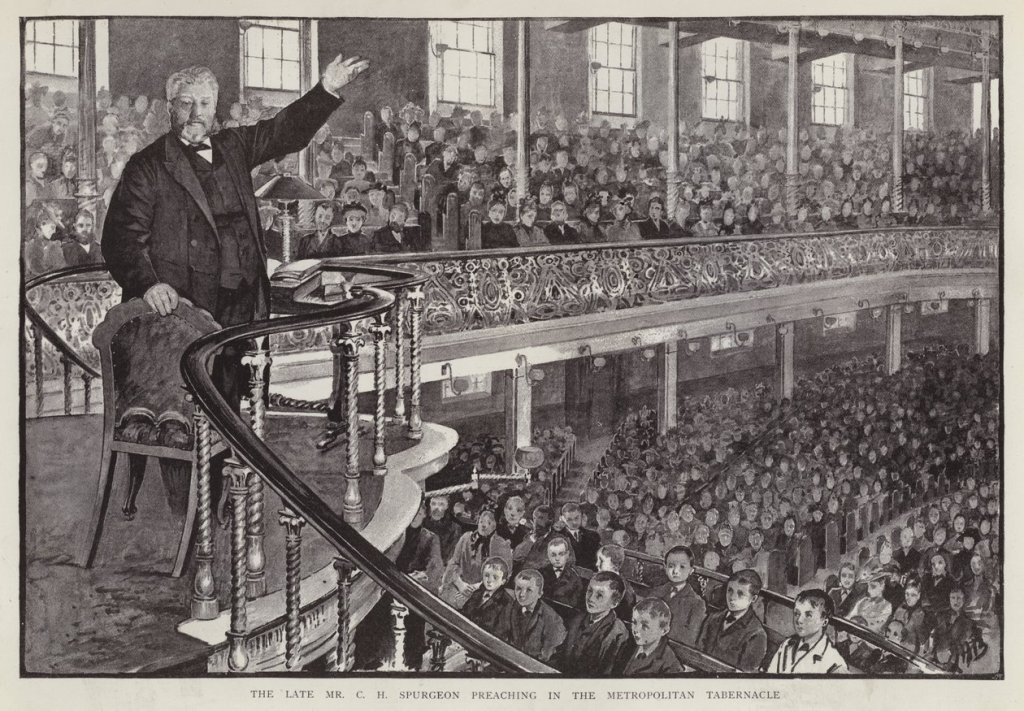
Charles Haddon Spurgeon preaching in the Metropolitan Tabernacle, London.
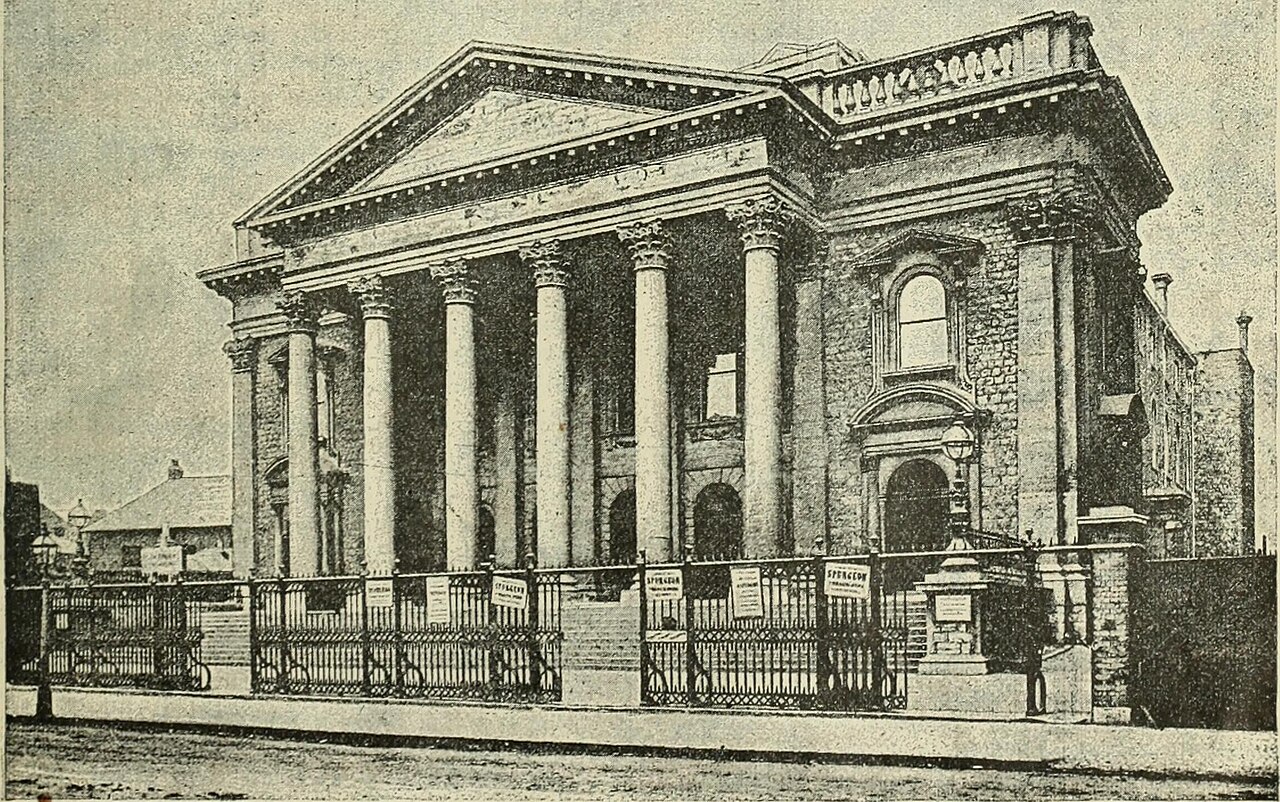
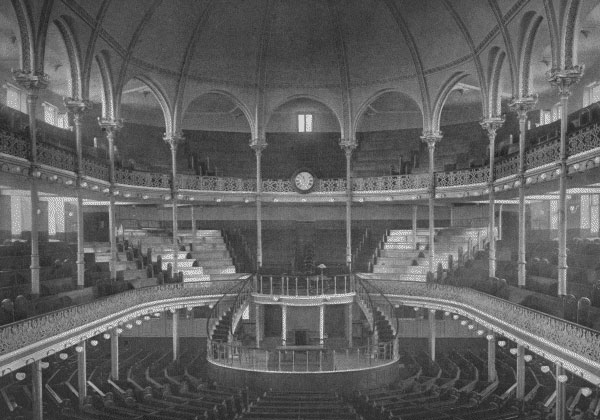
Metropolitan Tabernacle, 1890
The Metropolitan Tabernacle is a Baptist church in Elephant & Castle, South London, that in 1881 had 5,500 members, and was at one time the largest independent Baptist congregation in the world. Its pastor from 1854 until 1892 was Charles Haddon Spurgeon (1834 1892) a prominent and influential English Particular Baptist minister, author, philanthropist and evangelist, known to many as the ‘Prince of Preachers’. He is known to have preached to a congregation of more than 23,000 people at the Crystal Palace in Sydenham in 1857: ‘the largest audience that has assembled in modern times to listen to the exhortations of a minister of the gospel’.
* * *
He preached upon “breadth” till it argued him narrow,—
The broad are too broad to define;
And of “truth” until it proclaimed him a liar,—
The truth never flaunted a sign.
Simplicity fled from his counterfeit presence
As gold the pyrites would shun.
What confusion would cover the innocent Jesus
To meet so enabled a man!
The Preacher by Emily Dickinson (1830-1886)
Emily Dickinson was brought up in a Calvinist household, but never formally joined the church and later stopped attending services. She has been described as ‘spiritual but not religious’. Her poems are full of the language of traditional religious experience, but her tone varies from affirming the need for faith to expressing anger with an absent God.
“And now to God the Father”, he ends,
And his voice thrills up to the topmost tiles:
Each listener chokes as he bows and bends,
And emotion pervades the crowded aisles.
Then the preacher glides to the vestry-door,
And shuts it, and thinks he is seen no more.
The door swings softly ajar meanwhile,
And a pupil of his in the Bible class,
Who adores him as one without gloss or guile,
Sees her idol stand with a satisfied smile
And re-enact at the vestry-glass
Each pulpit gesture in deft dumb-show
That had moved the congregation so.
In Church by Thomas Hardy (1840-1928).
Thomas Hardy lost his Christian faith early in life and became an agnostic. His novels often engaged with religious themes and he featured many negative portrayals of members of the clergy in them, as well as exploring what he saw as the potentially damaging effects of Christian moral teachings.
‘When you see a man with a great deal of religion displayed in his shop window,
you may depend upon it he keeps a very small stock of it within’.
Charles Haddon Spurgeon
 WAINSGATE GRAVEYARD PROJECT